Olympic Glory, Fragile Hardware: The Investigation into Breaking Medals
The pinnacle of an athlete’s life’s work is often symbolized by a few centimeters of metal, suspended on a ribbon. It is a sacred object, a tangible piece of immortality. But what happens when that symbol of ultimate achievement… breaks? The 2026 Milan-Cortina Winter Olympics organizers have launched a formal investigation after a spate of medal malfunctions, turning the spotlight from athletic prowess to manufacturing flaws and raising questions about the integrity of the Olympic prize itself.
A Golden Letdown: When the Podium Moment Unravels
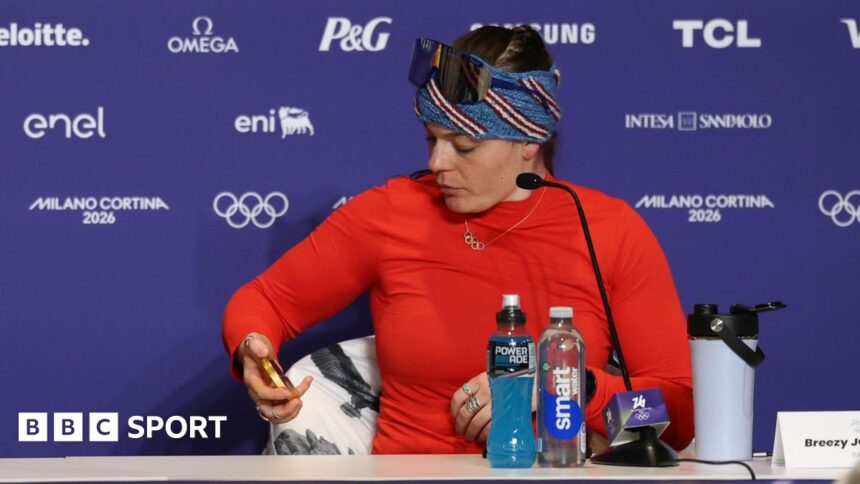
The issue came to light not in a quiet backroom, but under the glaring lights of the world’s media. Breezy Johnson, after conquering the treacherous women’s downhill course to claim gold, stood before reporters with her medal in pieces. In a moment of stark contrast to her powerful performance, she displayed the components like a forensic exhibit. “So there’s the medal. And there’s the ribbon,” she explained. “And here’s the little piece that is supposed to go into the ribbon to hold the medal, and yeah, it came apart.”
Johnson was not alone. Fellow American gold medalist Alysa Liu, the figure skating sensation, experienced an identical failure. The small, crucial connector—often a ring or a clasp—had detached, separating the hard-won disc from its ceremonial ribbon. These were not isolated incidents of rough handling; they were systemic failures occurring mere hours after the medals were placed around the athletes’ necks. The Milan-Cortina 2026 organisers confirmed they are “looking closely” at the situation, a necessary but embarrassing step for an event built on precision and permanence.
Deconstructing the Defect: More Than Just Bad Luck
To understand the significance, one must look at what an Olympic medal represents. It is not merely a prize. It is a historical artifact, a family heirloom, and a cultural icon. The breaking points appear to be in the attachment mechanism—the critical, yet often overlooked, hardware that bridges the medal and the ribbon. Expert analysis from jewelers and industrial designers suggests several potential culprits:
- Material Fatigue or Flaw: The small rings or loops could be made from a metal that is too brittle or a grade that cannot withstand the subtle stresses of movement and temperature change.
- Faulty Soldering or Welding: The joint where the ring connects to the medal’s top may be weak. A cold solder or an incomplete weld would create a point of failure under minimal load.
- Design Oversight: The design may prioritize aesthetics over durability. A beautifully thin, intricate connector is more prone to snap than a robust, if less elegant, one.
- Assembly Line Pressure: With thousands of medals to produce for a single Games, quality control on each individual piece can sometimes lapse, allowing a batch with weak links to slip through.
“This isn’t just about a broken piece of metal,” says a veteran sports memorabilia curator who wished to remain anonymous. “It’s about a breach of trust. The Olympic Committee is handing an athlete a piece of history. That object must be as enduring as the achievement it commemorates. A failure here feels symbolic of cutting corners.”
A Tangled Legacy: Past Medal Problems and Future Fixes
While the current investigation is focused on the 2026 medals, this is not a novel problem in the world of sports memorabilia. Past Olympians have reported medals tarnishing, enamel chipping, and even—in rare cases—breaking. The 2026 incident is notable for its public visibility and the number of athletes affected so quickly. The organizers’ investigation will likely involve metallurgical testing, a review of supplier contracts, and a design audit.
Predictions for the outcome and future Games are clear. The International Olympic Committee (IOC) and local organizers will:
- Mandate stricter durability testing for all medal components, likely implementing stress tests that simulate years of handling.
- Re-evaluate supplier selection criteria, potentially shifting from a purely artistic or cost-based decision to one that heavily weights engineering and craftsmanship.
- Issue immediate repairs or replacements to all affected athletes, though a replacement can never fully replicate the medal received on the podium.
- Most importantly, this will become a cautionary case study for future host cities. Medal design briefs will now undoubtedly include clauses for structural integrity that are as stringent as those for aesthetic beauty.
Conclusion: Preserving the Weight of Glory
The breaking medals of the 2026 Winter Olympics serve as a profound metaphor. They remind us that the foundations of even our grandest traditions need constant reinforcement. For the athletes like Breezy Johnson and Alysa Liu, the glory is untarnished; their performances are recorded in history, independent of a faulty clasp. Yet, the physical token of that glory matters. It is the object they will hold to show their grandchildren, the centerpiece of a legacy.
The Olympic medal investigation is, therefore, about more than fixing a manufacturing defect. It is about respecting the athlete’s journey. It is about ensuring that the symbol is as strong as the spirit it represents. As the Milan-Cortina team looks closely at why these medals broke, the world will be watching, hoping they reaffirm a simple principle: that Olympic gold should be unbreakable, in every sense of the word.
Source: Based on news from BBC Sport.