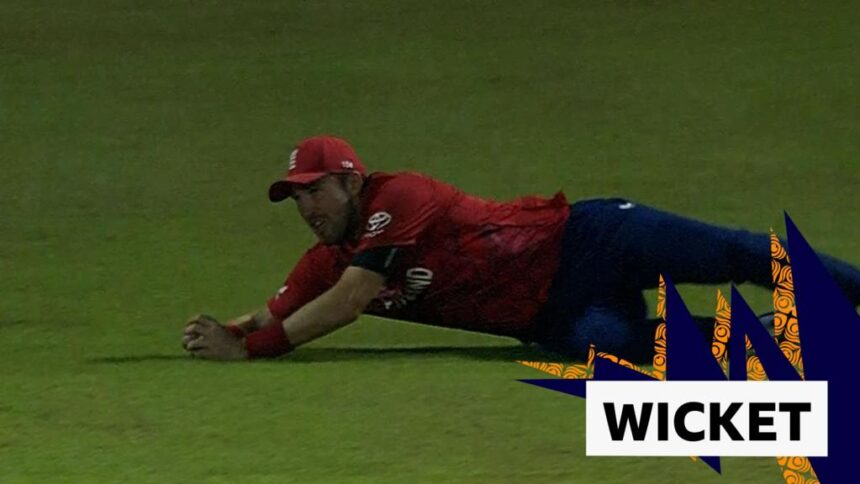
Overton’s Gravity-Defying Grab: A Catch That Shifted the T20 World Cup’s Momentum
In the high-octane cauldron of a T20 World Cup Super 8 clash, moments of individual brilliance often carve the path to victory. For England, defending a modest total against a dangerous Pakistan side in Pallekele, that moment arrived not with a thunderous six or a searing yorker, but with a single, breathtaking act of fielding that will be replayed for tournaments to come. Jamie Overton, the towering fast bowler, produced a catch of such staggering athleticism to remove the pivotal Salman Ali Agha that it didn’t just claim a wicket—it seized the game’s entire narrative.
The Pivotal Moment: Overton Defies Physics
The context was everything. Pakistan, chasing a tricky target, had lost an early wicket but were being steadied by the experienced Salman Ali Agha. The pressure was simmering. England needed a spark. Step forward Jamie Overton. On the field as a substitute, his energy was already palpable. As a delivery was lofted towards the wide long-on region, it seemed destined to clear the fielder’s head and race to the boundary. Salman likely thought he had found a crucial release valve.
What happened next was a masterclass in reaction, athleticism, and sheer will. Overton, turning and sprinting with his back to the ball, covered significant ground before launching himself into a full-stretch, horizontal dive. His timing was impeccable. Snatching the ball out of the air with both hands just inches from the turf, he completed a catch that can only be described as world-class. The immediate roar from his teammates, led by a disbelieving Jos Buttler, confirmed its significance. Pakistan slumped to 27-2, their innings destabilized by a moment of terrific athleticism that transcended the routine.
Expert Analysis: More Than Just a Wicket
While the scorecard will coldly record “Salman Ali Agha c sub (Jamie Overton),” the true impact of the catch was multi-layered. Let’s break down why this was a game-changing intervention.
- Psychological Warfare: In T20 cricket, momentum is a tangible currency. Overton’s catch was an enormous deposit into England’s account. It transformed fielding from a passive discipline into an aggressive, wicket-taking weapon. For Pakistan, it was a demoralizing blow, a reminder that even their well-executed shots came with extreme risk.
- Tactical Pivot: Salman Ali Agha is a proven player adept at building and finishing innings. His removal opened up Pakistan’s middle order prematurely to England’s varied attack. It forced new batters to start from scratch under intense scoreboard pressure, a scenario where England’s bowlers thrive.
- The Standard Setter: Catches like this raise the entire team’s fielding intensity. It sends an unambiguous message about commitment and desire. For a defending champion like England, it reinforced the non-negotiable standards required to win global tournaments.
This moment underscored a modern cricketing truth: in an era obsessed with batting firepower and bowling variations, elite fielding remains the great differentiator. Overton’s catch was the perfect embodiment of saving five runs and taking a wicket simultaneously—the ultimate two-in-one play.
The Ripple Effect: Implications for the Super 8 Stage
This match was a virtual quarter-final, and Overton’s catch likely decided which team advanced to the semi-finals. Its repercussions extend beyond a single result.
Firstly, it cemented England’s identity as the most dynamic fielding unit in the world. Teams will now second-guess taking risky singles or lofting the ball into the outfield against them, adding a mental hurdle to the already immense physical challenge. Secondly, for Pakistan, it was a cruel lesson in how fine the margins are at this level. One moment of opposition genius can undo minutes of careful planning and skillful batting.
Furthermore, the catch has ignited the tournament. It provides the iconic highlight reel moment that defines a World Cup, inspiring younger players and reminding fans why fielding is now a premier spectator attraction. It shifts the conversation, making spectacular catches a key point of pre-match discussion and analysis.
Predictions: A New Blueprint for Success?
Looking ahead, the impact of Overton’s heroics could be strategic and philosophical. We predict several potential outcomes:
- Increased Focus on Specialist Fielders: Selectors may begin to value players who, while perhaps not guaranteed starters with bat or ball, can be “impact substitutes” specifically for their fielding prowess in crucial phases, much like a defensive specialist in basketball.
- Training Revolution: Fielding drills will become even more innovative and demanding, with a greater emphasis on boundary-robbing techniques and reaction catches. Overton’s catch will be the benchmark.
- Pressure Multiplier: For England’s remaining opponents, the knowledge that a mere 80% shot could be turned into a wicket adds a layer of pressure that can cause indecision—a batter’s worst enemy.
In the immediate term, England will ride the wave of confidence this moment generated. It proves their campaign is built on more than just batting depth; it’s founded on a relentless, 360-degree effort that can produce match-winning plays from any position.
Conclusion: A Catch for the Ages
Jamie Overton’s catch to dismiss Salman Ali Agha was far more than a dismissal. It was a statement. In a single, gravity-defying leap, he captured the essence of modern elite cricket: supreme fitness, unwavering courage, and an unquenchable desire to change the game. It was the moment England’s title defense found its heartbeat, a moment of magic that turned a tense contest decisively in their favor.
As the T20 World Cup progresses, the sixes will be remembered for their distance, and the bowling spells for their guile. But for pure, adrenaline-fueled inspiration, few moments will rival the sight of Overton, horizontal to the ground, clutching a white ball that carried the hopes of a nation. It was a fabulous reminder that while cricket is a contest between bat and ball, it is often won by the bravery and brilliance of those tasked with stopping it.
Source: Based on news from BBC Sport.