Mercedes’ Melbourne Mirage: A ‘Perfect Storm’ or a New Era’s Bitter Dawn?
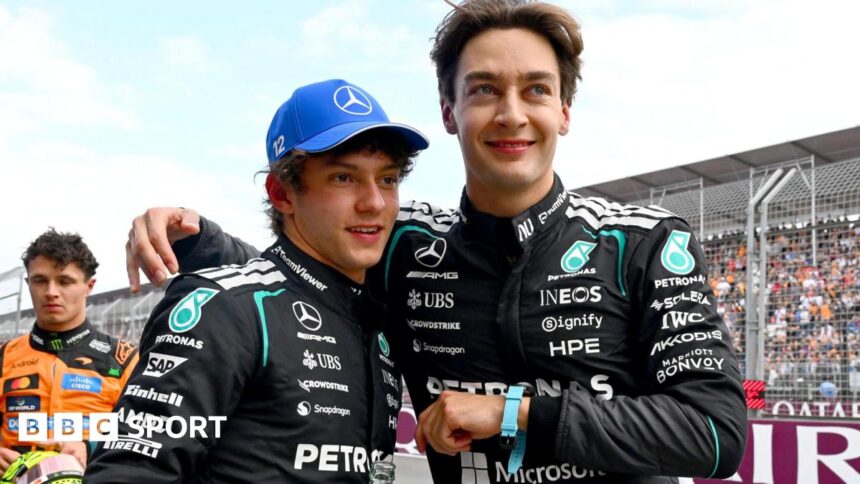
The Albert Park grid for the 2025 Australian Grand Prix presented a picture so surreal, it demanded a double-take. The Silver Arrows of George Russell and rookie Kimi Antonelli sat proudly on the front row, a Mercedes lockout not seen since the previous summer. Behind them, a scrambled order defied all preseason narratives. The explanation, depending on which garage you visited, oscillated between a freak meteorological event and an existential crisis. As Mercedes reveled in a “perfect storm,” the reigning world champion, Lando Norris, delivered a damning verdict on the new generation of cars, calling them “probably the worst.” This stark contrast in perspectives frames a pivotal moment: is this a one-off anomaly or the first true glimpse into a turbulent new world order?
The Eye of Russell’s “Perfect Storm”
For George Russell, securing pole position in Melbourne was a triumph of circumstance as much as speed. His post-qualifying analysis was candid, pinpointing the unique confluence of events that led to Mercedes’ shock dominance. George Russell’s “perfect storm” was a multi-faceted phenomenon.
- Verstappen’s Vanishing Act: As Russell admitted, Red Bull’s Max Verstappen—universally considered the benchmark—crashed heavily in Q2 without setting a time. This removed the single largest obstacle from the equation, instantly reshaping the competitive landscape.
- Track Evolution & Temps: Albert Park’s green surface and cooler-than-expected temperatures played havoc with tire warm-up, a notorious weakness for the Red Bull and Ferrari in early sessions. Mercedes’ W16, conversely, seemed to switch its rubber on more effectively.
- Regulation Roulette: The 2025 aerodynamic overhaul, aimed at reducing dirty air and improving racing, has clearly reset the competitive order. Some designs have hit the “sweet spot” early; others are floundering. Mercedes, after a painful few seasons, may have finally found a more compliant platform.
“You need everything to fall your way in this sport, and today it did,” Russell stated, tempering excitement with realism. The Mercedes front-row lockout, while a massive morale boost, comes with a giant asterisk attached. The true test will come over a race distance, with Verstappen charging from the back, and in the coming races where conventional conditions return.
Norris’s Scathing Indictment: From “Best Cars Ever” to “The Worst”
If the Mercedes garage was a scene of cautious optimism, the McLaren motorhome housed the sport’s most vocal critic. Lando Norris, navigating a radically different MCL60, could only manage sixth on the grid. His frustration, however, transcended his starting position. It struck at the very heart of the new regulations.
“We’ve come from the best cars ever made in Formula 1, and the nicest to drive, to probably the worst,” Norris declared. This is a staggering condemnation from a reigning champion. His comments reference the peak of the previous regulatory era—cars of immense downforce, razor-sharp responsiveness, and staggering cornering speeds. The new 2025 machines, with their simplified aerodynamics, revised tire profiles, and tweaked power units, are a different beast entirely.
Lando Norris unhappy is not just about a lack of pace; it’s about a loss of feel, predictability, and driver connection. These new cars are reportedly more temperamental, more sensitive to wind and “dirty air,” and harder to push to the limit consistently. For a driver of Norris’s caliber, used to a machine that was an extension of his will, this feels like a profound step backward. His sentiment is likely echoed in several cockpits, suggesting the FIA’s quest for better racing may have come at a significant cost to the driver-car connection that defines Formula 1’s engineering pinnacle.
Expert Analysis: Reading Between the Lap Times
This dichotomy between Russell’s fortune and Norris’s frustration reveals the volatile early phase of this new cycle. The 2025 F1 regulations were always a gamble. By aggressively targeting the aerodynamic wake, the governing body has potentially created cars that are inherently more “peaky”—brilliant in a specific operating window (as Mercedes found in Melbourne) and diabolical outside of it (as McLaren and others suffered).
The Australian Grand Prix grid is likely a magnified snapshot of this instability. Albert Park is a semi-street circuit, bumpy and evolving, which exaggerates car imbalances. Furthermore, the crash for Verstappen and a scrappy session for Ferrari’s Carlos Sainz have compressed the order artificially. Do not mistake this for a permanent Mercedes renaissance just yet. However, do recognize it as evidence that the development race under these new rules will be brutal and unpredictable. Teams that adapt their simulation tools and understand the new aerodynamic philosophy fastest will pull away. Others, like McLaren apparently, face a steep and frustrating learning curve, potentially miring even top drivers in the midfield.
Predictions: Storm Clouds or Clear Skies Ahead?
So, what does Melbourne’s chaos tell us about the season ahead?
- The Verstappen Factor: Expect a furious charge from the back from the Red Bull driver on Sunday. His race pace will be the most telling data point of all. If he slices through to the podium, the “perfect storm” narrative holds. If he’s mired in traffic, struggling to pass, the new rules’ racing intent may already be validated.
- Mercedes’ Moment of Truth: Can they convert the front row into a dominant 1-2? If they disappear into the distance, the storm may be a permanent climate shift. If they are hunted down, Melbourne becomes a beautiful anomaly.
- McLaren’s Malaise: Norris’s comments are a red flag. If a team of their resources is so fundamentally unhappy with the car’s characteristics, recovery could be a long, painful process, potentially putting their title defense in early jeopardy.
- The Development War: The first major upgrade packages, due around Imola or Barcelona, will be more consequential than ever. The team that best unlocks hidden performance from these complex new designs will gain a decisive edge.
Conclusion: A Season Defined by Disruption
The opening qualifying session of the 2025 season has set a compelling and contentious stage. George Russell’s “perfect storm” and Lando Norris’s “worst cars” critique are two sides of the same coin—a coin minted by the most radical regulatory shift in a generation. One man’s serendipity is another man’s struggle in this new F1 landscape. Melbourne may prove to be an outlier, but the passions it has unleashed are very real. The season will now become a gripping saga of adaptation: which teams can tame these new, wilful machines, and which drivers can reconcile their artistry with the raw, perhaps less forgiving, physics of the new era. The storm, perfect or otherwise, is just beginning.
Source: Based on news from BBC Sport.