Rams Star Puka Nacua Blasts NFL Refs: “The Worst,” Accuses Them of Making Calls for TV Time
The Los Angeles Rams’ thrilling victory over the Carolina Panthers has been overshadowed by a post-game controversy that cuts to the heart of a perennial NFL fan grievance. Star wide receiver Puka Nacua, fresh off a game-changing performance, launched a blistering, unfiltered critique of NFL officials, accusing them of fabricating calls to satisfy a craving for television exposure. His comments, made on a casual livestream, have ignited a firestorm about referee integrity, player-official relations, and the intense scrutiny of the modern sports spectacle.
From Game-Winning Hero to Vocal Critic
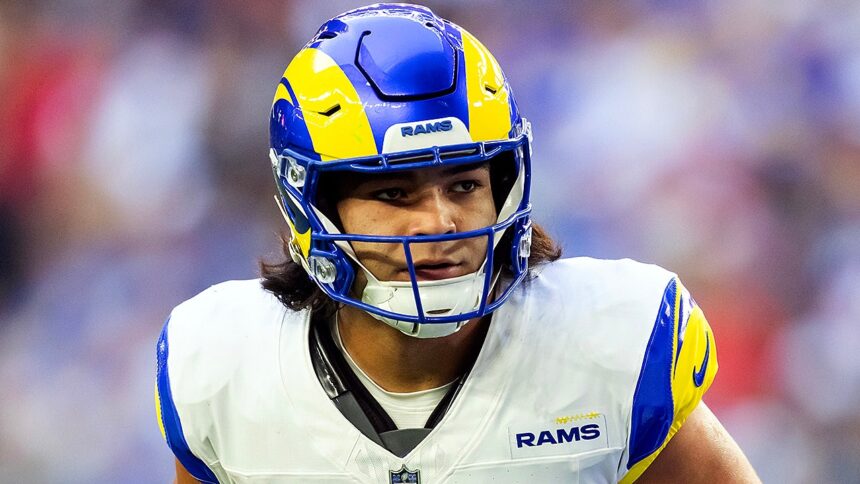
Puka Nacua’s on-field heroics were undeniable. In a critical moment, he made an insane contested catch along the sideline, a play that required elite body control and focus. That reception directly set up running back Kyren Williams’ decisive 7-yard touchdown run, propelling the Rams to a hard-fought lead and, ultimately, the win. Nacua’s performance solidified his status as one of the league’s most dynamic young offensive weapons.
However, the narrative shifted dramatically when Nacua appeared on a livestream with internet personalities Adin Ross and N3on. In the relaxed, off-the-cuff setting, the typically affable rookie sensation dropped his guard and delivered a scorching hot take. “The refs are the worst,” Nacua stated bluntly. He then elaborated with a theory that has long simmered in barrooms and social media threads but is rarely voiced by active players.
“These guys want to be… these guys are lawyers. They want to be on TV too,” Nacua alleged. “You don’t think he’s texting his friends in the group chat like, ‘Yo, you guys just saw me on “Sunday Night Football.” That wasn’t P.I., but I called it.'” This accusation—that officials are making up calls for airtime—is perhaps the most direct assault on their motives and professionalism to come from a player in recent memory.
Expert Analysis: The Pressure Cooker of Modern Officiating
Nacua’s comments, while hyperbolic, tap into a real and growing tension in professional sports. To understand the context, one must consider the environment in which today’s NFL officials operate.
- Unprecedented Scrutiny: Every call is dissected in ultra-HD slow motion from six angles, analyzed by former players and rules experts in broadcast booths, and memed across the internet within seconds. The margin for perceived error is zero.
- The “All-Star” Official Paradox: The league often assigns its highest-graded officials to the biggest prime-time games. While intended to ensure quality, this can inadvertently fuel the perception Nacua described: that being on “Sunday Night Football” is a stage for the officials as well.
- The Human Element vs. The Rulebook: The NFL rulebook is notoriously complex and subject to interpretation. Pass interference, in particular, remains a highly subjective call. What one official sees as incidental contact, another may flag decisively. This inconsistency breeds frustration and suspicion.
Sports media ethicist Dr. Lara Benson notes, “Nacua’s comments, though flippant, reflect a dangerous erosion of trust. When players begin to believe the arbiters of the game have motives beyond fairness, it undermines the sport’s legitimacy. The NFL has worked to market officials as authoritative experts, but this kind of player testimony directly counters that narrative.”
It’s crucial to state that there is no evidence to support the claim that officials make deliberate, incorrect calls for personal fame. The league’s rigorous grading and evaluation system penalizes mistakes harshly. However, the perception of bias or self-interest can be as damaging as the reality.
The Fallout and Potential Repercussions
The NFL is notoriously protective of its officials and its brand. Puka Nacua’s comments are almost certain to draw a fine from the league office for public criticism of officials. The Collective Bargaining Agreement explicitly prohibits statements that undermine the integrity of the game’s officials.
Beyond the fine, other potential repercussions include:
- A Target on His Back: While officials are professionals, there is a longstanding concern among players that criticizing refs can lead to a subconscious bias in future games, where a player may get fewer “50/50” calls.
- Internal Rams Discipline: Head Coach Sean McVay is a stickler for accountability and focusing on “controllables.” He may address the comments internally to ensure his team isn’t distracted by officiating narratives.
- Fueling a Broader Conversation: Nacua has given voice to a silent frustration felt by many players and most fans. This could embolden others to speak out, forcing the league to address the perception issue more directly, perhaps through enhanced transparency or media training for officials.
The incident also highlights the new media landscape. A player’s comments on a gaming livestream now carry the same weight as those in a formal press conference, blurring the lines between casual conversation and public statement.
Looking Ahead: Predictions for Nacua and the NFL
This incident is a pivotal moment in Puka Nacua’s young career. How he handles the aftermath will be telling.
Prediction 1: The Fine and Walk-Back. Nacua will likely be fined $10,000-$15,000. He or the Rams will issue a softened statement, clarifying that he respects the difficulty of the officials’ job but was expressing frustration in an informal setting. This is the standard NFL damage control playbook.
Prediction 2: On-Field Response. The best revenge for Nacua will be performance. Expect him to play with an even greater chip on his shoulder. His focus will shift back to producing more insane highlight-reel catches that are so undeniable they render officiating debates moot.
Prediction 3: A League in a Bind. The NFL faces a perennial dilemma. It cannot admit to systemic officiating issues without opening a floodgate, yet it cannot ignore the volume of criticism. We predict incremental steps: more mic’d up officials segments to humanize them, and possibly the expansion of the “SkyJudge” or a second challenge flag for specific penalties to act as a pressure valve for egregious mistakes.
Conclusion: More Than Just a Hot Mic Moment
Puka Nacua’s “worst” rant is more than just a young star venting after a physical game. It is a symptom of a larger disease infecting professional sports: a crisis of authority. In an era where every decision is magnified and monetized, the assumption of pure impartiality is harder for athletes and fans to maintain. Nacua’s lawyer and TV quip, while exaggerated, frames the official not as a neutral arbiter, but as another character in the drama, seeking their moment in the spotlight.
The NFL’s product depends entirely on the belief that the competition is fair. While Nacua will pay a literal price for his candor, his words have resonated because they articulate a widely held, if unproven, fear. The league’s challenge now is not just to fine a player, but to examine why one of its brightest young stars—and the millions of fans who cheered his take—believes the whistle could be blown for reasons other than the rules of the game. The integrity of the sport demands nothing less.
Source: Based on news from Fox Sports.