Wilyer Abreu’s Legendary Blast: Red Sox Prospect Powers Venezuela’s WBC Stunner Over Japan
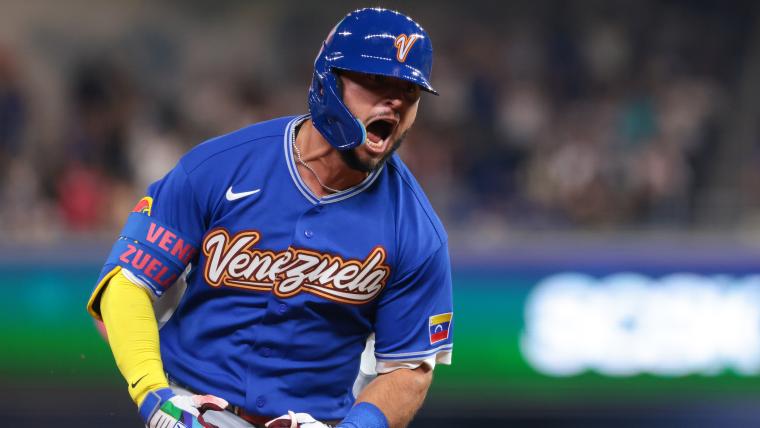
In the crucible of the World Baseball Classic, where national pride and baseball’s global soul collide, legends are forged in the span of a single swing. On a charged Saturday night at Miami’s LoanDepot Park, a Boston Red Sox prospect with everything to prove announced his arrival to the world, turning the tournament on its head. Wilyer Abreu, the 23-year-old outfielder, authored a moment of pure, unadulterated magic—a three-run, upper-deck homer that dethroned the defending champion Japan and propelled a jubilant Venezuela into the semifinals with a seismic 8-5 victory.
A Clash of Titans and an Early Rollercoaster
The quarterfinal matchup was a marquee event dripping with star power. Venezuela, a perennial “team on paper” contender, faced Japan, the tournament’s gold standard led by the transcendent Shohei Ohtani. The narrative was set from the very first pitches. Ronald Acuña Jr., Venezuela’s electric leadoff man, immediately attacked Japan’s ace Yoshinobu Yamamoto, sending a solo shot into the Miami night for a 1-0 lead. The advantage was breathtakingly brief. In the bottom of the inning, Ohtani—facing Red Sox lefty Ranger Suarez—answered with a titanic leadoff homer of his own, a statement of resilience that echoed through the stadium.
Japan, showcasing their characteristic discipline and clutch hitting, seized control. They methodically built a 5-2 lead by the fourth inning, capitalizing on key hits and quieting the Venezuelan faithful. The defending champions appeared to be executing their blueprint to perfection, inching closer to a return to the final four. Yet, within the Venezuelan dugout, a resolve was hardening. This team, a blend of established MLB stars and hungry young talent, had not come this far to bow out quietly.
The Spark and the Earthquake: Venezuela’s Relentless Rally
The comeback began not with a roar, but with a crucial crack of the bat that changed the game’s atmosphere. In the fifth inning, with Japan’s bullpen in play, Kansas City Royals infielder Maikel Garcia connected on a two-run homer off reliever Chihiro Sumida. The blast sliced the deficit to 5-4 and served as the vital spark. “That homer from Garcia shifted everything for us,” Abreu would later say. “The energy in the dugout completely changed. We knew we were back in it.”
Then came the sixth inning—a frame that will be replayed in Venezuelan baseball lore for generations. With two runners on and one out, Japan turned to their bullpen ace, Hiromi Itoh, the recent Sawamura Award winner (Japan’s equivalent of the Cy Young). To the plate stepped Wilyer Abreu, a player known more within prospect circles than to the global audience watching. What happened next was a masterpiece of timing and power.
- The Pitcher: Hiromi Itoh, Japan’s most trusted reliever, on the mound to snuff out the threat.
- The Moment: Sixth inning, one out, runners on first and second, Venezuela down by one.
- The Swing: Abreu turned on a pitch and launched a parabolic missile to right field.
The ball traveled an estimated 408 feet, soaring into the rarely reached upper deck. As it disappeared, Abreu executed a slow, deliberate, and emotionally charged bat flip—a release of pure passion. The Venezuelan dugout erupted, spilling onto the field before the ball even landed. The three-run shot completed a stunning five-run turnaround, vaulting Venezuela to a 7-5 lead they would not relinquish. The crowd of over 34,000, a sea of Venezuelan flags, reached a fever pitch.
Expert Analysis: Decoding the Impact of Abreu’s Moment
This victory was more than a single game; it was a cultural event for Venezuelan baseball. For years, the team has been plagued by the “underachiever” label, failing to translate its staggering MLB talent into international hardware. Abreu’s homer felt like an exorcism. It was a young player, not yet a household name, seizing the spotlight from the game’s biggest icon, Ohtani. The strategic decision to challenge Itoh, Japan’s best, and the subsequent success, speaks volumes about Venezuela’s confidence and the depth of their lineup.
From a Red Sox perspective, the implications are thrilling. Wilyer Abreu showcased a clutch gene that simply cannot be taught. Acquired in the 2022 trade that sent Christian Vázquez to Houston, Abreu has long been viewed as a high-upside talent with power and plate discipline. Performing under this magnitude of pressure, against elite international pitching, proves his mental fortitude and suggests his readiness to contribute at the highest level. His spring training just got a lot more interesting.
Key Takeaways from the Upset:
- Depth Wins: Venezuela’s rally was fueled not just by its stars (Acuña, Altuve) but by its next generation (Garcia, Abreu).
- Bullpen Management: Japan’s uncharacteristic bullpen stumble, particularly with Itoh, was the game’s critical tactical turning point.
- The WBC Effect: The tournament’s unique, win-or-go-home intensity creates heroes in an instant, altering career trajectories.
Looking Ahead: Semifinal Clash and Lasting Legacy
Venezuela now advances to face Italy in the semifinals, a matchup they will be heavily favored to win. The victory over Japan transforms them from contenders to outright favorites for the title. The momentum and emotional high from such a historic win are immeasurable assets. For Team Japan, the loss is a shocking end to their title defense, but their excellence and the star power of Ohtani and Yu Darvish have further globalized the game.
All eyes will now be on Wilyer Abreu. Can he carry this transformative confidence into the semifinals and beyond? For the Boston Red Sox, his performance is a beacon of promise. He has demonstrated a tangible “clutch” factor that the organization’s lineup craves. Expect his name to feature prominently in the right-field conversation as the 2023 MLB season approaches.
The 2023 World Baseball Classic needed a moment to define its incredible pool play stage. It found one in the Miami night, off the bat of a Red Sox prospect. Wilyer Abreu’s homer was more than just four runs on a scoresheet; it was a national catharsis for Venezuela, a statement to Japan, and a personal declaration to the baseball world. In tournaments like the WBC, heroes emerge from unexpected places. Abreu seized his chance, and in doing so, he didn’t just win a game—he created a legacy that will resonate from Caracas to Fenway Park for a long time to come.
Source: Based on news from Yahoo Sports.