O’Sullivan’s Ultimate Quest: Why a Return to Form Trumps Titles for the Rocket
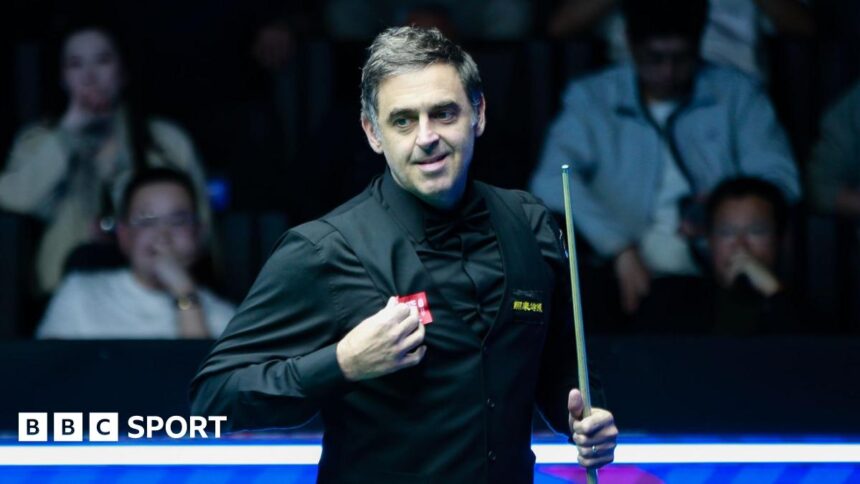
The narrative surrounding Ronnie O’Sullivan has, for two decades, been one of relentless accumulation. The most ranking titles, the most Triple Crowns, the maximum breaks, the sheer, unadulterated genius. Yet, as the snooker icon navigates his 50s, a new and profoundly personal storyline is emerging. After a commanding 5-1 victory over Adam Muir at the World Open in Yushan, punctuated by two closing century breaks, O’Sullivan laid bare a startling ambition. For “The Rocket,” restoring his game to its celestial peak would not be just another chapter; it would be, in his own words, the “biggest achievement” of his storied career.
The Crucible of Doubt: A Champion’s Honest Appraisal
Ranked world number 12 and often seemingly playing a different sport to his peers, O’Sullivan’s confession is a seismic moment in sports psychology. Here is a player who could be content with legacy, exhibition tours, and punditry, yet is consumed by the artisan’s pursuit of perfection. His post-match comments were not those of a victor basking in glory, but of a craftsman diagnosing a fault line. “I got here a week early just to do some practising on my own. I know I haven’t played a lot of tournaments, but I’ve been working because my game has been in such a bad place,” he admitted.
This is the crux of O’Sullivan’s current journey. The bad place he references isn’t a slump most players would recognize. For him, it’s a feeling of disconnect between mind, cue action, and positional flow. It’s the difference between winning and winning with the effortless, destructive fluency that defines his legend. His decision to arrive in Yushan a week early, to engage in solitary, intensive practice, signals a monastic dedication to his craft that belies his occasional public nonchalance.
Anatomy of a Comeback: Dissecting the Yushan Performance
The 5-1 scoreline against Muir tells only part of the story. The match was a microcosm of O’Sullivan’s current state: flashes of the sublime, underpinned by a clear intent to rebuild.
- Fast Start: Surging to a 3-0 lead demonstrated his enduring ability to dominate mentally and seize early opportunities.
- Mid-Match Dip: Allowing Muir to pull a frame back hinted at the concentration lapses or technical inconsistencies he’s striving to iron out.
- Devastating Finish: The response was emphatic—consecutive century breaks to close the match. This wasn’t just winning; it was a statement of intent, a sign that the hours of solo practice were translating into competitive punctuation.
Furthermore, his progression to the third round due to a withdrawal offers a double-edged sword. It provides valuable rest and additional practice time, a gift for a player fine-tuning his mechanics. However, it also delays the stern, high-pressure test he ultimately needs to gauge his true progress. The snooker world will be watching his next live match with heightened interest, analyzing every safety, long pot, and split for signs of the old, or rather, the renewed Rocket.
The Greatest Achievement? Contextualizing a Bold Claim
For a player with seven World Championship titles, a record 41 ranking titles, and over 1,200 century breaks, to label a return to form as his crowning glory is extraordinary. It requires a shift in how we measure sporting greatness. O’Sullivan is implicitly arguing that the internal battle—against age, expectation, physical change, and the tyranny of one’s own past brilliance—is a fiercer contest than any he has faced across a baize.
Consider the factors stacked against him:
- The Aging Athlete’s Challenge: Eyesight, stamina, and fine motor consistency naturally evolve.
- The Weight of History: Every shot is compared to a ghost—the ghost of his 20-year-old self, his 30-year-old self.
- Motivational Hurdles: After winning everything, the fuel must come from a purer source: the love of the game’s execution itself.
Overcoming this trifecta to once again play snooker that meets his own impossible standards is, in this context, a more Herculean task than lifting another trophy. It is the pursuit of artistry over silverware, a quest for personal fulfillment that transcends the record books.
Predictions and Implications for the Snooker World
What happens if O’Sullivan succeeds? The implications are thrilling for the sport. A fully-focused, technically-satisfied O’Sullivan operating near his peak would send shockwaves through the tour. It would create a fascinating dynamic with the current “Class of ’92” dominance of Judd Trump, Mark Selby, and the emerging younger talents.
Our prediction is one of cautious optimism. The signs in Yushan are positive. The self-awareness, the work ethic, and the ability to produce vintage bursts are all there. However, the true test will come in the longer-format matches, under the relentless pressure of a major final. We may see a season of experimentation—tinkering with technique, selective tournament entries—before a potential, glorious crescendo at the Crucible Theatre or in other elite events.
For his rivals, this declared mission is a ominous warning. Ronnie is not winding down; he is re-engineering. He is not playing for points, but for pride in performance. A champion motivated by personal artistry is perhaps even more dangerous than one motivated by trophies.
Conclusion: The Artisan’s Final Act
Ronnie O’Sullivan’s journey is no longer a simple linear path of trophy collection. It has evolved into a deeply personal odyssey—a master artist seeking to recapture the flawless brushstroke, the perfect chord. His statement in Yushan reframes his entire career. The titles, the records, the fame, are now positioned as byproducts of a quest for snooker perfection. The biggest achievement would be to once again unite his unparalleled talent with the technical and mental peace to let it flow unrestricted.
As the World Open continues and the season builds towards Sheffield, all eyes will be on the sport’s greatest enigma. Not just to see if he wins, but to see if he *conquers*. The scorelines will matter, but the story will be written in the flow of his break-building, the crispness of his cueing, and the look in his eye. Ronnie O’Sullivan is not just playing opponents; he is in a race against his own legend. And for the snooker fan, witnessing that battle—win or lose—promises to be the most compelling spectacle of all.
Source: Based on news from BBC Sport.