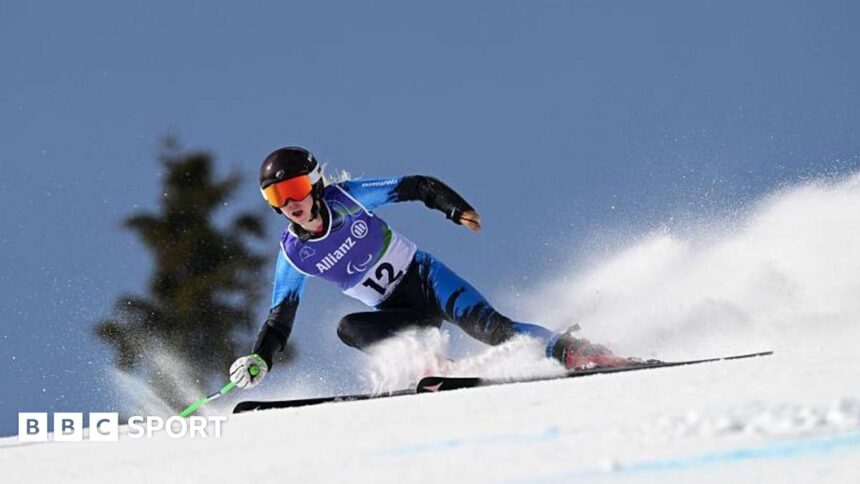
Varvara Voronchikhina Soars to Super G Gold, Ending Russia’s Paralympic Drought
The roar that echoed through the Yanqing National Alpine Skiing Centre was one of profound release. As Varvara Voronchikhina sliced across the finish line, her time untouchable, a decade of Paralympic exile for Russia was officially over. The 23-year-old para-alpine skier didn’t just win the women’s standing super G; she carved through a complex legacy of controversy and reinstatement to claim Russia’s first Paralympic gold medal since the 2014 Sochi Games. In a moment charged with sporting and political gravity, Voronchikhina’s victory was a powerful statement of athletic resilience, marking a contentious yet undeniable return to the pinnacle of adaptive sport.
A Triumph Forged in Exile and Resilience
Voronchikhina’s path to the top of the podium was anything but conventional. For the majority of her elite career, the international stage was a barred door. Russia’s state-sponsored doping scandal led to a blanket ban from the 2018 PyeongChang Games, a punishment extended after the nation’s 2022 invasion of Ukraine. For athletes like Voronchikhina, caught in the crossfire of geopolitical strife, the dream of Paralympic glory seemed indefinitely postponed.
Her journey back is a testament to bureaucratic and athletic perseverance. The breakthrough came only in January of this year, when Russia won a critical appeal to the Court of Arbitration for Sport (CAS) against FIS, skiing’s global governing body. This narrow window reopened international competition for Russian para-skiers, but it offered a brutally short runway to the Games. Voronchikhina’s rapid ascent from that return to a double-medal performance in Beijing is staggering. Her bronze in the standing downhill just two days prior was a signal—a nation and an athlete were no longer just participants, but contenders.
- Key Timeline: International ban (2016-2023) -> CAS appeal win (January 2024) -> Downhill bronze (Saturday) -> Super G gold (Monday).
- Athletic Context: Competing against rivals with years of uninterrupted World Cup experience, Voronchikhina’s technical mastery in the super G, a discipline demanding precision at high speed, is particularly impressive.
Analysis: The Weight of the Flag and the Future of Neutral Participation
This victory transcends the personal. The Russian flag and anthem, absent from Paralympic ceremonies for 12 years, returned in a moment that will be analyzed far beyond the sports pages. The International Paralympic Committee’s (IPC) decision to allow Russia’s return under strict conditions—though Ukrainian athletes and many Western nations protested vehemently—has irrevocably altered the landscape of these Games. Voronchikhina, in her moment of triumph, became the focal point of this deeply conflicted reality.
From a sporting perspective, her performance raises urgent questions about the competitive balance. Russia’s Paralympic program, historically a powerhouse, has operated in a form of intensive domestic isolation. The immediate success of their athletes suggests not just maintained, but potentially enhanced, high-performance systems away from the international spotlight. Experts are now watching closely: does this gold medal signal a new era of Russian dominance in adaptive winter sports, or is it a peak fueled by the singular motivation of a long-denied opportunity?
The “neutral” designation remains a thin veneer. While competing under the banner of the Russian Paralympic Committee, the athletes’ identities and the national symbolism in celebration are clear. Voronchikhina’s win will undoubtedly be framed as a national triumph within Russia, testing the IPC’s framework for reintegration and setting a precedent fraught with complexity for future global events.
Predictions: Ripple Effects for Beijing and Beyond
Voronchikhina’s gold is likely not an isolated incident. Expect the Russian team to carry this momentum forward in Beijing with increased confidence. The psychological barrier has been shattered. Look for strong challenges in:
- Para-alpine skiing across other disciplines (giant slalom, slalom).
- Para-cross-country skiing and biathlon, traditional areas of Russian strength.
The broader prediction is one of continued friction. This victory ensures that the political narrative will shadow every Russian medal. Protests, both silent and vocal, from other athletes are probable, and the IPC will face intensified scrutiny over its governance. Furthermore, Voronchikhina’s story creates a compelling, if controversial, template: can athletic excellence, achieved under extraordinary circumstances, ultimately overshadow the reasons for exile? The world’s sports governing bodies will be studying this case for years to come as they grapple with the near-impossible task of separating sport from state.
A Legacy of Complexity and a Champion’s Resolve
Varvara Voronchikhina’s super G run will be logged in the record books as a winning time. History will record it as far more. It is a story of an athlete who mastered her craft while her nation was banished, who seized a fleeting chance at the only moment that mattered. Her gold medal is undeniably a masterpiece of personal athleticism and focus.
Yet, it is irrevocably layered with the heavy context of global conflict, institutional sanctions, and the perennial debate about the purity of sport. The sight of the Russian flag rising in Yanqing closes one chapter—the period of post-Sochi punishment—but opens another, more uncertain one. It is a chapter where the Paralympic movement must navigate an even tighter rope between inclusion, integrity, and geopolitical reality.
For Voronchikhina, the future is now bright with possibility. She has emerged from the shadows not just as Russia’s first gold medalist in a generation, but as a defining figure of a fraught Paralympic era. Whether her legacy will ultimately be that of a unifying champion or a symbol of unresolved division is a story still being written. What is certain is that her name is now permanently etched in the annals of sport, a champion who skied through a storm to reach the top.
Source: Based on news from BBC Sport.