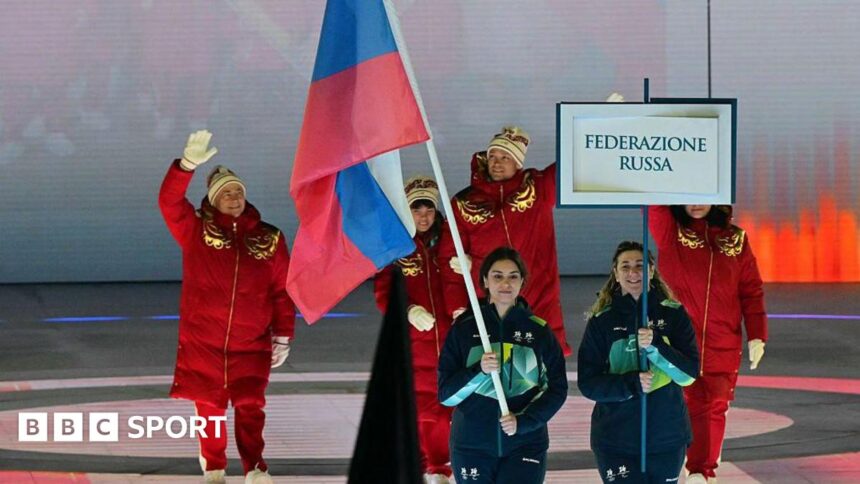
A Flag’s Return: Russian and Belarusian Athletes March into a Divided Paralympic Arena
The roar inside Verona’s historic Arena was a complex symphony of cheers and conspicuous silence. As the procession of nations wound its way across the ancient stones for the opening ceremony of the Milan-Cortina 2026 Winter Paralympics, a moment of profound geopolitical significance unfolded. For the first time in over a decade, athletes from the Russian Federation marched behind their red, white, and blue tricolor. Alongside them, the red and green flag of Belarus followed. This visual return, sanctioned by the International Paralympic Committee (IPC) to mark the Games’ 50th anniversary, was not a celebration of unity but the epicenter of a raging storm, casting a long shadow over the start of the anniversary Games and redefining the fraught intersection of sport, politics, and principle.
The Weight of the Flag: From Sochi Shadows to Sanctions
The sight of the Russian flag at a Paralympics is a rarity of the modern sporting era. Its last appearance was at the home Games in Sochi 2014, a zenith soon eclipsed by one of sport’s deepest valleys. The ensuing state-sponsored doping scandal led to blanket bans, forcing Russian athletes to compete as neutrals at subsequent Games. Just as that chapter seemed to be turning, the full-scale invasion of Ukraine in 2022 triggered a new wave of sanctions from global sports bodies.
The IPC, following the lead of the International Olympic Committee (IOC), initially imposed a full ban before quickly adapting it to a neutral status for the Beijing 2022 Winter Paralympics—a decision met with such uproar that it was reversed within 24 hours, excluding the athletes entirely. The march in Verona, therefore, represents a deliberate and contentious pivot. The IPC’s framework for reinstatement, based on athletes meeting strict conditions of neutrality, has culminated in what they frame as a conditional return to competition. Yet, for many, a flag is never neutral.
- Sochi 2014: Last Paralympics with official Russian team presence.
- 2016-2022: Russian athletes compete under neutral banners due to doping bans.
- 2022 Invasion: Leads to new sports sanctions and exclusions.
- 2026 Milan-Cortina: Conditional return under national flags, sparking intense controversy.
A Ceremony of Protest: The Empty Seats and Vocal Boycott
The IPC’s decision did not occur in a vacuum, and the reaction was immediate, principled, and painful. The boycott of the opening ceremony by seven national teams, including Ukraine
Ukrainian officials framed their absence as a moral imperative, stating that sharing the parade with representatives of the aggressor state was untenable while war rages on. This sentiment found resonance with other nations, creating a schism that no amount of ceremonial pageantry could bridge. The controversy dominated the pre-Games media build-up, shifting focus from athletic achievement to geopolitical fault lines. For the athletes from boycotting nations who chose to compete but not parade, it presented an agonizing choice between celebrating their Paralympic journey and standing in solidarity with their nation’s conscience.
Expert Analysis: The IPC’s Tightrope Walk
From a governance perspective, the IPC’s move is a high-stakes gamble. Sports sociologist Dr. Anya Petrova, an expert in post-Soviet sport, explains: “The IPC is attempting an impossible balancing act. Its foundational principles promote inclusion and the separation of sport and politics. Yet, the institution is now navigating a conflict where politics has violently imposed itself onto every aspect of life, including sport. By allowing the flags, they argue they are protecting athletes from the actions of their governments. But for the opposing nations, those flags are direct symbols of those very actions.”
The 50th anniversary edition of the Paralympics was intended to be a celebration of resilience and human spirit. Instead, it risks being remembered as the Games where the fault lines in the “Paralympic movement” were laid bare. The IPC likely calculated that a delayed reintegration was inevitable and that these Games, as an anniversary event, provided a symbolic moment for a managed return. However, this management has come at the cost of the ceremony’s unity and has placed an immense, perhaps unfair, burden on the ten individual athletes—six Russians and four Belarusians—who became the physical embodiments of this policy.
Predictions for the Games and Beyond
The reverberations from the ceremony will echo throughout the competition and shape the future of international sport.
1. Tense Podiums and Protests: Should athletes from Russia, Belarus, and Ukraine medal in the same event, the podium ceremony will be a global focal point. Any gesture perceived as political will be scrutinized. The IPC will enforce its neutrality rules stringently, but the emotional undercurrent will be palpable.
2. Media Narrative Battleground: Every performance by a Russian or Belarusian athlete will be framed through dual lenses: as a pure athletic achievement and as a political symbol. State media in Russia will hail the flag’s return as a victory and a validation. Outlets in opposing nations will highlight the boycott and the ongoing war.
3. A Precarious Blueprint for Paris 2024: All eyes now turn to the Summer Olympics. The IOC has outlined similar conditions for neutral participation. The tumultuous reaction in Verona may cause last-minute recalibrations, but the Milan-Cortina precedent is now set. The Olympic opening ceremony in Paris will be an even larger, more intense version of this diplomatic and ethical theater.
4. Long-term Fractures: The trust between Eastern European nations and the IPC/IOC governance structure has been severely damaged. This could lead to the formation of stronger, more politicized blocs within the sporting world, challenging the notion of universal participation.
Conclusion: The Unfurled Banner and the Unhealed Wound
The flags are unfurled. The march has happened. The Milan-Cortina Winter Paralympics have begun under a cloud of profound disagreement. The return of the Russian and Belarusian flags to the Paralympic stage is a chapter in a much longer, darker story—one of war, sanctions, and the relentless pressure on sport to serve as both a unifier and a conscience. The athletes from Russia and Belarus who have trained under unimaginable circumstances are now competing, but they do so in an arena where their very presence is a testament to conflict.
Ultimately, the 2026 Games will be remembered not just for the breathtaking feats of athleticism on the slopes and ice, but for the moment in Verona when the Paralympic movement’s idealistic motto, “Spirit in Motion,” collided with the unmoving realities of a world in conflict. The flags are back, but the healing they were perhaps naively intended to symbolize remains a distant hope, overshadowed by the stark, empty seats of protest and the unceasing thunder of war.
Source: Based on news from BBC Sport.