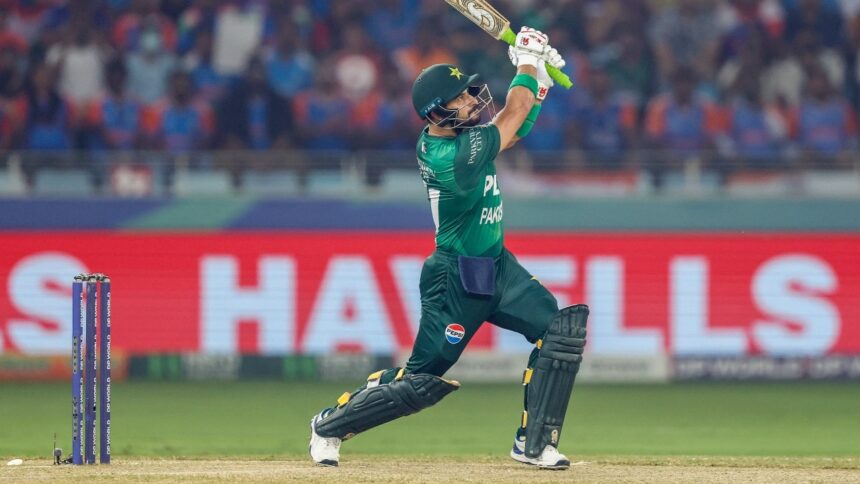
Sahibzada Farhan’s Stoic Response to The Hundred’s Pakistani Player Speculation
The world of franchise cricket, a vibrant tapestry of global talent and commercial ambition, finds itself entangled in a familiar geopolitical knot. As The Hundred’s player auction approaches, reports from British media suggest a potential snub: that four Indian-owned franchises may avoid selecting Pakistani cricketers. In the eye of this gathering storm stands Pakistani batter Sahibzada Farhan, whose response was a masterclass in quiet focus amidst swirling speculation. His words, delivered ahead of a crucial T20 World Cup clash, reveal less about player anxiety and more about the complex, often shadowy, forces shaping modern cricket’s economy.
Beyond Our Control: A Player’s Pragmatic Stance
When confronted with questions about the reports, Sahibzada Farhan displayed a perspective forged in the realities of contemporary cricket. “See, it’s not in our hands to decide who will pick us or not. That is not in our hands,” he stated, neatly deflecting the narrative from individual grievance to systemic reality. His focus remained squarely on readiness and performance. “Wherever we get a chance, whoever is interested can pick us and we are ready to play in that league,” he added, emphasizing a professional’s primary currency: availability and skill.
This stance is not born of apathy, but of experience. Pakistani players have long navigated a fragmented franchise landscape, where their immense talent sometimes collides with political and commercial considerations beyond the boundary rope. Farhan’s refusal to be drawn into the speculation—“And we are not interested to play with the people – the way you have spoken”—was a pointed disengagement from a premise he, as a player, cannot control. It underscores a critical truth: in the auction room, cricketers are commodities subject to invisible market forces.
The Four Franchises at the Heart of the Speculation
The reports specifically highlight four teams in The Hundred with direct ownership links to powerful Indian Premier League (IPL) entities:
- Manchester Super Giants (Owned by the RPSG Group, owners of Lucknow Super Giants)
- MI London (Owned by Reliance Industries, owners of Mumbai Indians)
- Southern Brave (Part-owned by Mukesh Ambani’s Reliance)
- Sunrisers Leeds (Owned by the Sun Group, owners of Sunrisers Hyderabad)
This corporate architecture creates a direct pipeline of strategy and, potentially, policy from the IPL to The Hundred. The broader absence of Pakistani players in IPL-owned competitions is a well-documented, if rarely officially acknowledged, phenomenon. Since 2008, no Pakistani player has been auctioned in the IPL, a result of the frosty political relations between India and Pakistan. The fear now is that this unspoken precedent may be extending its reach into other global leagues under the same ownership umbrella, effectively creating a “soft ban” in tournaments beyond India’s borders.
None of the franchises have commented, which in itself fuels further analysis. The silence speaks to the sensitivity of the issue, where any official statement could have significant diplomatic and commercial repercussions.
Expert Analysis: Commerce, Politics, and Cricket’s New World Order
This situation is a microcosm of 21st-century sports. Franchise cricket is not merely a sporting contest; it is a multi-billion-dollar ecosystem where decisions are driven by a complex algorithm of brand perception, market access, and stakeholder interest.
From a purely business standpoint, IPL franchise owners expanding into the UK are investing to build global sports brands. Their primary market—the colossal Indian viewership and sponsorship base—remains the core of their revenue. Avoiding potential controversy that could alienate that base, regardless of the sporting merit involved, can be framed as a cold, hard business calculation. It’s a form of corporate risk management that supersedes the pursuit of pure playing talent.
Conversely, this approach threatens the very essence of leagues like The Hundred, which are marketed on a “world’s best” premise. Excluding players from a top-tier cricketing nation like Pakistan, renowned for producing some of the most dynamic T20 stars, undermines the sporting product’s credibility. It raises ethical questions about whether a private league’s ownership can impose a de facto political sanction in a third country, effectively bypassing the England and Wales Cricket Board’s (ECB) own governance.
Predictions and Ramifications for the Global Game
The immediate fallout will be clear after The Hundred auction. Should no Pakistani player be picked by the four franchises in question—while other teams select them—it will be seen as a tacit confirmation of the reports. The longer-term implications are more profound:
- Balkanization of Talent Pools: We may see the emergence of distinct “franchise blocs,” where player movement is subtly dictated by ownership ties rather than open competition.
- ECB’s Dilemma: The ECB must weigh its desire for Indian investment against its duty to ensure a fair and inclusive competition. Their response, or lack thereof, will set a powerful precedent.
- Player Empowerment Shift: As seen with Sahibzada Farhan, players may increasingly disassociate from these narratives, focusing on leagues where they are welcome, potentially strengthening competitions like the PSL, CPL, or emerging T20 circuits.
- Diplomatic Shadow Play: Cricket continues to be a barometer for India-Pakistan relations. These franchise-level decisions are a new, corporate-fronted extension of that enduring tension.
Conclusion: Focus on the Field, Complexity Off It
Sahibzada Farhan’s reaction was not one of weakness, but of stark clarity. It redirected attention from speculative politics back to performance, from boardroom machinations back to the cricket field. His message was simple: a player’s job is to be ready. The rest is noise. Yet, this noise is the soundtrack of modern sports, where capital, geopolitics, and athleticism are inextricably linked.
The speculation around Pakistani players in The Hundred is more than a pre-auction rumor; it is a stress test for the soul of franchise cricket. It asks whether these leagues are truly global sporting competitions or merely commercial vehicles for geographically-bound interests. As fans, we are left hoping the spirit of sport prevails, that talent is judged solely by runs, wickets, and catches. But the sobering lesson from Sahibzada Farhan’s press conference is that in today’s game, the most important selections often happen not on the field, but in rooms where cricketers are not present.
Source: Based on news from India Today Sport.