Senegal’s AFCON Triumph Eclipsed by Chaos: Controversy and Crowd Violence Mar Historic Win Over Morocco
In what should have been a coronation of African footballing royalty, the 2023 Africa Cup of Nations final descended into unprecedented bedlam. Senegal secured its second continental title with a dramatic 1-0 victory over host nation Morocco in Rabat, but the historic achievement was instantly and irrevocably overshadowed by a maelstrom of controversy, a mass brawl, and a protest that saw the champions-elect vanish from the pitch. The match, a tense tactical affair, exploded in the dying moments, transforming the Prince Moulay Abdellah Stadium from a theater of dreams into a scene of chaos, leaving the football world to ponder the cost of a trophy won amidst such turmoil.
A Tepid Final Ignites: The Spark of Controversy
For 90 minutes, the final was a cagey, nervy affair. Both Senegal, with its experienced core, and Morocco, buoyed by a fervent home crowd, seemed paralyzed by the magnitude of the occasion. Clear chances were at a premium. The breakthrough came deep into stoppage time, not from a moment of flowing brilliance, but from a set-piece scramble. Pape Gueye, the Marseille midfielder, pounced on a loose ball to stab home, sending the traveling Senegalese support into raptures. Yet, the goal acted not as a climax, but a catalyst for the insanity to come.
Moments after the restart, Morocco launched one final, desperate attack. Brahim Diaz weaved into the box and went down under a challenge from Senegal’s El Hadi Malik Diouf. The referee initially waved play on, but was summoned to the VAR monitor. The decision to overturn the call and award a penalty to Morocco was seismic. To compound Senegalese fury, just minutes before Gueye’s winner, they had seen a goal of their own chalked off for a tight offside—a decision unreviewable by VAR as the play had been restarted. The sense of injustice was palpable and immediate.
- Pape Gueye’s stoppage-time goal appeared to seal the title for Senegal.
- A subsequent VAR check overturned a non-call, awarding Morocco a late penalty.
- This came after a Senegalese goal was disallowed for an offside unreviewable by VAR.
- The sequence created a perfect storm of tension and perceived injustice.
Pandemonium Erupts: Benches Clear and a Team Walks Off
The penalty decision triggered an instantaneous and violent reaction. Both benches emptied, with substitutes, coaches, and staff surging onto the field. Pushes, shoves, and heated confrontations erupted along the touchline as security personnel waded into the fray. In the midst of this, Senegal manager Pape Thiaw made a decision that will be debated for years. Fearing for his players’ safety and protesting the officiating sequence, he made the extraordinary call to lead his team off the pitch and into the locker room.
“We were not going to be complicit in a robbery,” Thiaw is reported to have shouted at officials. “If the sport is not fair, we will not participate.” This act of protest left the stadium in a state of bewildered suspension. The Moroccan players remained on the field, awaiting their chance at a reprieve from the spot, while their opponents were nowhere to be seen. The authority of the tournament, and the match officials, hung by a thread.
Stadium in Flames: The Supporter Section Erupts
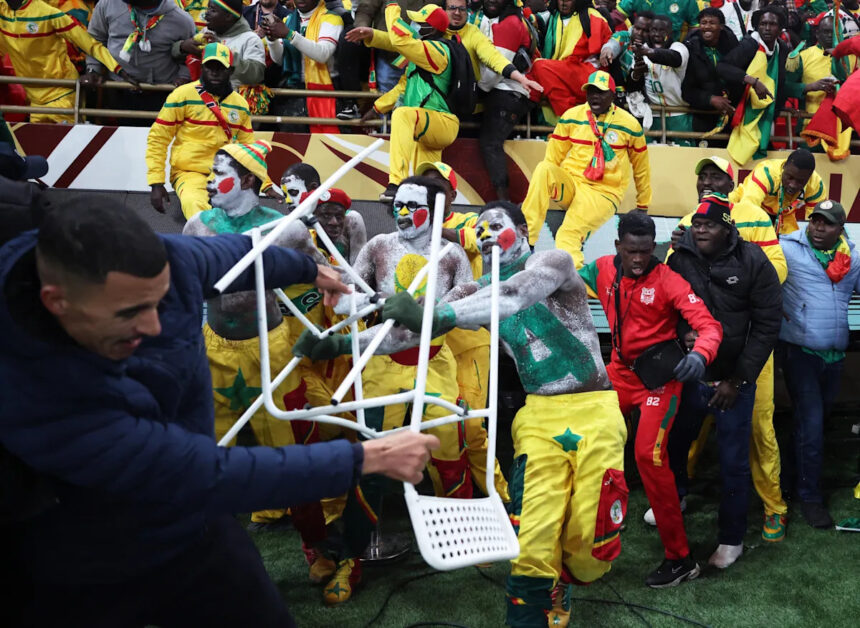
As the surreal scene unfolded on the pitch, a far more dangerous situation developed in the stands. The Senegalese supporters’ section, a vibrant sea of green and yellow all match, became a battleground. Frustration over the penalty decision, combined with the tense standoff on the field, boiled over into a giant fan brawl.
Shocking footage circulated globally showing supporters clashing violently with stadium security. Chairs were ripped from their moorings and hurled. Fights broke out between fans themselves and between fans and stewards. The area behind the goal descended into anarchic violence, a stark and terrifying contrast to the celebration that had occurred there just minutes earlier. It took a significant deployment of riot police to eventually restore a fragile order, but the images had already seared themselves into the memory of the tournament.
Stadium security was overwhelmed by the scale and ferocity of the outburst, raising serious questions about contingency planning for high-risk fixtures.
Resolution, But No Redemption: A Trophy Lifted in Shadow
After a delay of nearly 40 minutes, and following intense negotiations between CAF officials, team management, and local authorities, Senegal was persuaded to return to the field. The penalty, still awaiting, was taken. Moroccan star Achraf Hakimi, under unimaginable pressure, stepped up and skied his effort over the bar. The final whistle blew immediately, confirming Senegal’s victory.
Yet, there was no unbridled joy. The celebrations were muted, confused, and fragmented. Players embraced with looks of exhaustion more than ecstasy. The trophy presentation felt like a procedural afterthought, a box to be checked. Senegal had its back-to-back titles, a cementing of its dynasty, but the narrative was forever altered. Expert analysis in the aftermath has focused less on Senegal’s tactical resilience and more on the profound failure of event management and the psychological tipping point of high-stakes football.
“This wasn’t a football match at the end; it was a social experiment in pressure and protocol failure,” noted sports psychologist Dr. Amara Sow. “The players and fans were subjected to a rollercoaster of extreme emotions—disallowed goal, last-minute winner, controversial penalty, abandonment—in a matter of minutes. The system broke, and so did the crowd.”
Looking Ahead: Repercussions and a Clouded Legacy
The fallout from this final will be extensive. CAF is certain to launch a full investigation, with heavy fines and potential suspensions for both federations, particularly regarding the conduct of the Senegal bench and the failure to control supporters. The legacy of this Senegalese golden generation is now complex. While their on-field achievements are undeniable, this victory will forever be asterisked by the chaos that surrounded it.
Predictions for the future of AFCON must now include a hard look at security protocols and referee management. The use of VAR, intended to quell controversy, instead became its central actor. The tournament’s credibility has taken a hit. For Morocco, the heartbreak is twofold: losing a final at home, and having their chance at equalizing mired in a global story of violence and protest.
In the end, Senegal leaves Rabat with the continent’s most prized trophy. But they also leave with a victory stained by a violent outburst and a protest that challenged the very fabric of the game. The 2023 AFCON final will be remembered not for a display of footballing excellence, but as a cautionary tale of what happens when sport’s competitive fire burns beyond the boundaries of control. The champions have their title, but the beautiful game was the day’s ultimate loser.
Source: Based on news from Yahoo Sports.