Senegal’s Afcon Triumph Torn Away: A Controversial Overturn Shakes African Football
The image was iconic: Senegal’s Lions of Teranga, draped in their national flag, lifting the 2025 Africa Cup of Nations trophy after a grueling final against Morocco. The narrative was perfect: a reigning champion solidifying its dynasty. Now, that image has been officially erased by a stunning disciplinary decision, replacing jubilation with outrage and setting the stage for a bitter continental feud. The Confederation of African Football’s ruling to strip Senegal of its title and award it to Morocco has not just changed a record book; it has ignited a firestorm over protest, power, and the very soul of the game in Africa.
The Final That Unraveled: Protest, Penalty, and Pandemonium
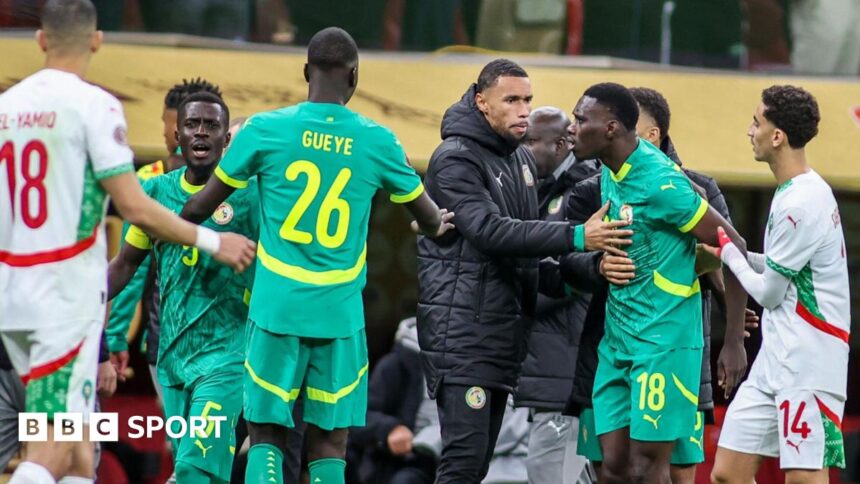
To understand the seismic nature of CAF’s decision, one must revisit the chaotic final moments of the January final. With the score 0-0 deep into second-half stoppage time, the referee awarded a penalty to host nation Morocco. The decision was immediately and vehemently contested by the entire Senegalese team, who believed the call was a grievous error. In an unprecedented move at this level of competition, Senegal’s players walked off the pitch in unified protest.
The delay lasted for 17 tense minutes—an eternity in a continental final. Upon returning, Moroccan star Brahim Diaz stepped up and attempted a chipped ‘Panenka’ penalty, which was calmly saved by Senegal’s goalkeeper. The drama then flipped entirely in extra time, when Pape Gueye scored the winning goal for Senegal, sparking wild celebrations for what appeared to be a hard-fought, emotionally charged victory.
However, the Moroccan Football Federation (FRMF) swiftly lodged a formal appeal. Their argument was rooted in Law 3 and Law 7 of the game, concerning the number of players and the duration of a match. CAF’s disciplinary board concurred, issuing a ruling of extraordinary severity.
- The Core Ruling: CAF determined that Senegal’s walk-off constituted a refusal to play, effectively forfeiting the match.
- The New Result: The 1-0 victory was expunged. In its place, a 3-0 forfeit victory was awarded to Morocco.
- The Consequence: Morocco was declared the 2025 Africa Cup of Nations champion, while Senegal was stripped of its title.
“The Fight is Far From Over”: Senegal’s Defiant Stance
The reaction from Dakar was one of cold fury. Senegal FA President Augustin Senghor did not mince words, stating the organization was “shocked and disgusted” by a decision that “robs our nation and our players of their rightful glory.” His subsequent declaration—“the fight is far from over”—signals a legal and diplomatic battle that will extend far beyond the pitch.
Senegal’s likely appeal will hinge on several key arguments. First, they will emphasize that the players returned to the pitch and completed the match. The game was not abandoned; it was contested to its conclusion with a winning goal scored in open play. Second, they will argue that the walk-off, while punishable, should not carry the disproportionate sanction of a forfeit in a continental final. Expect references to precedents in other FIFA-sanctioned tournaments where walk-offs or delays resulted in fines or point deductions, but not the retroactive overturning of a final result.
Most powerfully, Senegal’s case will tap into a deep-seated sentiment across African football: a perception of systemic bias. The narrative of a host nation benefiting from a controversial late call, and then being handed the trophy via a boardroom decision, is politically toxic. It fuels longstanding accusations that CAF governance is influenced by power politics rather than pure sporting integrity.
Expert Analysis: A Precedent with Perilous Implications
This decision creates a precarious precedent that threatens to destabilize the management of future tournaments. “CAF has placed itself in an incredibly difficult position,” notes Dr. Amara Diouf, a sports law analyst based in Abidjan. “By applying the strictest letter of the law in this uniquely high-stakes context, they have potentially opened the door for endless litigation. Every major controversial call in a knockout match could now be seen as a potential trigger for a post-match appeal seeking a forfeit, rather than a focus on in-game resolution.”
The ruling also brutally reframes the concept of player protest. In an era where athletes are increasingly using their platform to speak out, the message from CAF appears absolute: leaving the pitch, for any reason, will be punished by the ultimate sanction. This clashes with global conversations about player safety and respect, particularly if a team feels a decision is so unjust it compromises the contest’s fairness.
Furthermore, the footballing logic is baffling to many purists. Morocco missed the penalty. Senegal then won the game in extra time. The sporting outcome on the field was clear. To alter that result in an office days later feels, to many, like an affront to the essence of competition. It elevates procedural adherence above the witnessed events of the game, creating what fans are calling a “virtual championship.”
Predictions and the Rocky Road Ahead
The immediate future is set for conflict in the courtrooms of the Court of Arbitration for Sport (CAS). Senegal will appeal, and this case has all the hallmarks of a protracted legal duel. Predictions for the outcome are complex:
- CAS Upholds CAF: This would cement the title for Morocco but leave a permanent stain on their victory and deepen disillusionment with CAF’s authority across the continent, particularly in West Africa.
- CAS Overturns the Forfeit: The most dramatic scenario. The original result could be reinstated, returning the title to Senegal. This would be a humiliating rebuke for CAF and the FRMF.
- A Compromise Sanction: CAS may rule that Senegal’s action warranted punishment—a heavy fine, a stadium ban, or even a deduction in the next Afcon qualifying campaign—but that the forfeit of a final was excessive. However, this still leaves the question of the 2025 title unresolved.
Beyond the legal battle, the political fallout within CAF will be intense. Alliances will be tested. The decision is seen by many as a power play reinforcing the North African bloc’s influence. This could galvanize other regional federations to challenge CAF’s leadership more aggressively in future elections and policy decisions.
For the players, the emotional whiplash is cruel. Senegal’s heroes have been told their pinnacle achievement never happened. Morocco’s squad, who displayed immense grace in defeat on the night, now receive a trophy under a cloud. Neither nation’s footballing community gets the closure or clean celebration they deserve.
Conclusion: A Victory That Satisfies No One
In the end, CAF’s decision to overturn Senegal’s Africa Cup of Nations victory has created a lose-lose-lose scenario. Senegal loses its hard-won title. Morocco’s championship will forever carry an asterisk and the whispers of a boardroom gift. And CAF itself loses credibility, appearing as a governing body that prioritizes rigid regulation over the palpable spirit and tangible outcome of the sport it is meant to steward.
The beautiful game in Africa is often a reflection of its passions, its politics, and its struggles. This controversy encapsulates all three. Augustin Senghor’s promise that the “fight is far from over” is a guarantee that the final whistle of the 2025 Afcon final was not an end, but the beginning of a new, contentious, and defining match—one played not on grass, but in the arenas of law and legacy. The true cost of this decision will be measured not in trophies exchanged, but in the lasting damage to trust in the institutions of African football.
Source: Based on news from BBC Sport.