New Era Dawns: Seven Uncapped Talents Bolster Red Roses’ Six Nations Squad
A new chapter for English women’s rugby is officially underway. Fresh from their historic World Cup triumph in September, the Red Roses have named a 38-strong squad for the upcoming Women’s Six Nations that pulsates with both the absence of legendary figures and the thrilling promise of a fresh generation. Head coach John Mitchell, now fully at the helm, has selected seven uncapped players, signaling a deliberate and exciting shift towards building the next era of champions.
Navigating the Post-World Cup Transition
Mitchell’s squad selection is a masterclass in managing transition. The spine of the World Cup-winning team remains, but several key pillars are temporarily or permanently absent. Usual skipper Zoe Aldcroft and lock partner Abbie Ward are both pregnant, while the iconic Emily Scarratt and electric winger Abby Dow have retired from international rugby. These are not just gaps in a lineup; they are voids of experience, leadership, and try-scoring prowess that must be filled.
This context makes Mitchell’s selections profoundly significant. He is not merely tinkering; he is architecting a new foundation. The inclusion of seven new faces, alongside the recall of players with minimal caps, is a clear statement: the Red Roses’ dominance will be sustained not by resting on laurels, but by aggressively promoting and testing the next wave of talent. The Women’s Six Nations becomes less about mere victory and more about evolution, integration, and discovering who can thrive under the intense pressure of the white shirt.
Meet the New Guard: Uncapped Prospects Ready to Shine
The seven uncapped players span the pitch, offering solutions and competition across key positions. Their selection is rooted in standout domestic form in the Premiership Women’s Rugby (PWR), proving the pathway from club to country is robust and meritocratic.
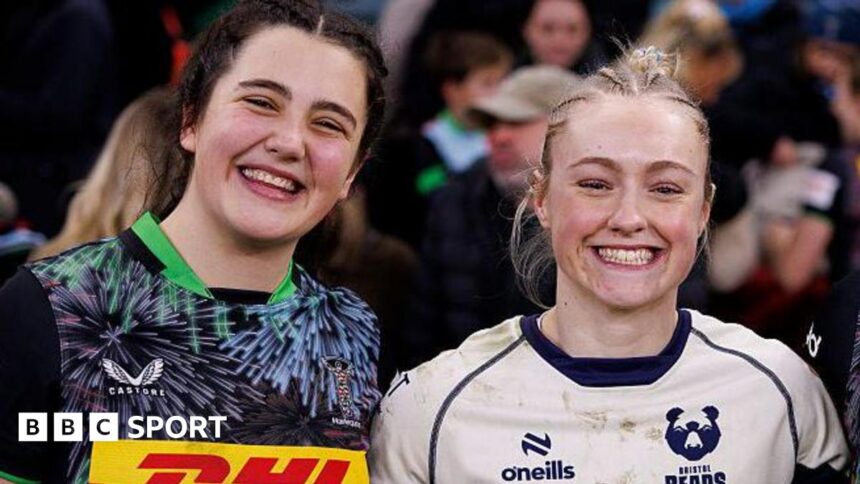
- Millie David (Bristol Bears, Wing): The headline-maker. David finished joint-top of the PWR try-scoring charts last season and is the highest-ranked English-qualified back this campaign. A lethal finisher with searing pace, she is the prime candidate to step into the void left by Dow’s retirement.
- Sarah Parry (Bristol Bears, Hooker): A dynamic and technically sound thrower, Parry has been a consistent force for Bristol. With Lark Davies and Connie Powell established, her inclusion creates fierce competition at hooker, future-proofing a critical set-piece position.
- Maddie Feaunati (Exeter Chiefs, Back Row): A powerful, ball-carrying No. 8 who has been instrumental in Exeter’s rise. Her physicality and work-rate offer a different dimension to the back row, challenging the established order.
- Lilli Ives Campion (Gloucester-Hartpury, Prop): Part of the formidable Gloucester-Hartpury pack, her scrummaging power and work around the park have earned this call-up, adding depth to the engine room.
- Kelsey Clifford (Saracens, Prop): Another tighthead prospect, Clifford’s strength at the set-piece and in the loose for the league leaders marks her as one for the future.
- Ella Lovibond (Bristol Bears, Scrum-Half): A livewire and tactically astute playmaker, Lovibond provides crucial cover and challenge behind Lucy Packer and Natasha Hunt.
- Megan Varley (Gloucester-Hartpury, Centre): While not uncapped, her recall after a long absence alongside these newcomers underscores Mitchell’s fresh look. A powerful, direct runner, she offers a robust option in midfield.
Furthermore, Mitchell has recalled wingers Mia Venner (Gloucester-Hartpury) and Bo Westcombe-Evans (Loughborough Lightning), each with just two caps. Their inclusion, alongside David, transforms the wing position from an area of concern into one of vibrant, youthful competition.
Mitchell’s Blueprint: Analysis of Tactical Implications
John Mitchell’s philosophy has always leaned towards explosive, multi-phase attacking rugby. This squad selection amplifies that intent. By injecting raw pace on the wing (David, Venner) and powerful ball-carriers in the pack (Feaunati), he is doubling down on a game built on gaining quick front-foot ball and converting it into points out wide.
The inexperienced wing options are a calculated risk. Mitchell is betting that their club form and natural talent can be harnessed at Test level faster than conventional wisdom might suggest. The presence of world-class distributors like Holly Aitchison and Helena Rowland inside them will be crucial to their integration.
Equally telling is the reinforcement of the forward depth. The props and back-row selections ensure that England’s famed set-piece and physicality—the non-negotiables of their game—will not drop off with replacements on the field. This allows Mitchell to use his bench aggressively, maintaining a high-tempo, punishing style for the full 80 minutes.
Predictions for the Six Nations and Beyond
Expect the Red Roses to start the tournament with a core of experienced World Cup winners, gradually blooding the new talent from the bench or in specific home fixtures. Players like Millie David could have a “breakout” tournament similar to Ellie Kildunne’s rise in previous years.
The ultimate success of this campaign will not be measured by a Grand Slam alone—though that will remain the expectation. The true metrics will be:
- Seamless Integration: How quickly the new caps adapt to Test match intensity and structures.
- Depth Chart Clarity: Identifying the primary successors in key positions like lock and wing.
- Style Evolution: Whether the new personnel allows England to play with even more width and pace.
France, with their own array of stars, will provide the ultimate test. The clash in Bordeaux could see several of these new Roses face their fiercest examination yet.
Conclusion: A Bold Step Towards 2025
John Mitchell and the Red Roses have made a bold and intelligent statement. By embracing change so proactively, they have avoided the stagnation that often follows a World Cup cycle. The seven uncapped players are not just filling spots; they are the vanguard of a team building towards the next World Cup in England in 2025.
This squad announcement is a testament to the health of the Premiership Women’s Rugby ecosystem, which is producing ready-made Test talents. The 2024 Women’s Six Nations is no longer just a title defense; it is the exciting first act of a new story. The legacy of Scarratt, Aldcroft, Ward, and Dow is secure. Now, under Mitchell’s guidance, a hungry new generation has the chance to begin forging their own.
Source: Based on news from BBC Sport.