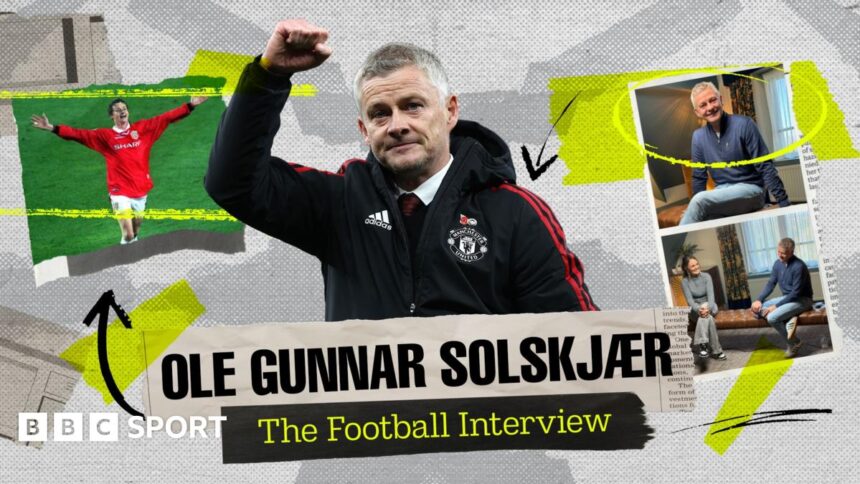
Speaking Backwards and a Manager at 13: The Unseen Solskjaer Story
In the pantheon of Manchester United legends, few images are as indelible as that of Ole Gunnar Solskjaer, wheeling away in ecstasy, his shot having rippled the Bayern Munich net in the dying seconds of the 1999 Champions League final. He is forever the “Baby-Faced Assassin,” the man who clinched an unprecedented Treble with a single, clinical touch. But behind that iconic moment lies a man of profound depth, intricate mindset, and surprising stories that have, until now, remained largely in the shadows.
In a revealing episode of the groundbreaking new series, The Football Interview with Kelly Somers, Solskjaer peels back the layers of his legendary career, offering a stunningly personal reflection on the experiences that forged him. This is not just a trip down memory lane; it’s an exploration of the very DNA of a man who has lived and breathed football from an almost impossibly young age.
The Boy Boss: A Managerial Calling at 13
One of the most astonishing revelations from the interview is the origin story of Solskjaer the tactician. Long before his celebrated stint in the Old Trafford dugout, a teenage Ole was already orchestrating play from the sidelines. At the tender age of just 13 years old, he was player-manager for his local youth team in his native Norway.
This wasn’t a symbolic role. Solskjaer describes with clarity how he would:
- Select the starting eleven and make decisive substitutions.
- Set the team’s tactical formation, instilling a philosophy even then.
- Lead the pre-match and half-time team talks, motivating his peers.
This incredible anecdote reframes his entire career. His later success at Molde and his tenure at Manchester United were not happy accidents but the culmination of a lifelong obsession with the mechanics of the game. “I’ve always been a manager,” Solskjaer confesses to Somers, suggesting that his playing career, for all its glory, was merely one chapter in a much larger footballing narrative. It reveals a precocious footballing intellect, a mind that was always analysing, always thinking two steps ahead.
The Mind Game: Speaking Backwards and Mental Fortitude
Perhaps the most unique insight into Solskjaer’s character comes from his discussion about mindset and motivation. He unveils a bizarre yet brilliant technique he used to sharpen his focus and cognitive agility: speaking backwards.
Yes, you read that correctly. Solskjaer would practice reversing sentences in his native Norwegian, a mental exercise that required intense concentration and a flexible mind. He explains to Somers that this wasn’t just a quirky habit; it was a deliberate tool to train his brain to think differently, to see patterns and solutions that others might miss.
This practice speaks volumes about the man behind the player. While others were physically training, Solskjaer was engaged in a form of cognitive conditioning. It underscores a fundamental truth about elite athletes: their greatest asset is often not their physical prowess but their mental strength. This unique discipline provided a foundation for the ice-cool composure he displayed in the pressure-cooker moments that defined his career, none more so than that night in Barcelona.
Defining Moments: More Than Just a Goal
Of course, no conversation with Ole Gunnar Solskjaer is complete without addressing the 1999 Champions League final. The goal is the stuff of legend, but in The Football Interview, he provides the intimate, human context that television cameras could never capture.
He recounts the moments in the dugout before being substituted on, the specific instructions from Sir Alex Ferguson, and the surreal, almost slow-motion feeling of seeing Teddy Sheringham’s shot fall to his feet. “It was just instinct, pure instinct,” he reflects. But this interview moves beyond the goal itself, delving into the aftermath—the emotional whirlwind, the weight of the achievement, and how that single kick irrevocably altered the course of his life.
This personal reflection transforms a well-worn highlight reel moment into a fresh, deeply moving story. It was a career high that also became a lifelong responsibility, a beautiful burden that he has carried with grace and humility ever since.
The Person Behind the Player: Legacy and Future
Kelly Somers’ line of questioning masterfully connects these disparate threads—the boy manager, the backwards-thinker, the Treble hero—into a coherent portrait of a complex individual. The series’ promise to deliver “the person behind the player” is fulfilled spectacularly. We see a man driven by a deep, analytical love for football, whose identity is intertwined with leadership and mental fortitude.
So, what does the future hold for Ole Gunnar Solskjaer? His time at Manchester United may have ended, but his story is far from over. Based on the philosophy and resilience uncovered in this interview, his next chapter is eagerly anticipated.
- International Management: His man-management skills and tactical acumen would be a major asset for a national team.
- Premier League Return: A refreshed and re-energized Solskjaer could be a compelling appointment for a club with a long-term project.
- Director of Football: His eye for talent and holistic understanding of club culture would make him ideal for a role upstairs.
Wherever he goes, he will take with him the lessons from the pitch, the sidelines, and the unique mental exercises that shaped one of football’s most thoughtful minds.
Conclusion: A Story Worth Hearing
The Football Interview with Ole Gunnar Solskjaer is more than just a nostalgia trip; it is a masterclass in uncovering the unseen dimensions of a sporting icon. By exploring his defining moments, from a childhood spent managing to a career defined by a single kick, the series proves its immense value. It gives a platform for the stories that statistics can’t capture and highlights the profound truth that greatness is often forged in the most unexpected ways.
This is a must-watch for any football fan, offering a rare and intimate look at the mindset and motivation of a true Manchester United legend. It confirms that the most fascinating stories aren’t always found in the trophy cabinet, but in the quiet moments of reflection, the unconventional training methods, and the early, undeniable signs of a destiny fulfilled.
Source: Based on news from BBC Sport.
Image: Source – Original Article