STATEHOOD?! Trump’s Bizarre Baseball Tweet Ignites Political Firestorm
In a surreal collision of sports, politics, and geopolitical power plays, former President Donald Trump has responded to Venezuela’s stunning victory over Team USA in the World Baseball Classic final with a single, incendiary word: “STATEHOOD!!!” The post, made on his Truth Social platform shortly after the final out in Miami, has ripped through the news cycle, transforming a moment of pure sporting triumph into a bizarre political Rorschach test. The suggestion that a sovereign nation, fresh off a symbolic on-field conquest of its political rival, should become a U.S. state is more than just typical Trumpian bombast. It is a window into a radically altered geopolitical landscape and a potent reminder of how sports and statecraft are forever intertwined.
A Championship Game With Geopolitical Undertones
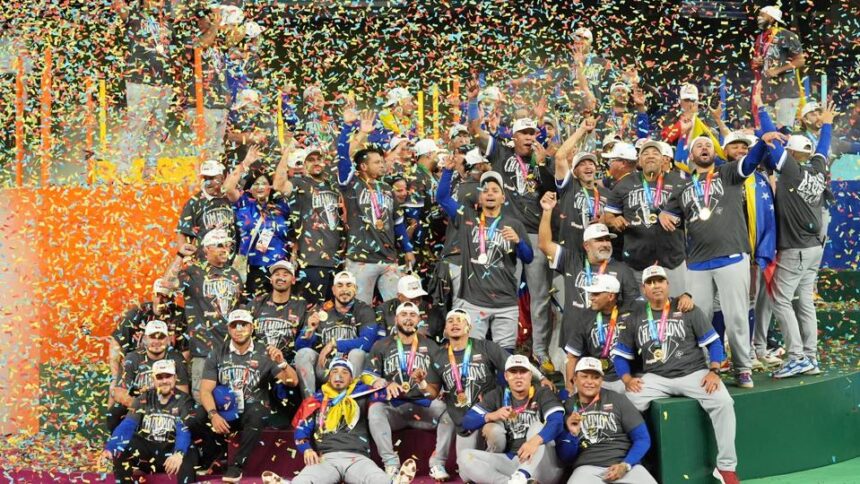
The 2023 World Baseball Classic final was a masterpiece of sporting drama. Venezuela, led by modern legends like Miguel Cabrera and a cadre of MLB All-Stars, faced a U.S. team stacked with generational talent. The game was played at loanDepot Park in Miami, the heart of the Venezuelan diaspora, creating an electric, partisan atmosphere that felt more Caracas than Coral Gables. When Venezuela secured the final out, the celebration was one of unadulterated national pride—a moment of unity for a country deeply fractured by years of economic collapse and political turmoil.
Into this emotionally charged scene entered Donald Trump. His two-sentence post—“STATEHOOD!!! President DJT.”—was not an isolated comment. It followed a pattern of remarks since the dramatic capture of former Venezuelan leader Nicolás Maduro by U.S. forces earlier this year, an operation Trump has repeatedly cited as proof of American dominion. “Since former Venezuelan President Nicholas Maduro was ousted from power and captured by U.S. forces in January, Trump has insisted the U.S. is running Venezuela,” a fact that frames his baseball commentary not as a joke, but as a statement of policy belief.
The timing was meticulously provocative. Just one night earlier, after Venezuela’s semi-final win, Trump had teased, “They are looking really great. Good things are happening to Venezuela lately! I wonder what this magic is all about?” The “magic,” in his view, is clearly American control. The WBC victory, therefore, was reframed not as Venezuela’s achievement, but as a byproduct of U.S. stewardship.
Decoding the “Statehood” Gambit: Politics as Performance
To understand this reaction, one must view it through the dual lenses of Trump’s political strategy and the historical use of sports in nationalist propaganda. This is not policy analysis; it is political performance.
- Redefining Victory: By injecting “statehood” into the conversation, Trump instantly shifted the narrative. The story was no longer “Venezuela beats the U.S.” but “Trump claims credit for Venezuela’s success.” It’s a classic power move, annexing the glory of the opponent’s win to bolster his own strongman image.
- Signaling to the Base: The comment reinforces a maximalist, America-First worldview for his supporters. It paints a picture of an expansive, dominant United States, so powerful it can casually absorb nations and claim their athletic triumphs. It turns a sports loss into a rhetorical demonstration of strength.
- Historical Echoes: Authoritarian regimes have long used international sports victories as proof of systemic superiority. Trump’s twist is to claim that superiority for the U.S. by implying Venezuela’s team won because it is effectively already American territory. The athletes’ skill becomes an extension of American influence.
Furthermore, the venue—Miami—adds a critical layer. Florida is a must-win state with a powerful Venezuelan-American community largely opposed to the Maduro regime. Trump’s comments, while outrageous to many, also serve as a stark reminder to these voters of his administration’s role in Maduro’s capture, a hardline stance popular with the exile community.
Expert Analysis: The Dangerous Game of Sporting Diplomacy
Political and sports analysts see Trump’s “statehood” post as a dangerous blurring of lines with real-world consequences. “This is the logical endpoint of politicizing every aspect of life,” says Dr. Elena Rodriguez, a professor of Latin American studies. “It diminishes the authentic achievement of these Venezuelan athletes, reducing their lifelong dedication to a political prop. For Venezuelans, this win was a rare moment of untainted national joy. To have it immediately co-opted by a foreign political figure is a profound insult.”
From a geopolitical standpoint, the comment is explosively irresponsible. It undermines the delicate efforts of diplomats and the Venezuelan opposition who seek a legitimate, sovereign democratic transition. “Trump has insisted the U.S. is running Venezuela,” but broadcasting that belief as a gloating tweet after a baseball game complicates every negotiation and fuels anti-American sentiment, not just in Venezuela but across Latin America.
Sports journalists also note the irony. “The U.S. team was the ‘Empire,’ the Goliath, the super-team,” notes veteran baseball writer Ben Crawford. “For Trump to respond to an underdog story—which is what this was, despite Venezuela’s talent—by essentially saying, ‘You’re ours anyway,’ completely misses the point of sport. It’s the ultimate ungracious response to a loss.”
Predictions: The New Playbook for Political-Sporting Events
This incident is unlikely to be an anomaly. It sets a precedent for how major international sporting events will be weaponized in the hyper-charged political climate of the 2020s.
- Future events like the Olympics or Soccer World Cups will become even higher-stakes political theaters. Victories and losses will be instantly mined for partisan talking points, with athletes’ accomplishments leveraged to support or attack a political agenda.
- Trump’s “statehood” framing creates a new, troubling template. It encourages a zero-sum, imperial interpretation of international competition where a win by another nation must be re-contextualized as a reflection of one’s own power.
- The response may galvanize athletes to be more politically vocal in defense of their own narratives. We should expect post-game interviews where athletes explicitly reject the politicization of their performance, as seen in other sports globally.
For Venezuela specifically, the moment is bittersweet. The glory of their championship is now partially overshadowed by a geopolitical shouting match. The team’s victory was a testament to the nation’s incredible baseball culture, which has persisted through immense hardship. Trump’s intervention risks making that story a footnote to his own political spectacle.
Conclusion: When the Final Out Isn’t the End of the Game
Venezuela’s 2023 World Baseball Classic title will forever have an asterisk in the history books—not for anything that happened on the field, but for the political maelstrom that followed. Donald Trump’s “STATEHOOD!!!” post is a masterclass in narrative hijacking. It demonstrated how a single social media blast can reframe a global event, provoke outrage, satisfy a base, and keep a commentator firmly at the center of the conversation.
The Venezuelan players celebrated a hard-fought victory for their homeland. Donald Trump saw a platform to promote a vision of American hegemony. In that disconnect lies the modern condition, where no sphere of human endeavor—not even the sacred diamond of baseball—is safe from the reach of political ambition. The final score was Venezuela 4, United States 2. But in the arena of political spectacle, the game, it seems, never ends.
Source: Based on news from Yahoo Sports.