They Were Told It Wasn’t For Girls. Meet The Future Faces of F1.
In the high-octane, multi-billion dollar theatre of Formula 1, a revolution is being plotted not on the main straight, but in the feeder series where dreams are forged. For decades, the narrative was monolithic: motorsport, especially its pinnacle, was a realm for men. Young girls with petrol in their veins were met with a patronizing, institutional shrug: it wasn’t for girls. Today, that archaic script is being ripped up and replaced with the thunderous sound of a new generation. Leading the charge is a teenager who, in many ways, is utterly typical, and in one, profoundly extraordinary.
The Dual Life of a Racing Prodigy
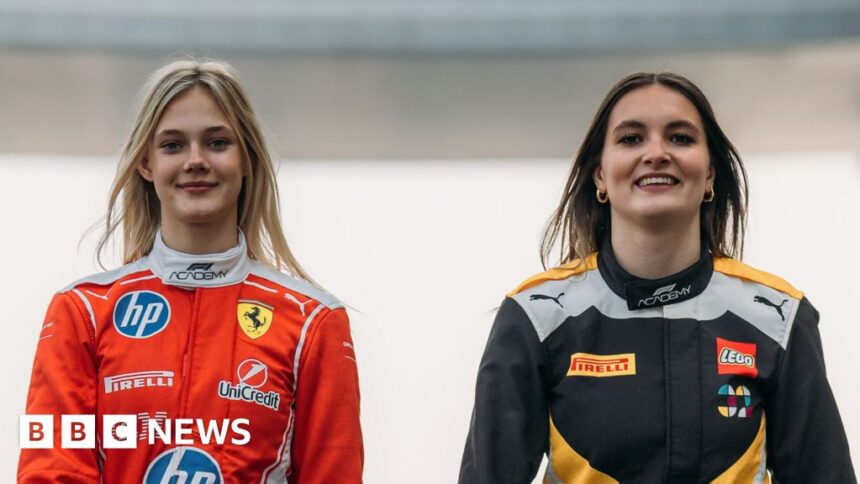
Rachel Robertson is, on paper, a classic British 18-year-old. She attends college in the south of England, enjoys lunches with friends, and lives near her family home. It’s a portrait of relatable normality. But this normality exists in a parallel universe to her other life. When she slips into her race suit, straps into the cockpit of a sleek, 174-horsepower machine, and feels the visceral smell of petrol and the squeal of rubber tyres, she transforms. In those moments, Robertson isn’t just a student; she is one of the most promising and fastest young drivers on the planet.
Her arena is the F1 Academy, the all-female racing championship founded and fully funded by Formula 1 itself. This isn’t a side-show. It’s a direct, purposeful pipeline designed to shatter the sport’s most persistent glass ceiling. Robertson’s ambition is stark and historic: to become the first woman in over half a century to qualify for a Formula 1 race. The last to do so was Lella Lombardi in 1976. The weight of that history is heavy, but Robertson and her peers are built to carry it.
Breaking the Grip of Men and Money
Since its inception, elite motorsport has been dominated by two formidable, interlinked forces: men and money. The cycle has been vicious: a lack of female representation at the top led to fewer sponsorships and opportunities for girls at the grassroots, which in turn perpetuated the absence at the pinnacle. The financial barriers to entry are astronomical, often requiring millions in personal backing before pure talent even gets a look-in.
This is where F1 Academy represents a fundamental shift. By covering the costs for its drivers, the series removes the financial hurdle that has sidelined countless talents, regardless of gender. It allows raw skill and competitive fire to be the primary metrics. As one team principal noted, “We’re finally seeing a generation evaluated purely on lap times, not on the size of their father’s bank account or their gender. The data doesn’t lie.”
The current landscape for women in F1 is not limited to the cockpit. A quiet, powerful evolution is happening in the paddock and garages:
- Engineering Powerhouses: Women like Hannah Schmitz, Red Bull’s Principal Strategy Engineer, are already championship-winning forces.
- Pit Wall Pioneers: Teams are increasingly featuring female performance engineers and race strategists calling the shots.
- Grassroots Growth: Initiatives like F1 Academy and W Series (which preceded it) have created a visible, viable pathway, inspiring a surge in karting participation among young girls globally.
This holistic approach is critical. It normalizes the presence of women at every level of the sport, creating an ecosystem where a female driver on the grid feels inevitable, not anomalous.
Expert Analysis: The Road From Academy to Grand Prix
I spoke with a former F1 team manager and current analyst, who asked to remain anonymous to speak freely. “Rachel Robertson’s path is clearer than any woman’s before her, but it remains brutally steep,” he stated. “F1 Academy is the perfect launchpad. It gives her the identical machinery, engineering support, and media scrutiny as F3 or F2, but within a focused environment.”
The expert outlined the traditional, grueling ladder:
- Master F1 Academy: Dominate the field, show consistent racecraft and technical feedback.
- Graduate to F3: This is the first major mixed-gender test. The physical and mental demands jump exponentially.
- Conquer F2: The final proving ground. Success here, with its powerful cars and fierce competition, is the mandatory CV line for an F1 seat.
“The key,” he emphasized, “is that she must be viewed as a racing driver, not a ‘female racing driver.’ The moment the narrative shifts from novelty to normalcy is the moment she—or someone like her—gets a true shot. The talent is demonstrably there. The system, finally, is being built to support it.”
Predictions: When Will We See a Woman Back on the F1 Grid?
Making predictions in motorsport is a fool’s errand, but the trajectories are now visible. Based on the current pathway and the age of the top F1 Academy talents, the timeline is taking shape.
The Optimistic Timeline (5-7 years): A standout star from the current F1 Academy cohort progresses seamlessly through F3 and F2, hitting the required Super License points. A mid-field F1 team, under pressure from the sport’s “We Race As One” ethos and seeing commercial potential, takes a calculated risk. This would place a woman on the grid before 2030.
The Conservative Timeline (7-10+ years): The integration takes longer. The first few graduates serve as pioneers in F2, proving ultimate pace and physicality against the best male prospects, paving a smoother road for the cohort behind them. This “generation of pioneers” model ensures the first F1 driver isn’t carrying the burden alone.
One thing is certain: the conversation has shifted from *if* to *when*. The commercial appeal for a brand aligned with the first female F1 driver of the modern era is immense. The sporting justification is being built, lap by lap, in F1 Academy.
The Final Lap: A New Formula For The Future
The story of Rachel Robertson is more than an inspiring profile. It is a symbol of systemic change. The message that “it wasn’t for girls” is now being drowned out by the roar of purpose-built engines and a corporate mandate from the very top of Formula 1. The sport is not just opening a door; it is constructing a new highway.
These young women are not novelties. They are athletes, engineers, and tacticians. They carry the hopes of every little girl who ever looked at a race car and felt a pull, only to be told it wasn’t her place. Their journey will require superhuman skill, resilience, and speed. But for the first time in 50 years, the journey is possible. The future faces of F1 are here. They are training, they are competing, and they are coming. The grid will never be the same.
Source: Based on news from BBC Sport.