Tottenham’s Midweek Curse and Boardroom Unity: Inside Thomas Frank’s Defining Moment
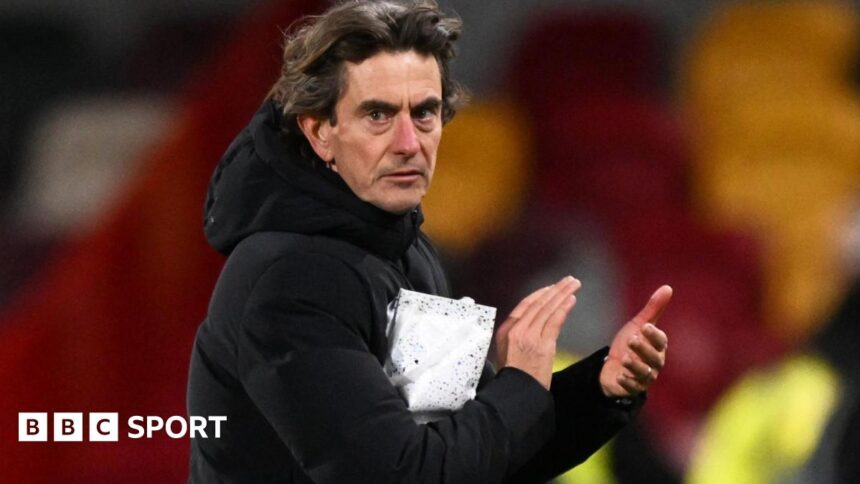
The final whistle at the Tottenham Hotspur Stadium on Sunday did not signal applause, but a familiar, disgruntled chorus of boos. A 1-1 home draw with Sunderland, a side battling relegation, was a result that laid bare the growing chasm between expectation and reality in N17. As pressure mounts on head coach Thomas Frank, his public response has been not a rallying cry, but a striking declaration of boardroom harmony. In a Premier League landscape where managers are falling amid internal strife, Frank insists Tottenham are “completely aligned.” The question now is whether this proclaimed unity is the foundation for a turnaround or merely the calm before the storm.
The Glaring Disconnect: Results Versus Rhetoric
Thomas Frank’s assertion of a club in lockstep arrives at a moment when the tangible evidence points to profound struggles on the pitch. The statistics make for grim reading for the Spurs faithful:
- Winless in their last 10 midweek Premier League games (Tuesday, Wednesday, Thursday).
- Just two victories in their past 11 league outings, a run that has extinguished hopes of a top-four challenge.
- A palpable sense of stagnation, culminating in the audible frustration heard after the Sunderland stalemate.
This context makes Frank’s comments particularly intriguing. While fans witness a team struggling for consistency and identity, the manager is painting a picture of pristine collaboration behind the scenes. He singled out chief executive Vinai Venkatesham for particular praise, calling him “one of the best communicators I ever met” and a maker of “sensible decisions.” This is a clear, strategic message aimed at distinguishing Tottenham’s internal culture from the chaos seen elsewhere.
A Contrast in Chaos: Spurs’ Stability vs. Rival Turmoil
Frank’s emphasis on alignment is no accident. His comments came in the same week the Premier League witnessed two dramatic departures rooted in executive-coach fractures. At Chelsea, Enzo Maresca’s exit followed reported disagreements over transfer strategy with the sporting directors. More explosively, Manchester United parted ways with Ruben Amorim after a very public fallout with the club’s technical director.
In this climate, Frank’s message is clear: Tottenham’s project, however challenging, remains a unified one. He is positioning the club as a bastion of stability in a volatile market. The implied argument is that success built on a solid, communicative foundation is more sustainable than the erratic, reactionary models seen at their rivals. Whether this narrative resonates with fans depends almost entirely on a swift improvement in results. Stability is only a virtue if it leads to progress.
The Midweek Mystery: A Psychological or Tactical Hurdle?
Among the troubling statistics, one stands out as peculiarly persistent: the 10-game midweek winless run in the Premier League. This is more than a quirky footnote; it points to a potential systemic or psychological issue. Analyst speculation ranges from the practical to the mental:
- Recovery and Rotation: Does Frank’s training or post-weekend recovery model leave players physically underprepared for quick turnarounds?
- Squad Depth: Does the lack of quality beyond the first XI become more exposed in these condensed schedules?
- Mental Block: Has the run itself become a self-fulfilling prophecy, where the weight of the record impacts performance?
Addressing this specific curse is a tangible challenge Frank must solve. It is a direct obstacle to climbing the table, as dropping points in these “game in hand” scenarios is a surefire way to stall momentum.
The Venkatesham Vote of Confidence: A Double-Edged Sword
Frank’s lavish praise for CEO Vinai Venkatesham is a fascinating subplot. By stating the club makes “sensible decisions,” he is publicly tying his own fate to the judgment of the board. This is a classic management tactic to reinforce a shared vision and present a united front to the world. It says, “We are in this together, and we have a plan.”
However, this can become a double-edged sword. Should results continue to deteriorate, fans and critics will logically argue that the “sensible decisions”—which include player acquisitions, contract extensions, and ultimately, the retention of Frank himself—are not so sensible after all. The alignment Frank celebrates could then be reinterpreted as a groupthink, insulating the leadership from legitimate criticism. The board’s support for Frank is clear, but in modern football, that support is invariably conditional on points and performance.
Predictions: The Path Forward for an “Aligned” Spurs
The immediate future for Thomas Frank and Tottenham hinges on translating boardroom unity into on-pitch chemistry and results. The coming weeks will be critical. Here is what to expect:
1. The Transfer Window as a Litmus Test: Frank’s comments will be tested in the next transfer window. Will the club back his specific targets, demonstrating the alignment he speaks of? Or will there be signs of the discord that has plagued Chelsea and United? The profile and fit of new signings will be the ultimate proof of concept.
2. Breaking the Midweek Hex: The next midweek Premier League fixture becomes a monumental psychological hurdle. Ending that run could release significant pressure and serve as a turning point, proving the team can translate stable preparation into crucial results.
3. The Patience of the Supporters: The audible boos are a warning. Fans appreciate stability, but not at the expense of ambition. The “alignment” narrative will buy Frank only a limited amount of time. A string of positive results, starting with a convincing performance and win, is the only currency that will truly restore belief.
Conclusion: Unity is the Start, Not the Solution
Thomas Frank has wisely identified the corrosive nature of internal conflict, using the turmoil at rival clubs to highlight Tottenham’s purported strength. A club aligned in vision from the boardroom to the training ground is, without doubt, the optimal model for long-term success. However, in the ruthless economy of the Premier League, alignment is the prerequisite, not the prize.
The stark reality is that Tottenham are not being judged on their meeting room harmony, but on their inability to win football matches, especially under the midweek lights. Frank has successfully framed the club’s internal culture as an asset. Now, he must prove it is an engine for victory. The unity he champions must soon manifest as urgency, creativity, and resilience on the grass. Otherwise, the very alignment he praises will face its greatest test: deciding when the sensible decision must be a change in the dugout. For now, the project remains united. But in football, the clock is always ticking.
Source: Based on news from BBC Sport.