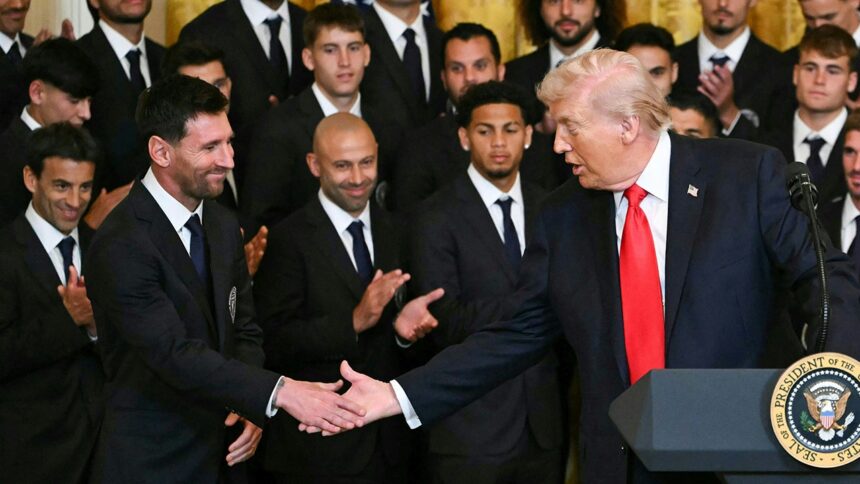
Trump Praises Messi’s Winning Mentality in Historic White House Celebration for Inter Miami
The South Lawn of the White House has hosted countless champions, but on a sun-dappled Thursday, it witnessed a unique convergence of global sport, American politics, and undeniable star power. As President Donald Trump welcomed Inter Miami CF to celebrate their 2025 MLS Cup victory, the spotlight, as it has for two years, found its inevitable focus on Lionel Messi. In remarks that blended his signature style with genuine admiration for athletic triumph, President Trump delivered a pointed commendation to the Argentine icon, cutting through the typical fanfare to highlight the core tenet of competition: winning.
A Presidential Toast to Pure Sporting Merit
The ceremony followed the traditional rhythms of a championship visit—team introductions, the presentation of the gleaming MLS Cup trophy, and celebratory remarks. Yet, President Trump’s words about Messi transcended boilerplate congratulations. He framed the forward’s success within a broader, almost philosophical view of imported sporting talent. “I have to say this. I’ve seen a lot of great players come into the world of sports, and they’ve come from all different countries, all different players,” Trump began, setting the stage for a contrast familiar in his business and political rhetoric: the distinction between hype and results.
He continued, drawing a line between perceived glamour and tangible achievement: “They’ve come, from some cases, from different states. They come to the Yankees, or they come to the Dodgers, or they come from whatever. I’ve seen them come from other countries, and there’s such a glamour [like], ‘Oh, everything’s great.’ But they don’t win.” Then, gesturing toward Messi, he landed the punchline that resonated across sports headlines: “This guy won.” The succinct phrase, “you came in and you won,” became the day’s defining soundbite, a raw acknowledgment of Messi’s immediate and transformative impact.
Messi’s Miami Mission: Beyond the Hype
President Trump’s commentary, while delivered in his unique idiom, touched on a profound truth about Messi’s American chapter. When Messi’s move to Inter Miami was announced in 2023, it was arguably the most hyped transfer in North American sports history. The global icon arrived with unprecedented fanfare, commercial frenzy, and a weight of expectation that could have crippled a lesser competitor. The narrative was about selling tickets, growing the league, and enjoying a victory lap.
Yet, as Trump’s remarks underscored, Messi rewrote that narrative. His mission wasn’t merely to appear; it was to conquer. The analysis from sporting purists is clear:
- Immediate Impact: Messi’s first half-season in 2023 culminated in a Leagues Cup title, delivering silverware almost instantly.
- Cultural Transformation: He elevated the technical standard and tactical awareness of the entire squad, making his teammates demonstrably better.
- Clutch Gene: Throughout the 2025 championship run, Messi delivered in critical moments, embodying the “winner” mentality Trump praised.
- Legacy Cementing: The 2025 MLS Cup victory provided the definitive, book-ending achievement for his American odyssey, proving a superstar of his caliber could be the final piece in a championship puzzle.
Trump’s blunt assessment—”they don’t win. This guy won.”—validates what MLS observers have noted: Messi avoided the fate of other aging legends who came for a paycheck and a profile boost. He came for a crown, and he got it.
The Trump Sports Nexus: A Recurring Theme
This event was not an anomaly but a chapter in President Trump’s long, visible engagement with the sports world. His ownership history, his friendships with figures like Tom Brady and Dana White, and his frequent appearances at major sporting events paint a picture of a president who sees athletic competition as a clear metric of excellence and resilience. Hosting Inter Miami allowed him to connect several of his apparent interests: the spectacle of victory, the appeal of a self-made global brand (Messi), and the promotion of American enterprise (MLS’s growth).
The White House celebration itself was a symbol of soccer’s cemented place in the American mainstream. A decade ago, an MLS team’s visit would have been a minor note. Today, with Messi as its catalyst, it commanded presidential attention and global media coverage. Trump’s ability to identify and amplify the central story—the triumph of a winner under pressure—showed his instinct for the compelling narrative within the sporting spectacle.
Predictions: The Lasting Impact of the “You Won” Era
The reverberations from Messi’s tenure and this presidential acknowledgment will shape MLS and American soccer for years to come. We can anticipate several key developments:
- Elevated Ambition for Marquee Signings: The bar for Designated Player signings is now irrevocably raised. Clubs will seek players with a proven “winner” mentality, not just name recognition. The question will shift from “Can they sell jerseys?” to “Can they deliver a championship?”
- Increased Scrutiny on International Stars: Future aging superstars entering MLS will be measured against the Messi Standard. Did they elevate their team? Did they win the biggest games? Trump’s blunt framing will echo in future analyses.
- Solidification of Miami as a Global Hub: Inter Miami, backed by Jorge Mas and David Beckham, has been validated as a top-tier destination. This White House seal, following a championship, cements their status.
- Political Crossroads with Sport: The event is a reminder that sports, especially at this level of cultural penetration, will continue to intersect with the political realm, offering leaders a platform to connect with a massive audience through shared values of victory and excellence.
Conclusion: A Simple Verdict on a Complex Legacy
In the end, President Donald Trump’s praise for Lionel Messi at the Inter Miami White House celebration distilled a complex two-year saga into a powerful, simple verdict. Amidst the analysis of television deals, attendance records, and sporting legacy, Trump highlighted the irreducible core of professional sports. Lionel Messi arrived in North America amid a cyclone of glamour and expectation that would have suffocated most. He could have merely existed within that glow and been considered a success. Instead, he chose to win. By focusing on that fundamental achievement, President Trump’s remarks—”you came in and you won”—served as a fitting tribute not just to a player, but to the relentless, championship-winning mentality that defines the very greatest athletes in history. For American soccer, the message is clear: the era of coming for glamour is over; the era of coming to win has officially begun.
Source: Based on news from Fox Sports.