Trump’s Surprise World Cup Welcome: A Political Curveball on the Soccer Pitch
The world of international sport and global geopolitics are set for a breathtaking collision this summer, and the latest twist comes from an unlikely source: the Mar-a-Lago estate. In a revelation that has sent shockwaves from the FIFA headquarters to the halls of the Pentagon, FIFA President Gianni Infantino disclosed that former U.S. President Donald Trump has stated Iran is “welcome” to compete in the 2026 FIFA World Cup on American soil. This announcement, emerging from a private meeting between the two controversial figures, throws the tournament’s most politically charged subplot into a state of unprecedented complexity, blending diplomacy, sport, and the specter of a simmering conflict.
A Meeting of Minds at Mar-a-Lago: The Infantino-Trump Summit
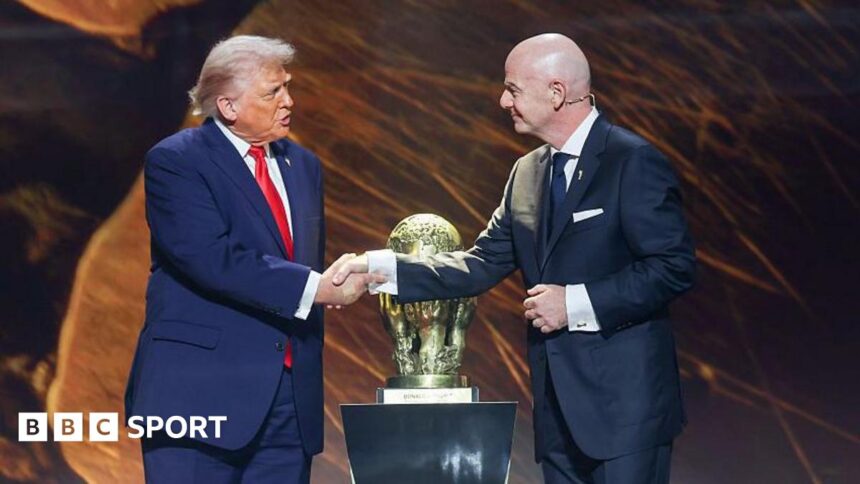
The stage for this stunning development was set this week when Gianni Infantino, the globetrotting president of world soccer’s governing body, met with the former U.S. President at his Florida resort. Infantino took to Instagram to share details of their discussion, which centered on preparations for the monumental 2026 tournament co-hosted by the United States, Canada, and Mexico. The meeting itself, a follow-up to their photographed appearance at December’s World Cup draw, underscores Trump’s continued influence and the political navigation required for a seamless mega-event.
However, the conversation swiftly moved from logistics to geopolitics. “We spoke about the current situation in Iran,” Infantino revealed. It is within this context that he attributed the pivotal statement to Trump: that the Iranian national team, despite the nations being in a state of open hostilities, would be welcomed. This assurance is not merely a sporting courtesy; it is a potential diplomatic lifeline for a tournament that aims to unite the world through soccer. The 2026 World Cup preparations have now become inextricably linked with the most volatile international crisis of the moment.
The Geopolitical Powder Keg: Iran’s Precarious Path to the Pitch
The backdrop to this “welcome” could not be more tense or tragic. Just this month, U.S. and Israeli military strikes targeted Iran, resulting in the reported killing of the country’s Supreme Leader, Ayatollah Ali Khamenei. This act has escalated a long-running shadow war into a direct and devastating confrontation, raising immediate questions about the feasibility of Iran’s participation in a tournament where they are scheduled to play multiple matches on American territory.
Iran’s participation was already a logistical and security nightmare for tournament organizers. The team is slated to play games in:
- Seattle, Washington: A city with a large and active Iranian diaspora.
- Boston, Massachusetts: A major East Coast hub.
- Los Angeles, California: Another center with significant Iranian-American communities.
Each venue presents monumental security challenges, requiring protection for players, officials, and fans amidst what will inevitably be massive political protests and a global media frenzy. The U.S. State Department and Homeland Security agencies, in coordination with FIFA, now face a task of unparalleled scale: ensuring the safety of a delegation from a nation with which the U.S. is actively engaged in military conflict. Trump’s “welcome” does not simplify this; it amplifies the political stakes of making it a reality.
Expert Analysis: Decoding the “Welcome” and Its Ramifications
From a sports journalism and geopolitical perspective, Trump’s statement is a multifaceted maneuver. It cannot be taken at simple face value. First, as a former and potential future president, his words carry weight but not official policy. The ultimate authority on visa issuance and security protocols rests with the current Biden administration, which is navigating a live conflict. Trump’s pronouncement could be seen as an attempt to shape the narrative, positioning himself as a statesman capable of transcending conflict for the sake of sport—a powerful image in an election year.
Second, for Infantino and FIFA, obtaining such an assurance, even from a political figure not in office, is a crucial piece of crisis management optics. It allows FIFA to publicly argue that the highest levels of American political life are committed to an inclusive World Cup. It places the onus on the current administration to not be the entity that blocks participation, potentially painting them as the spoilers of global unity.
For Iran, the dynamic is agonizing. Accepting a “welcome” from a U.S. leader whose administration is blamed for the death of their supreme leader presents an immense internal political challenge. Will hardliners allow the national team to become a symbol of sporting diplomacy under such conditions? The Iranian Football Federation is caught between national pride, political dogma, and the dreams of its players and millions of fans.
Predictions for a Tournament on a Tightrope
The path to the 2026 kick-off is now fraught with uncertainty. Here is what the world can likely expect as this drama unfolds:
- A Visa and Security Standoff: The most immediate hurdle will be the visa process for the Iranian team and affiliated personnel. Expect intense scrutiny, delays, and high-level diplomatic wrangling behind the scenes. The U.S. government will demand unprecedented security cooperation from Iranian authorities.
- Protests and Global Spotlight: Every Iranian match in the U.S. will be a magnet for protests, both from anti-regime Iranian expatriates and from groups opposing U.S. foreign policy. Stadium security will resemble that of a G7 summit more than a sporting event.
- The “Football vs. Politics” Narrative: FIFA and broadcasters will heavily promote the storyline of soccer bridging divides. However, this narrative will be constantly tested by real-world events; any military escalation between now and 2026 could force a last-minute withdrawal or exclusion.
- A Legacy-Defining Moment: How this situation is handled will define the legacy of the 2026 World Cup. It will either be remembered as a triumph of sport over adversity or as a tournament forever shadowed by geopolitical conflict.
Conclusion: A Welcome with a Thousand Caveats
Donald Trump’s “welcome” to Iran for the 2026 World Cup is less an open door and more a highly charged invitation to walk a diplomatic tightwire over an active volcano. It has irrevocably linked the beautiful game to one of the world’s most dangerous conflicts. While the statement from Mar-a-Lago provides Infantino with a valuable soundbite for unity, the practical, security, and political obstacles remain mountainous. The world will be watching not just the matches, but the agonizing journey of a national team caught in the crossfire. The 2026 FIFA World Cup has just become the ultimate test of whether the global soccer pitch can truly serve as neutral ground, or if the beautiful game must finally concede to the ugly realities of war. The final whistle on this issue is still years away.
Source: Based on news from BBC Sport.