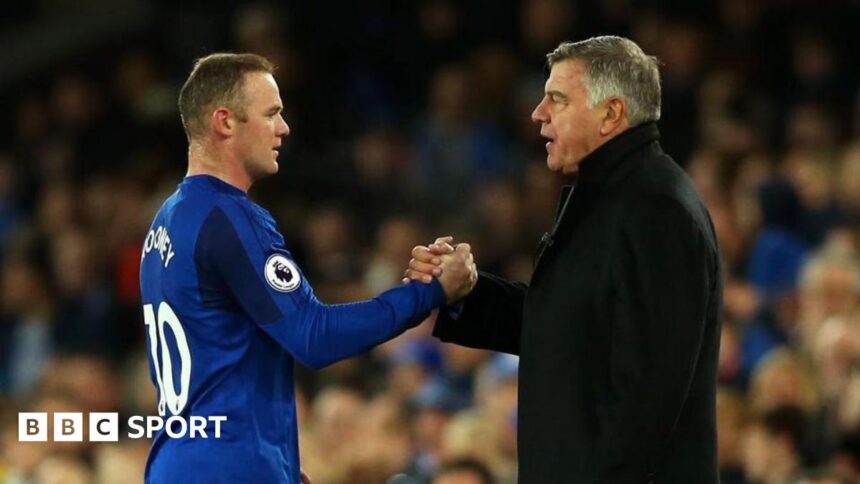
Beyond the Caricature: How Sam Allardyce, Football’s Unlikely Innovator, Shaped Wayne Rooney’s Managerial Blueprint
The world of football management is often painted in broad, simplistic strokes. The firebrand motivator. The tactical obsessive. The pragmatic survivalist. Few figures have been as firmly pigeonholed into that last category as Sam Allardyce. “Big Sam,” the archetypal English manager, famed for set-pieces, defensive solidity, and saving clubs from relegation. Yet, to view him solely through this lens is to miss a crucial, and far more influential, part of his story. Long before “marginal gains” became a sporting cliché, Allardyce was a bona fide pioneer, an early adopter of sports science and holistic performance methods whose influence has quietly rippled through generations. And one of his most attentive students, sitting not in a lecture hall but in the Everton dressing room in 2017, was a global superstar contemplating his next act: Wayne Rooney.
The Innovator in Plain Sight: Deconstructing the Allardyce Method
To understand the impact on Rooney, we must first recalibrate our view of Allardyce. His reputation for “old school” management obscures a career built on relentless curiosity. At Bolton Wanderers in the early 2000s, he assembled a backroom team that was the envy of the Premier League. He employed ProZone data analysis before it was mainstream, used psychologists and introduced cryotherapy chambers. He famously took inspiration from American football, studying their meticulous play-calling and specialist coaching structures.
This wasn’t just gadgetry for its own sake; it was a holistic performance philosophy designed to squeeze every possible percentage point from his players. “He made football simple on the pitch, but the work that went in behind the scenes was incredibly detailed,” Rooney noted. For Allardyce, innovation wasn’t about complexity for the fans; it was about clarity and advantage for his players. He created an environment where science supported sweat, where data informed desire. This foundational approach—building a club’s entire operation around optimising the first team—left an indelible mark on those who experienced it.
Rooney the Apprentice: A Captain’s Education in Modern Management
When Wayne Rooney returned to Everton in the summer of 2017, he was a legend in the autumn of his illustrious playing career. He was also a man with a plan. “At the time I was under Sam I was older and I knew I wanted to go into coaching,” Rooney revealed. This period became a crucial internship. No longer just the star pupil executing a game plan, Rooney began observing the architect.
From his unique vantage point, Rooney absorbed key lessons that would later form the bedrock of his own managerial philosophy:
- Structural Clarity: Allardyce’s methods demonstrated how a clear, well-communicated structure could empower players, not restrict them.
- Margins Matter: The focus on sports science, recovery, and data highlighted how games are won and lost away from the training pitch.
- Adaptability: Witnessing Allardyce’s pragmatic approach to different opponents taught the value of tactical flexibility.
- Man-Management Scale: Managing a dressing room of diverse personalities, from young stars to veteran leaders, was a masterclass in psychology.
For Rooney, this was a bridge between the superstar-centric world he inhabited at Manchester United and the resource-constrained, problem-solving reality of management at clubs like Derby County, D.C. United, and Birmingham City. He saw that management was less about moments of genius and more about constructing a resilient, repeatable process.
The Ripple Effect: Allardyce’s Legacy in the Modern Game
Sam Allardyce’s influence extends far beyond a single protege. He represents a vital, often overlooked, strand in the DNA of English football management. His early work created a template that many now take for granted. The modern manager’s sprawling support staff—featuring specialists in nutrition, biomechanics, and performance analysis—is a direct evolution of the model he championed at Bolton.
Furthermore, his career path proves that pragmatism and innovation are not mutually exclusive. He successfully integrated cutting-edge methods into a traditionally conservative football culture, achieving results that allowed his ideas to gain credibility. This legacy is carried forward not just by former players like Rooney, but by a cohort of coaches and staff who cut their teeth in his innovative regimes. He normalized the quest for an edge, making the manager’s role as much a CEO of performance as a tactical guru.
Rooney’s Road Ahead: Applying the Lessons in a New Era
Wayne Rooney’s managerial journey has been a turbulent baptism, featuring extreme challenges like Derby County’s points deduction and the intense pressure at Birmingham City. Through these trials, the lessons from his time under Allardyce have likely been his constant companions. The need for a strong, clear structure is paramount when morale is low. Leaning on sports science is critical when trying to extract maximum effort from a limited squad. The value of simple, effective communication becomes glaringly obvious in a crisis.
Looking forward, Rooney’s success will hinge on his ability to blend these foundational principles with his own innate footballing intelligence and stature. The prediction here is not for a mere Allardyce replica, but for a synthesis. We will see a Rooney team that is:
- Organised and physically robust—a clear nod to his mentor’s core tenets.
- Unafraid to utilise modern performance technology to gain an advantage.
- Led with the competitive fire and high standards of a former elite captain, adding a layer of demanding excellence on top of the structural base.
His ultimate test will be marrying Allardyce’s pragmatic framework with the creative, attacking verve that defined his own playing career.
Conclusion: A Trailblazer’s Quiet Revolution
The story of Sam Allardyce and Wayne Rooney is a powerful reminder that influence in football is not always loud or glamorous. It is often quiet, practical, and transmitted in the daily grind of a training ground. Allardyce, so often caricatured, was in fact a trailblazer whose openness to new ideas helped modernise the English game from the inside out. Wayne Rooney, the ultimate football superstar, had the foresight to recognise the value in this approach during his final playing years, understanding that great management often lies in the details others overlook.
As Rooney continues to navigate his managerial path, he carries with him the blueprint of an unlikely innovator. It proves that the most enduring lessons aren’t always about breathtaking tactics, but about building a resilient, intelligent, and professional environment where players can perform. In this pupil-mentor relationship, we see the true, unsung lineage of football management—where the quest for an edge is passed down, reshaping the game one pragmatic innovation at a time.
Source: Based on news from BBC Sport.