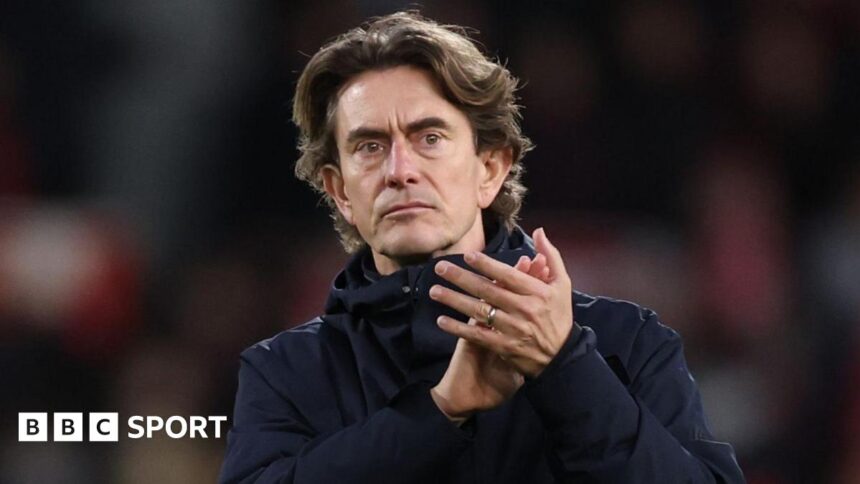
The Frank Divide: Inside the Growing Discontent at Tottenham Hotspur
The away end at the City Ground is typically a bastion of unwavering, if often unrewarded, support. But last Sunday, a gesture from Tottenham Hotspur’s board took on a symbolism they never intended. As each travelling fan was handed a free club scarf, the atmosphere was less one of gratitude and more of grim irony. For at least one supporter, the knitwear became a tool to blot out the horror unfolding on the pitch, a literal and figurative veil against a 3-0 capitulation to Nottingham Forest. That image—a fan hiding behind the club’s own colours—perfectly encapsulates the fractured reality of Spurs under Thomas Frank. The Dane’s record—six wins, six losses, four draws—paints a picture of profound inconsistency. But the story of his embattled tenure is told not just in stats, but in the growing chasm between the dugout, the boardroom, and the stands.
A Tapestry of Trouble: Stats, Style, and Stubbornness
On paper, Thomas Frank’s appointment was a logical, even exciting, next step. The architect of Brentford’s brilliant rise, he promised tactical clarity, data-driven decisions, and a cohesive identity. Sixteen games into the Premier League season, that identity remains frustratingly opaque. The raw numbers reveal a team stuck in neutral:
- Win-Loss Parity: An exact .500 record (6-6-4) is the definition of mid-table mediocrity for a club with top-four aspirations.
- Defensive Fragility: Spurs have kept just three clean sheets, conceding three or more goals on four separate occasions.
- Away Day Blues: The Forest debacle was their fourth away defeat, highlighting a softness on the road.
But the statistics only tell half the story. The more damning evidence is visual. Tottenham’s press is often disjointed, easily bypassed by competent opponents. The transition defense, a hallmark of Frank’s successful Brentford side, has been chaotic. While there have been flashes of the progressive, possession-based football promised—the 2-0 win over Aston Villa a prime example—they are too often followed by performances devoid of intensity and ideas, like the subsequent loss at Fulham. This tactical inconsistency has led to questions about Frank’s adaptability and whether his very specific system can be successfully transplanted to a squad with different pressures and expectations.
The View from the Stands: Scarves, Sighs, and Mounting Anger
Fan sentiment is a volatile barometer, but at Tottenham Hotspur Stadium and on the road, the mercury is falling rapidly. The scarf incident at Forest was not an isolated moment of frustration. Social media channels and fan forums are alight with debate, which has steadily shifted from patient concern to outright anger. The core complaint is not merely the results, but the perceived lack of passion and identity.
“We were sold a project, a vision of a modern, attacking team,” says lifelong supporter and podcast host Anya Sharma. “What we’re seeing feels like a collection of individuals with no clear plan. The football is often slow, predictable, and when we go a goal down, there seems to be no plan B. The scarves on Sunday felt like a placation, but what we need is a performance.”
This disconnect is critical. The free scarf initiative was meant to build unity, yet it coincided with an exhibition that fractured it further. For fans, it underscored a worrying theme: a club more focused on peripheral gestures than on the core product on the pitch. The atmosphere has turned palpably tense, with groans greeting sideways passes and a growing section of the support now openly questioning Frank’s tenure—a stark contrast to the universal goodwill that greeted his arrival.
The Boardroom Calculus: Patience, Investment, and a January Crossroads
Inside the Tottenham Hotspur boardroom, the calculus is more complex. Chairman Daniel Levy and Football Managing Director Rebecca Caplehorn invested significant capital in Frank, both in terms of a substantial compensation package to Brentford and the promise of a long-term rebuild. They are understood to be wary of the revolving door of managers that has plagued rivals and are, publicly at least, maintaining a stance of patience.
However, insiders suggest that patience is not unconditional. The nature of the performances, particularly the lack of a visible game model, is a growing concern. The upcoming January transfer window is now framed as a pivotal moment for Frank’s project. The club is expected to back him with funds, particularly for a dominant central defender and a creative midfielder, but this support comes with heightened expectation.
“The board wants to see that their investment in the manager is translating to progress on the pitch,” notes a senior football journalist with close ties to the club. “They’ll look at the second half of the season and ask: Is there a clear style emerging? Are the players visibly improving? Is the league position trending upwards? If the answer to those is still ‘no’ by May, then the summer could bring a very difficult conversation.”
What Comes Next: Predictions for Frank’s Fate
The immediate fixture list offers little respite, with clashes against top-half rivals looming. Frank’s future now hinges on a rapid reversal of momentum. Several paths seem possible:
- The Rally (Most Likely Short-Term): Frank secures targeted reinforcements in January who perfectly fit his system. The team clicks, strings together positive results, and finishes strongly in the top seven, buying him a crucial second season.
- The Stalemate (A Dangerous Middle Ground) Spurs continue their inconsistent form—impressive wins followed by baffling losses. They finish 8th-10th. In this scenario, the board’s summer decision becomes a true dilemma, with fan discontent making continuity a major risk.
- The Unraveling (The Worst-Case Scenario): The poor form deepens, the atmosphere turns toxic, and Spurs find themselves in the bottom half by March. This would almost certainly force the board’s hand, resulting in a premature managerial departure.
The most probable outcome remains that Frank will see out the season. The board’s institutional preference for stability and the significant investment in his project are powerful insulating factors. However, the goodwill and long-term credit he arrived with have been severely depleted. He is no longer judged on the promise of a project, but on the stark, weekly evidence of the pitch.
Conclusion: More Than a Bad Day at the Office
The story of Thomas Frank at Tottenham is no longer about a new manager finding his feet. The free scarves at the City Ground will endure as a potent symbol of this era: a well-intentioned act of unity that instead highlighted a profound disconnect. The fans are shielding their eyes, the stats show a team going nowhere, and the insiders are watching the balance sheet and the league table with equal anxiety.
Frank’s challenge now is existential. He must prove that his celebrated philosophy can work at this level, with this squad, under this glare. It requires more than points; it requires a visible, compelling identity that can reconnect a disillusioned fanbase with their team. The alternative is that his tenure becomes defined by that single, surreal image: a Tottenham scarf, handed out by the club, used by a supporter to look away from the very thing it is supposed to represent. The clock is ticking to ensure that moment was an aberration, and not the defining metaphor of the Frank era.
Source: Based on news from BBC Sport.