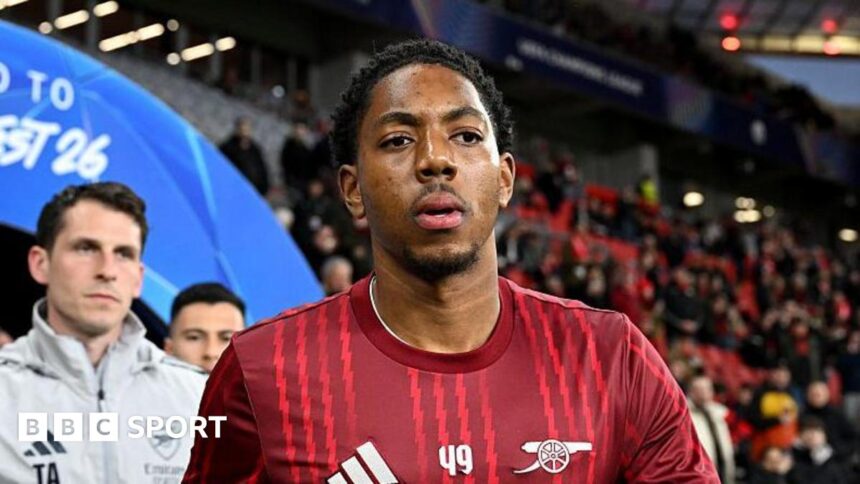
The Myles Lewis-Skelly Conundrum: From Wembley Hero to Arsenal’s Tactical Puzzle
The trajectory of a young footballer is rarely a straight line. For every prodigy who ascends seamlessly to stardom, there are a dozen whose paths are defined by peaks, troughs, and the immense pressure of adaptation. At the heart of one of the Premier League’s most intriguing narratives sits Myles Lewis-Skelly, the Arsenal teenager whose meteoric rise has hit a plateau, leaving fans and pundits alike to ask: what’s next for the gifted defender?
Just under a year ago, the image was indelible: a 19-year-old Lewis-Skelly, brimming with composure beyond his years, marshalling Arsenal’s left flank against the galactic might of Real Madrid in a Champions League quarter-final. His performances were so commanding that he was being penciled in as England’s starting left-back for the impending World Cup. Fast forward to the present, and the reality is more complex. With 12 starts across all competitions this season, he is no longer an automatic pick, embroiled in a fierce battle for minutes at the Emirates. This is the story of a breakout star navigating the difficult second act.
The Meteoric Rise: A Perfect Storm of Talent and Opportunity
To understand Lewis-Skelly’s current situation, one must first appreciate the astonishing velocity of his ascent. The 2024-25 campaign was, by design and necessity, Myles Lewis-Skelly’s breakout season. A crippling injury crisis at Arsenal thrust the academy graduate into the first-team spotlight, and he seized it with both hands. His blend of athleticism, technical security, and defensive intelligence belied his age. He wasn’t just filling a gap; he was enhancing the side.
This club form precipitated a whirlwind on the international stage. In March of last year, Lewis-Skelly etched his name into the history books, becoming the youngest man to score on their England debut, coolly slotting home the opener in a 2-0 win against Albania at Wembley. The culmination of this golden period was a deserved five-year contract with Arsenal in the summer, a statement of faith from the club in their homegrown talent. The future seemed not just bright, but guaranteed.
The Tactical Squeeze: Why Game Time Has Hardened
The current campaign has introduced new variables into Lewis-Skelly’s equation. The return to full fitness of senior defenders has naturally increased competition. However, the shift is more nuanced than a simple numbers game. Manager Mikel Arteta’s tactical evolution has also played a significant role.
Arteta has increasingly favored a system that demands specific, hybrid qualities from his full-backs. The role often requires:
- Inverted movement into central midfield to create overloads.
- Exceptional ball retention under intense pressure in confined spaces.
- A high-volume passing output, often acting as a secondary playmaker.
While Lewis-Skelly is a superb modern defender, his core strengths have traditionally been seen in more orthodox, high-and-wide positioning, utilizing his pace and crossing ability. The competition for his spot isn’t just against other left-backs; it’s against players Arteta may view as more naturally suited to this inverted brief. This tactical nuance is the crucible in which young players are either molded or marginalized.
Expert Analysis: Development Isn’t Linear
From a development perspective, Lewis-Skelly’s season should not be viewed as a regression. “What we are witnessing is the standard, often painful, phase two of a top talent’s career,” notes a prominent youth development analyst who has followed his journey. “The first phase is surprise and explosion. The second is opposition analysis and adaptation. Teams now have a full dossier on him. They know his tendencies. The challenge for Myles is to add layers to his game, to develop the tactical flexibility that Arteta demands.”
The 12 starts in all competitions remain a significant tally for a teenager at a club with title ambitions. They represent trust, but perhaps a more measured, long-term trust. His minutes are now being managed not out of necessity, but as part of a strategic plan. The key for Lewis-Skelly is to use each opportunity—whether a cup start or a league substitute appearance—to demonstrate he can be more than a brilliant traditional full-back, but a versatile, tactical weapon.
Future Predictions: Patience, Versatility, and a Potential Role
Predicting the next 18 months for Myles Lewis-Skelly involves reading the tea leaves of Arteta’s philosophy and the club’s trajectory. Several paths are possible:
- The Inverted Apprentice: Lewis-Skelly dedicates himself to mastering the inverted role in training, adding the required central midfield skills to his defensive base, eventually making the position his own.
- The Tactical Wildcard: He becomes a specific tactical option—the man Arteta turns to when he needs pure width, defensive solidity against a top winger, or a different look in the final 20 minutes of a game.
- The Loan Question: If game time diminishes further, a high-level loan to a Premier League rival where he would start every week could be a compelling option to reignite his momentum, though Arsenal may be reluctant given their squad depth needs.
The most likely scenario is a blend of the first two. Lewis-Skelly’s five-year contract signals he is in Arsenal’s long-term vision. His challenge is to evolve from a revelation into a reliable, multifaceted component.
Conclusion: A Chapter, Not The Story
The narrative around Myles Lewis-Skelly has subtly shifted from “next big thing” to “work in progress.” This is not a demotion, but a natural recalibration. The football world has a short memory and an impatient appetite, but true development at the elite level requires weathering these periods of uncertainty.
His historic England debut goal and his heroics against Real Madrid were not flukes; they were proof of transcendent potential. The current fight for minutes is the less glamorous, but equally vital, test of his mentality and adaptability. For Arsenal fans, the sight of a fully-developed Myles Lewis-Skelly—combining his explosive breakout qualities with refined tactical intelligence—remains a thrilling prospect. His story is far from written; this is merely the complex, compelling chapter where a star learns to shine in a different light.
Source: Based on news from BBC Sport.