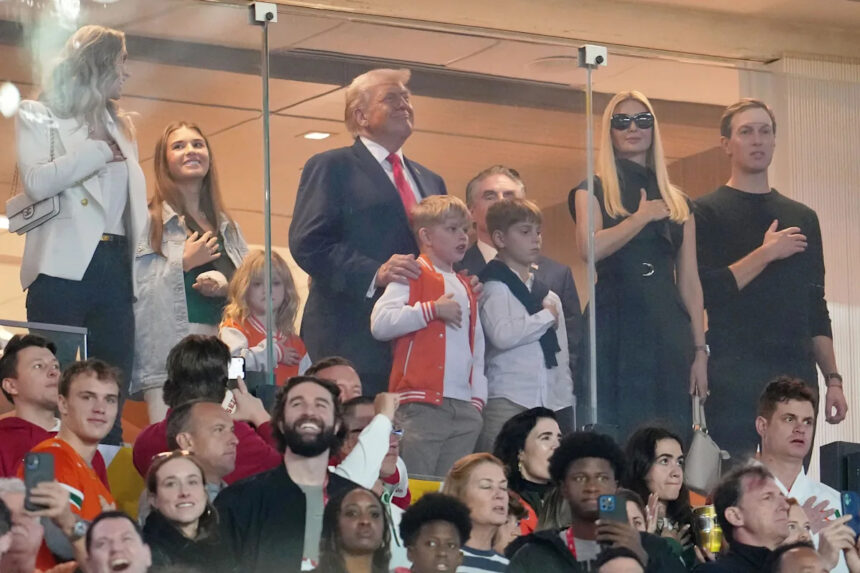
Who Was in President Trump’s Championship Game Entourage? A Breakdown of the Indiana-Miami Box
The roar of the crowd at Hard Rock Stadium wasn’t just for the opening kickoff. On Monday night, as the Indiana Hoosiers and Miami Hurricanes battled for the college football crown, a different kind of spotlight swung to the luxury suites. President Donald Trump’s attendance at the College Football Playoff National Championship became an instant subplot to the on-field drama. While the game itself delivered historic moments, the political and cultural tableau forming around the 45th President offered a fascinating glimpse into his public strategy and personal alliances. The question on everyone’s mind, amplified by the ESPN broadcast cutaways: just who was sitting with Donald Trump at the national championship game?
A Florida Homecoming: Political and Personal Alliances on Display
President Trump’s appearance in Miami Gardens, Florida, was far from a solitary affair. His box was a curated mix of political power, local influence, and personal loyalty, reflecting both the venue’s geography and his administration’s posture.
Most prominently seated alongside the President was Secretary of State Marco Rubio. The presence of the Miami alumnus and former Florida Senator was rich with symbolism. It signaled a continued alliance between Trump and a once-fierce Republican primary rival, now a key figure in the administration’s foreign policy apparatus. Rubio’s local credibility and shared Sunshine State roots provided a natural bridge to the crowd, which met Trump’s on-screen appearance with predominantly enthusiastic cheers.
But the guest list extended beyond Rubio. The box also included:
- Florida Governor Ron DeSantis: A staunch Trump ally whose political rise has been closely tied to the President’s support. His presence underscored the importance of Florida as a political bastion.
- Several members of the Trump family: While not all were visible in every shot, the First Family’s attendance at major sporting events has been a consistent feature of the administration, blending official presence with personal leisure.
- Key political donors and allies: As is customary for such high-profile events, the suite likely included influential supporters, a practice that merges the optics of presidential access with the realities of political networking.
The “Sports Presidency”: Analyzing Trump’s Arena Strategy
President Trump’s appearance at the Indiana-Miami matchup was not an isolated incident. It was a deliberate chapter in what political observers have termed his “sports presidency.” Since taking office, Trump has made a concerted effort to embed himself within the fabric of American sporting culture, a arena that traditionally commands bipartisan, broad audience appeal.
This strategy serves multiple purposes. First, it projects an image of vigor and connectivity with mainstream American passions. By attending the Super Bowl, the Army-Navy Game, UFC events, and now the college football championship, Trump positions himself within celebratory, patriotic environments often saturated with military flyovers and national anthem performances. The Hard Rock Stadium crowd reaction—a mix of loud cheers and some audible boos—is a microcosm of his broader appeal and division, but the setting itself is inherently positive.
Second, these appearances generate massive, unfiltered media coverage. The ESPN broadcast shots, the crowd reaction videos, and the subsequent social media discussion provide a powerful alternative to traditional political press channels. The imagery is direct and potent: the President, surrounded by cheers, at the nation’s biggest sporting events.
Finally, it continues a tradition with modern precedent. While Trump was the first sitting president to attend a Super Bowl, others like George W. Bush (throwing out the first pitch after 9/11) and Barack Obama (filling out NCAA brackets, attending NBA finals) have used sports to communicate resilience, normalcy, or common ground. Trump’s approach, however, is notably more frequent and staged within events that often directly intersect with debates over national anthem protests, linking his appearances to broader cultural conversations.
Beyond the Suite: The Game as a Political Backdrop
The choice of this particular game was itself strategically sound. The matchup between Indiana and Miami placed Trump in the critical swing state of Florida, bolstering local allies like DeSantis and Rubio. Furthermore, by attending a college football event, he engages with a sport deeply rooted in American heartland culture and with a powerful tradition of patriotism in its pre-game ceremonies.
The broadcast focus on Trump during the national anthem was undoubtedly anticipated. In an era where the anthem has become a flashpoint for social protest, his presence during that moment is a powerful, unspoken statement of his administration’s stance. The crowd’s largely positive response in the stadium, as reported, provides the desired visual and auditory backdrop for that message.
It also created a unique moment of bipartisan overlap. Sports, especially championship events, temporarily suspend partisan divisions for many fans. Trump’s presence inserts him into that unified space, however briefly or controversially, allowing his image to be associated with collective national celebration rather than political fray.
Predictions: The Future of the Presidential Sports Box
Looking ahead, we can expect this strategy to continue and possibly intensify as the political calendar advances. The presidential sports box will remain a versatile tool.
- Campaign Trail Extension: Major events in battleground states will become prime opportunities for curated appearances, blending official duty with campaign optics.
- Alliance Reinforcement: The guests seated beside the President will be read as signals of political health and loyalty. Expect key senators from host states or rising stars within the party to receive invites.
- Cultural Commentary: Attendance at events like the NASCAR Daytona 500, the MLB World Series, or future college championships will continue to serve as a platform for engaging with—and shaping—broader cultural discussions around patriotism and tradition.
The reaction from sports leagues and broadcasts will also be telling. ESPN’s decision to show the President, and the timing of those cutaways, itself becomes part of the story, demonstrating how sporting events are navigating their role in an increasingly politicized landscape.
Conclusion: More Than a Game Day Photo Op
So, who was Donald Trump sitting with at the national championship? He was seated with a carefully selected group representing political consolidation, local power, and personal loyalty. But the question and its answer reveal a deeper truth about modern political communication. The luxury suite at Hard Rock Stadium was more than a seat; it was a stage. The Indiana-Miami championship game was more than a football contest; it was a backdrop of national unity and passion. In this environment, President Trump’s appearance, flanked by Secretary Rubio and Governor DeSantis, was a strategic act of political theater designed to resonate far beyond the final whistle. It reinforced alliances, projected presidential stature within a beloved American tradition, and ensured that amidst the analysis of offensive schemes and defensive stands, the narrative of the “sports presidency” continued its relentless forward march. In the era of Trump, the box seat has become a powerful bully pulpit, and the roar of the crowd, for or against, is all part of the calculation.
Source: Based on news from Yahoo Sports.