Who Slept Best Last Night? Toto Wolff, After Mercedes’ Masterclass Exposes 2026 F1 Charade
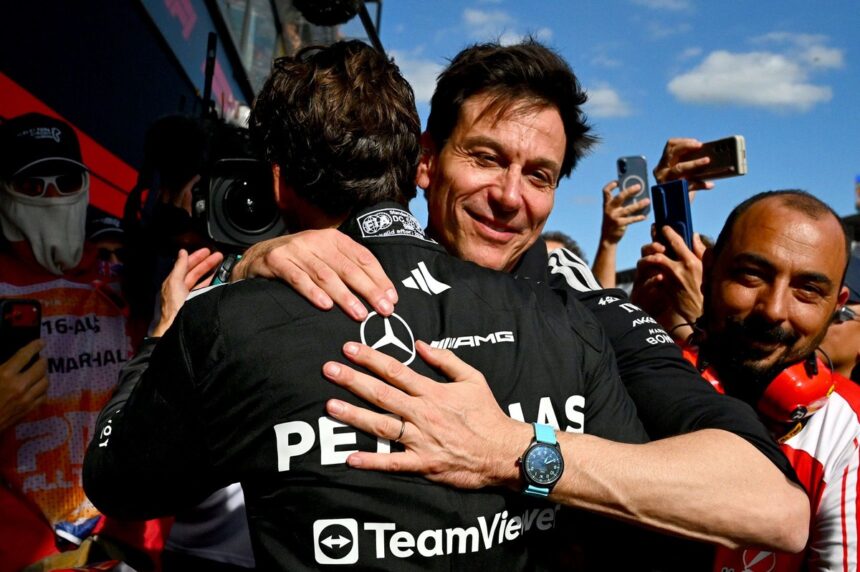
The question echoing through the Formula 1 paddock in Melbourne wasn’t just about pole position. It was a quieter, more profound inquiry whispered in motorhomes and murmured in debriefs: who slept the soundest last night? The answer, after a seismic Australian Grand Prix qualifying, is unequivocal. Toto Wolff, the Mercedes team principal, finally enjoyed a deep, untroubled slumber, his long-game strategy of calculated deception having paid off with devastating effect. While rivals spent the winter parsing lies, Mercedes was building a monster.
The Great Sandbagging Heist: How Mercedes Fooled the Grid
Let’s be blunt: the pre-season narrative was a farce, and Mercedes authored it. The so-called “testing” was a theatrical performance of the highest order. The W17, laden with metaphorical sandbags, trundled around circuits, posting times that suggested a midfield scrap. The press, ever hungry for a story, played along. But the clues were there for those who read between the lines.
The most telling moment wasn’t a lap time; it was a race simulation. On just the second day of running, Kimi Antonelli completed a full race stint. This wasn’t a team struggling with a concept; this was a team conducting a precise, confident systems check. They weren’t learning to walk; they were practicing their sprint. The foundation of their 2026 F1 prepared campaign was already rock-solid while others were still laying bricks.
Then came the psychological games. The childish, almost insulting campaign to suggest Red Bull held the power unit advantage. “People dressed in kits with three-pointed star shirts” peddling a tale so transparent it was laughable.
- Strategic Misdirection: They created a smoke screen around engine performance to hide chassis and aero gains.
- Data Blackout: By not showing single-lap pace, they gave rivals nothing concrete to react to or benchmark against.
- Psychological Warfare: It forced doubt into rival teams, making them question their own data and progress.
As one senior engineer from a rival team conceded off the record: “We knew they were hiding, but we didn’t dare guess the scale.”
Melbourne Unmasking: The W17’s Terrifying True Pace
The facade began to crack on Friday in Melbourne. During the long runs, George Russell’s race pace was described by multiple team bosses as “scary.” The consistency and tire management displayed were a sledgehammer to the assumptions of winter. Those who had bought Wolff’s February fables were abruptly sobered.
Saturday, however, was a brutal unveiling. The sandbags came off completely. In Q3, under the bright Australian sun, George Russell didn’t just secure pole; he eviscerated the field. A massive 0.8s gap to the nearest non-Mercedes car isn’t a margin; it’s a statement of total dominance. It’s the kind of gap that rewrites development timelines and sends panic through competitor factories. This was no fluke or fuel-light miracle. This was the raw, unfiltered output of a car operating in a different conceptual window.
The Mercedes W17 revealed its core strengths:
- Low-Speed Mechanical Grip: Dominant through the final sector’s twists.
- High-Speed Aero Stability: Unshakable in the fast sweeps of Turns 1-2.
- Engine Deployment: That “inferior” power unit delivered seamless, brutal power out of corners.
Russell’s lap was a masterpiece, but it was painted with brushes engineered in total secrecy.
Antonelli’s Ascent and the Wolfpack’s Resurgence
While Russell delivered the headline, the subplot is equally compelling: the seamless integration of Andrea Kimi Antonelli. The rookie’s calm demeanor belies a preternatural talent, honed not in public view but in the private, pressure-cooked crucible of Mercedes’ internal program. His composure during that early race simulation was a signal. In Melbourne, matching his more experienced teammate for pace in sectors throughout qualifying, he proved he is not a passenger in this resurgence but a key component of it.
This points to a larger cultural shift within Mercedes. The “diva” cars of recent years are gone. The W17 appears to be a predictable, stable platform that both drivers can exploit to the limit. This unlocks not just performance, but strategic flexibility and development clarity. The team is no longer fighting its own car; it’s weaponizing it. The Silver Arrows showed up not just with a fast car, but with a unified, confident wolfpack, from the strategy wall to the cockpit.
2026 Prognosis: A New Era of Silver Dominance?
One qualifying session does not win a championship, but a performance gap of this magnitude in the modern, hyper-convergent era of F1 is a five-alarm fire for Red Bull, Ferrari, and McLaren. Mercedes hasn’t just found a tenth; they’ve unlocked a new formula.
The predictions for the rest of 2026 are now fraught with Mercedes-shaped caveats:
- Development War: Can rivals close a gap that large before Mercedes’ own upgrade cycle widens it further?
- Strategic Pressure: With a car this fast, Mercedes can afford to be aggressive on strategy, forcing errors from pursuers.
- Psychological Blow: The morale boost for Mercedes and the doubt sown in rivals cannot be underestimated. Momentum in F1 is a tangible force.
The most terrifying prospect for the grid is that this might only be the beginning. With a stable regulatory platform, Mercedes’ deep resources and now-clear technical direction could see this advantage solidify. The team that mastered the hybrid era early may be poised to do the same for this new chapter.
Conclusion: The Sound of Silence in Brackley
So, who slept best last night? The evidence is incontrovertible. While rival team principals stared at ceiling tiles, running simulations of damage limitation, Toto Wolff rested easy. His sleep was earned not by a single lap, but by the flawless execution of a months-long plan of secrecy, innovation, and misdirection. The childish games of winter were a calculated gambit, and the pot he has claimed is a dominant car and a terrified grid.
The 2026 season was supposed to be a question. After Melbourne qualifying, Mercedes provided a thunderous, unequivocal answer. The sandbags are gone, replaced by the gleaming silver of a machine built not just to compete, but to conquer. For the first time in years, the hunter has become the hunted, and the sound you hear is the rest of Formula 1 scrambling to wake up from a nightmare engineered in Brackley.
Source: Based on news from Yahoo Sports.