Beyond the Podium: Why ParalympicsGB’s Single Medal in Beijing Signals a New Dawn
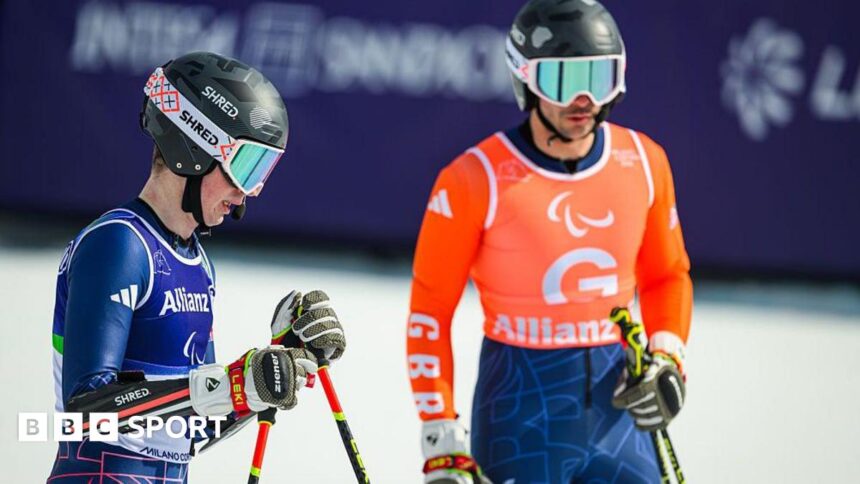
As Neil Simpson, guided by the voice of Rob Poth, straddled a gate at the start of his slalom run on Sunday, the moment was a poignant metaphor. It captured the fine margins and formidable challenges of elite sport, and perhaps summed up the entire Beijing 2022 Winter Paralympic campaign for Great Britain. With that stumble, a potential second medal evaporated, leaving the team with a solitary, shining achievement: Simpson and Poth’s superb silver in the visually impaired alpine combined. One medal marks the nation’s lowest tally since the blank of Vancouver 2010, a stark contrast to the six or more won at every Games since. In the stark arithmetic of elite sport funding—with just over £7m invested over the quadrennial—the ledger appears lean. Yet, to view this outcome as a failure is to misunderstand the narrative. Dig deeper, and a story of resilience, strategic realignment, and genuine optimism for the future emerges.
A Medal Forged in Partnership and Promise
To appreciate the present, one must first celebrate the achievement that defines it. The silver medal won by Neil Simpson and guide Rob Poth was no consolation prize; it was a landmark moment of exceptional quality. At just 19, Simpson, guided by his brother’s childhood friend, became Britain’s first male alpine skier to win a Winter Paralympic medal. Their performance in the alpine combined—a gruelling test of both speed and technical skill—was a masterclass in trust and precision. In a classification dominated by legends, they announced the arrival of a new force. This medal is the cornerstone of GB’s positivity, a tangible return on investment and proof that world-class success is possible within the current programme. It provides not just a memory, but a beacon for every aspiring athlete in the system.
The Crucible of Challenge: Why Beijing Was Always a Mountain
The results sheet requires context. ParalympicsGB’s leadership had been candid in the years building up to Beijing: replicating the highs of Sochi 2014 (six medals) or PyeongChang 2018 (seven medals, including a gold) was a monumental ask. Several converging factors created a uniquely challenging environment:
- An Unprecedented Athlete Transition: The team experienced a seismic generational shift. Legendary figures like multiple medal-winners Menna Fitzpatrick and Millie Knight were still present, but Knight was recovering from her seventh concussion, and Fitzpatrick was adapting to a new guide. The foundational stars of previous cycles were in various stages of rebuilding.
- The Impact of the Pandemic: For winter sports, COVID-19 was particularly devastating. Lost training camps, cancelled crucial competition miles, and restricted access to European slopes and snow deprived developing athletes of irreplaceable experience. For a nation without alpine mountains, this was a critical disadvantage.
- Intense Global Competition: The global Paralympic movement has exploded. Nations have professionalised, and the depth of talent in sports like Nordic skiing and snowboarding has increased exponentially. Medals are now fought for in fiercely contested fields where tenths of a second separate podium finishes.
As one team insider noted, this was a “development Games” in the truest sense. The £7m investment from UK Sport was not a guarantee of a medal haul, but a lifeline to navigate these storms and build for the future.
Seeds of Optimism: The Successes Beyond the Medal Count
The true source of GB’s positive outlook lies not in what was won, but in what was demonstrated. Look beyond the podium, and the performances spark genuine excitement.
In para snowboard, the emergence of young talent was breathtaking. Ollie Hill, in his first Games, delivered three top-10 finishes, including a stunning fourth place in the banked slalom, missing bronze by a mere 0.77 seconds. James Barnes-Miller also secured a fourth place. These are not also-ran results; they are statements of intent from athletes who will be in their prime for Milano-Cortina 2026.
In alpine skiing, despite the setbacks, there were flashes of brilliance. Menna Fitzpatrick and guide Katie Guest battled valiantly for top-five finishes, showcasing the champion’s mentality that remains. Newcomers gained invaluable experience on the biggest stage, a currency that cannot be bought.
Perhaps most tellingly, in Nordic skiing—a traditionally tough discipline for GB—Scott Meenagh achieved a historic milestone. He secured Britain’s best-ever cross-country skiing results at a Paralympics, with four top-10 finishes. This breakthrough in a high-participation sport points to systemic growth and technical progress.
Building for Milano-Cortina 2026: A Blueprint in Progress
The post-Beijing analysis is not one of regret, but of calibration. The strategic focus for ParalympicsGB is now sharply fixed on the 2026 Winter Games in Italy. The lessons from Beijing are clear:
- Accelerate the Development Pathway: Ensuring the likes of Ollie Hill, Neil Simpson, and others have consistent, high-level competition and training access is paramount. The pipeline must flow smoothly.
- Consolidate in Strength: Building on the snowboard and alpine skiing foundations, while strategically targeting areas like Nordic for continued improvement.
- Harness Experience: The athletes who faced the crucible of Beijing will return wiser, tougher, and more prepared for the pressures of an Olympic cycle.
The investment, while scrutinised, has kept the engine running. It has funded the coaches, the sports science, and the support network that allows athletes to even reach the start gate. The argument from UK Sport and ParalympicsGB is that this cycle was about protecting the flame, not expecting a bonfire.
Conclusion: The Silver Lining is a Foundation
Yes, one medal is a modest return by recent historical standards. But to judge ParalympicsGB’s Beijing 2022 solely on that metric is to miss the point entirely. This was a Games of transition, contested in the most trying of global circumstances. The single medal from Neil Simpson and Rob Poth stands as a testament to enduring excellence, while the host of near-misses and top-tier finishes from a new generation signal a wave of potential gathering force.
The positivity within the camp is not spin; it is the rational confidence of a programme that has navigated its toughest quadrennial in recent memory and emerged with its core intact and its future bright. The seeds have been sown in the hard-packed snow of Beijing. With careful nurturing, strategic investment, and the raw talent now in the system, the harvest in the Italian mountains of 2026 could be plentiful. The story of Beijing is not one of decline, but of a necessary recalibration. The journey to the podium is often a marathon, not a sprint, and Great Britain has just completed its most important leg.
Source: Based on news from BBC Sport.