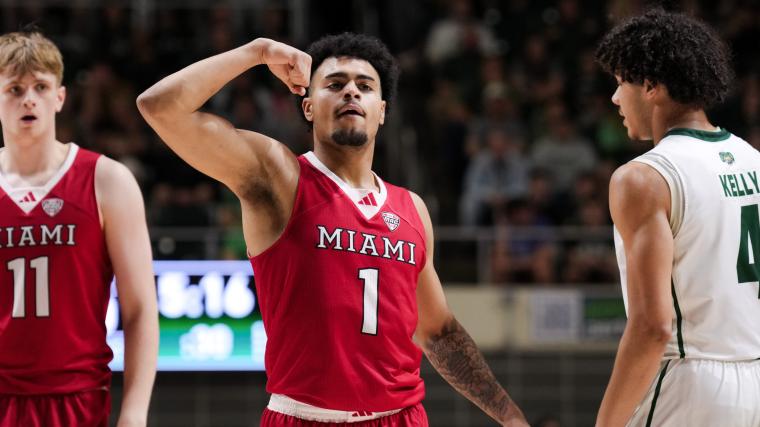
Will Miami (Ohio) Still Make March Madness? Analyzing the Stakes After a Stunning First Loss
The zero is gone. The perfect, pressure-packed, historic 31-0 regular season run by the Miami (Ohio) RedHawks met a cruel and sudden end in Cleveland, not in the bright lights of the MAC championship, but in the tournament quarterfinals. An 87-83 loss to UMass has sent shockwaves through college basketball, transforming the narrative from a celebration of perfection to a fraught debate about postseason worthiness. For Travis Steele’s squad, the dream of an undefeated MAC Tournament crown is over. But the central, agonizing question remains: will their 31-1 record be enough to secure an at-large bid to the 2026 NCAA Tournament?
The Resume: A Tale of Two Columns
To understand Miami (Ohio)’s precarious position, one must dissect the two starkly different columns of their resume. On one side, the sheer weight of the win total is undeniable. Going unbeaten in the regular season, regardless of conference, is a monumental achievement that only a handful of teams in history have accomplished. It speaks to remarkable consistency, mental fortitude, and dominance within their scheduled framework.
However, the other column reveals the core of the Selection Committee’s dilemma. The RedHawks’ non-conference schedule, often a key metric for at-large teams, was notably soft. Their best win outside the MAC likely came against a middling power conference team or a strong mid-major, lacking the “Quad 1” victories that are the currency of the modern NCAA Tournament bid. Their strength of schedule (SOS) and net ranking, despite the gaudy record, likely languish outside the typical at-large range.
Key Resume Strengths:
- 31-1 Overall Record: An undeniable attention-grabber with historical context.
- Undefeated Regular Season: Demonstrates supreme consistency and conference dominance.
- MAC Regular Season Champions: Clear, uncontested supremacy over the league’s double-round-robin.
Key Resume Weaknesses:
- Lack of Quad 1 Wins: The most glaring hole on the sheet, critical for at-large consideration.
- Weak Non-Conference Schedule: Fails to prove they can beat tournament-level teams.
- Bad Loss (by seed): Losing to UMass, likely a lower-tier MAC team, in the conference quarterfinals is a catastrophic result in the committee’s eyes.
- Untested in High-Pressure Games: Until the UMass loss, they had not faced a true “win or go home” scenario against a desperate team.
The UMass Loss: A Fatal Blow or a Wake-Up Call?
The nature of the loss itself is devastating. Falling in the MAC Tournament quarterfinals is not like losing in the championship game. It eliminates the “they got hot at the wrong time” excuse and amplifies the “they couldn’t handle the moment” narrative. For the Selection Committee, a conference tournament is a proxy for the NCAA Tournament environment—neutral site, single-elimination, heightened pressure. Miami (Ohio) did not just lose; they stumbled at the first hurdle, which will significantly undermine confidence in their ability to compete on the national stage.
This result will inevitably lead committee members to question the validity of the 31-0 record. Was it built on a schedule incapable of preparing them for March? The UMass game, unfortunately, becomes the primary data point supporting that theory. It transforms their resume from a unique, puzzling case into one with a definitive and damaging blemish.
The Committee’s Dilemma: History vs. Metrics
The NCAA Selection Committee now faces its most public and difficult decision in recent memory. They are tasked with balancing two opposing philosophies:
The Case FOR Inclusion: Excluding a 31-1 team would be unprecedented in the modern era. It would send a message that scheduling aggressively is the only path, potentially harming regular season integrity across mid-major conferences. The RedHawks did everything asked of them in the regular season, winning every single game. Their body of work, the argument goes, is 32 games, not one. They deserve a chance to prove their mettle on the biggest stage.
The Case AGAINST Inclusion: The committee’s mandate is to select the 36 best at-large teams based on resume, not storylines. Metrics like NET, SOS, Quadrant records, and performance away from home are the standardized tools used to compare teams from different conferences. By nearly every one of those metrics, Miami (Ohio) will fall short compared to other bubble teams from power conferences who played tougher schedules and secured marquee wins, even if they have 8-10 losses. Including the RedHawks would mean excluding a team with a “better” resume by the established criteria.
Expert Analysis and Prediction: On the Wrong Side of the Bubble
As a seasoned observer of the March Madness selection process, the evidence points toward a heartbreaking omission for Miami (Ohio). Here’s why:
The committee has consistently shown that “who you beat” matters more than “how many you beat.” A power conference team with a 19-13 record but three Quad 1 wins and a top-30 strength of schedule will almost always get the nod over a mid-major with a sparkling record built on a weak schedule. The UMass loss provides the perfect “out” for the committee. It allows them to say, “We considered their historic record, but their inability to win their conference tournament and their lack of high-quality wins left us no choice.”
Prediction: Miami (Ohio) will be one of the first four teams left out of the 2026 NCAA Tournament field. They will be a No. 1 seed in the NIT, where they will be rightly celebrated and have a strong chance to make a deep run in New York. Their story will become the ultimate cautionary tale for mid-major programs: schedule aggressively in November and December, or risk having a historic season rendered meaningless by the metrics of March.
The legacy of this Miami (Ohio) team is secure in Oxford and in the annals of MAC history. But in the cold, analytical eyes of the Selection Committee, their perfect 31-0 run is likely to be remembered as a magnificent, yet ultimately insufficient, answer to the complex question of who belongs in the Field of 68.
Source: Based on news from Yahoo Sports.