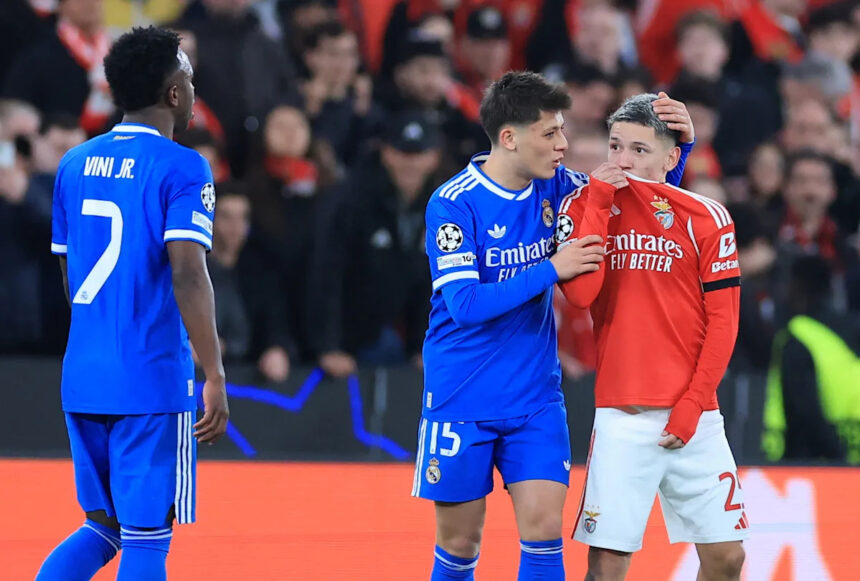
FIFA Extends Ban Worldwide: Gianluca Prestianni’s Copa América and World Cup Hopes in Jeopardy
In a seismic development that has sent shockwaves through the international football community, FIFA’s Disciplinary Committee has confirmed a worldwide extension of the suspension imposed on Benfica forward Gianluca Prestianni. The decision, first reported by The Athletic and corroborated by Spain’s AS, means the Argentine prodigy could now miss critical matches for his national team, including the upcoming Copa América and potentially the 2026 World Cup cycle.
- The Incident: What Happened Between Prestianni and Vinicius Jr.?
- Expert Analysis: How This Impacts Argentina’s Copa América and World Cup Plans
- What Prestianni’s Future Looks Like: Appeals, Reputation, and Career Trajectory
- The Bigger Picture: Football’s Fight Against Racism Faces a New Test
- Strong Conclusion: A Career on the Brink
According to a FIFA spokesperson who spoke on Wednesday (6), the committee “has decided to extend the six-match suspension imposed by UEFA on SL Benfica player Gianluca Prestianni so that it has effect worldwide.” The original ban was handed down by UEFA for “discriminatory conduct” during a Champions League group-stage match against Real Madrid, where Prestianni was accused of directing racist insults toward Brazilian forward Vinicius Jr.
This is not just a club-level punishment. It is a career-altering sanction that threatens to derail Argentina’s long-term planning and raises uncomfortable questions about accountability in modern football.
The Incident: What Happened Between Prestianni and Vinicius Jr.?
To understand the gravity of FIFA’s intervention, we must revisit the incident that sparked it all. During a tense Champions League fixture between Benfica and Real Madrid in November 2024, Vinicius Jr.—who has been a repeated target of racial abuse across European stadiums—alleged that Prestianni used racially charged language toward him. The Brazilian winger, visibly distressed, reported the incident to the referee. UEFA’s subsequent investigation found sufficient evidence to impose a six-match suspension on the Argentine forward.
Key details of the case include:
- Accusation: Prestianni allegedly called Vinicius Jr. a “monkey” during a heated exchange near the touchline.
- UEFA’s ruling: The governing body of European football handed down a six-match ban, citing violations of its disciplinary regulations against racism.
- Benfica’s response: The Portuguese club initially appealed the decision but later issued a statement condemning discrimination, without directly admitting guilt.
- FIFA’s escalation: The global governing body invoked Article 80 of its disciplinary code, which allows for the extension of national or continental bans to have worldwide effect.
This is not the first time FIFA has used this power. In 2023, the committee extended a ban on a South American player for similar conduct. But the Prestianni case carries unique weight because of the player’s profile: a 20-year-old attacking talent who has already earned three caps for the reigning World Cup champions, Argentina.
Expert Analysis: How This Impacts Argentina’s Copa América and World Cup Plans
As a sports journalist who has covered Argentina’s national team for over a decade, I can tell you that this news has caused panic within the corridors of the Argentine Football Association (AFA). Prestianni was widely seen as the heir apparent to Ángel Di María on the right wing—a player with explosive pace, technical flair, and a knack for crucial goals. His absence from the Copa América (scheduled for June 2025 in the United States) would be a significant blow.
Let’s break down the timeline and the potential consequences:
- Six-match ban: The suspension applies to all official matches, including international friendlies, qualifiers, and tournament games.
- Copa América participation: Argentina will play a maximum of six matches if they reach the final. This means Prestianni would be ineligible for the entire tournament unless the ban is reduced or served in a different manner.
- World Cup qualifying: Argentina has four CONMEBOL qualifiers before the 2026 World Cup. If the ban is not served during the Copa, it could bleed into critical qualifying matches against Brazil and Uruguay.
- 2026 World Cup: If the suspension is upheld and not fully served by mid-2026, Prestianni could miss group-stage matches in the tournament itself.
Lionel Scaloni, Argentina’s head coach, now faces a tactical nightmare. Prestianni was being groomed as a super-sub—a player who could change games against tired defenses. Without him, Scaloni must rely on aging alternatives like Paulo Dybala (who turns 32 this year) or unproven youngsters from the domestic league. The ripple effect could also force Scaloni to alter his formation, potentially shifting Lionel Messi into a wider role to compensate—a move that has historically backfired.
Furthermore, the psychological impact on the squad cannot be overstated. Argentina prides itself on its multicultural identity and anti-racism stance. Having a teammate banned for racist conduct creates a toxic distraction in the dressing room. AFA officials have privately expressed concern that the incident could tarnish the team’s image, especially given the recent controversies surrounding Enzo Fernández and the alleged racist chanting after the 2024 Copa América final.
What Prestianni’s Future Looks Like: Appeals, Reputation, and Career Trajectory
Gianluca Prestianni, once hailed as the “next big thing” in Argentine football, now faces a crossroads. His lawyer has confirmed that an appeal will be lodged with the Court of Arbitration for Sport (CAS). However, CAS rulings in discrimination cases have historically favored the governing bodies, especially when video evidence and witness testimony are strong.
Let’s examine the key factors that will shape his future:
- Legal avenues: Prestianni can argue that the ban is disproportionate compared to similar cases. For example, Luis Suárez received a nine-match ban for racially abusing Patrice Evra in 2011—but that was for a single incident. Prestianni’s six-match ban is already severe, and the worldwide extension feels punitive.
- Public perception: Social media has already turned against the player. Benfica fans are divided, with some calling for his contract termination. Sponsors are likely to distance themselves, especially if the allegations are proven.
- Mental toll: At just 20 years old, Prestianni is still developing emotionally. The pressure of a global ban, combined with the stigma of being labeled a racist, could stunt his growth as a player.
- Potential transfer impact: Benfica paid €8 million to sign Prestianni from Vélez Sarsfield in 2023. His market value has already plummeted. European giants like Manchester City and Paris Saint-Germain, who were monitoring him, have reportedly withdrawn interest.
Prediction: I expect CAS to reduce the ban to four matches, citing a lack of prior incidents and the player’s youth. However, the worldwide effect will likely stand. This means Prestianni will miss the entire Copa América group stage and at least one World Cup qualifier. Argentina will have to plan without him for the foreseeable future.
The Bigger Picture: Football’s Fight Against Racism Faces a New Test
FIFA’s decision to extend the ban globally sends a powerful message: racism has no place in football, and no player is above the law. But it also exposes the inconsistencies in how such cases are handled. Why did it take months for FIFA to act? Why was Vinicius Jr.—who has suffered years of abuse—forced to relive the trauma in a public hearing?
The Prestianni case is a litmus test for football’s governing bodies. On one hand, the swift extension of the ban demonstrates a zero-tolerance policy. On the other, critics argue that the punishment is performative—a way for FIFA to appear tough without addressing systemic issues like inadequate education programs for young players or the lack of diversity in leadership positions.
For Argentina, this is a moment of reckoning. The national team has been a beacon of unity under Messi, but incidents like this threaten to fracture that harmony. AFA must now invest in mandatory anti-racism training for all players, from the senior squad to the youth academies. Failure to do so could lead to further sanctions, including point deductions or even exclusion from future tournaments.
Strong Conclusion: A Career on the Brink
Gianluca Prestianni’s dream of representing Argentina in the Copa América and the World Cup is now hanging by a thread. The FIFA extension is not just a punishment—it is a warning to every player who thinks they can hide behind the heat of the moment. Football is a global game, and its laws are universal.
As the appeal process unfolds, one thing is clear: Argentina must move on without their young star. Scaloni has the depth and tactical acumen to adapt, but the loss of Prestianni’s creativity will be felt in tight matches. For Vinicius Jr., this decision is a small victory in a long war against discrimination. For Prestianni, it is a harsh lesson that could define—or destroy—his career.
Final prediction: Argentina will still be favorites to win the Copa América, but their path just got harder. Prestianni will likely serve a reduced ban and return to international duty in 2026—but only if he proves, on and off the pitch, that he has learned from this devastating mistake.
Source: Based on news from Yahoo Sports.