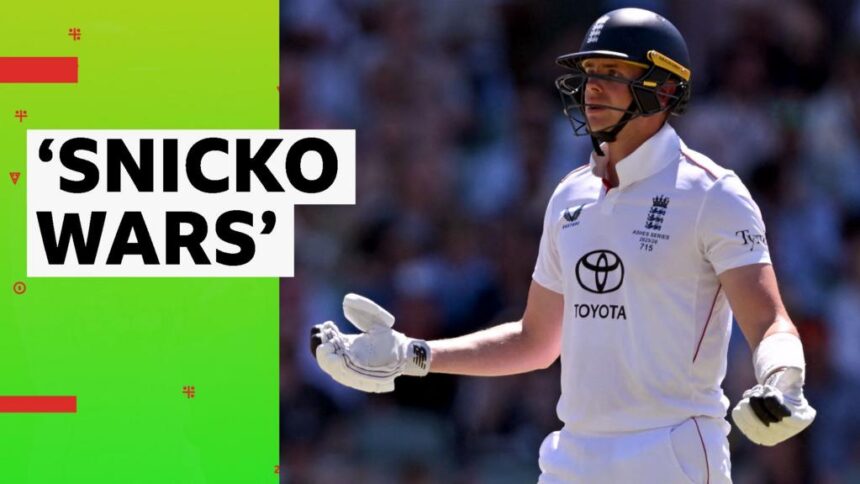
‘This is Ridiculous!’ – Jamie Smith Dismissal Sparks Ashes Uproar Over Snicko Controversy
The Ashes is a theatre of history, skill, and raw nerve. But on day two of the pivotal third Test at Headingley, the stage was commandeered by confusion, controversy, and a chorus of disbelief. England’s promising wicketkeeper-batter, Jamie Smith, found himself at the eye of a perfect storm, dismissed in a sequence so baffling it has reignited the fiercest debate in cricket: the fallible marriage of technology and tradition. What unfolded was a farcical two-act play that left players, pundits, and fans worldwide shouting at their screens: “This is ridiculous!”
A Tale of Two Reviews: The Unfolding Farce
The incident was as complex as it was controversial. Facing the Australian pace attack, Jamie Smith was initially given out caught behind off the bowling of Pat Cummins. Convinced he had missed the ball, Smith immediately reviewed. The Snicko technology (Real-Time Snickometer) showed a minuscule, flat line as the ball passed the bat—no definitive spike. The Third Umpire, under the protocol that requires clear evidence to overturn the on-field call, had no choice but to rule Not Out. The crowd roared, Smith survived.
Yet, the drama was only beginning. On the very next delivery—a separate ball in the eyes of the law—Smith played a similar shot. This time, Australia appealed for a catch at the wicket, but the on-field umpire’s decision was Not Out. Cummins, sensing an opportunity, opted for a review. The replays showed a clear gap between bat and ball. However, the focus shifted to the Snicko waveform from the *previous* delivery—the one just overturned. A tiny, delayed murmur appeared on the graph, well after the ball had passed the bat. Despite this belonging to a different play and being temporally misaligned, it was seemingly considered in the “context” of the second appeal. With no hot spot available, and amidst palpable confusion, the Third Umpire reversed the decision and gave Smith Out.
The bullet points of bewilderment:
- First Ball: Given out on-field. Review shows no clear Snicko spike. Overturned to NOT OUT.
- Second Ball: Given not out on-field. Australia reviews for a catch. No visual evidence.
- The Crux: A delayed, marginal signal on Snicko from the *first* ball is referenced.
- The Result: Smith is given out on the second ball, based partly on evidence from a prior, overturned decision.
Smith walked off, shaking his head in utter bemusement. The England balcony was a picture of fury. The explanation broadcast to fans, “There is a spike as the ball passes the bat,” felt disconnected from the visual reality everyone had just witnessed across two distinct deliveries.
Expert Analysis: A System in Crisis of Confidence?
This incident is not merely a blip; it’s a symptom of a deeper crisis in the Decision Review System (DRS). The fundamental principle of DRS is to eliminate the “howler.” Yet, here it created one. The problem lies in the interpretation and application of the technology, not the tech itself.
Firstly, the concept of using evidence from one delivery to inform a decision on another is a dangerous precedent. It violates the fundamental autonomy of each ball in cricket. If the Snicko signal on the first ball was deemed conclusive enough to inform the second dismissal, why was it not used to uphold the original out decision? The logic appears circular and self-defeating.
Secondly, it highlights the over-reliance on Snicko in isolation, especially without the corroborating evidence of Hot Spot. Snickometer is an incredibly sensitive audio tool; it can pick up sounds from bat on pad, bat clipping pad, or even hands on handle. The infamous “delay” in the waveform seen in Smith’s case is often the hallmark of such extraneous noises, not a clean edge. The protocols for DRS state that the on-field call must stand unless there is “clear and conclusive” evidence to overturn it. A delayed, microscopic spike from a previous ball is the antithesis of clear and conclusive.
“What we witnessed was a failure of process,” says a former international umpire speaking on condition of anonymity. “The third umpire’s role is to adjudicate on the specific delivery under review. Introducing data from a previous, adjudicated ball creates a chaotic, unmanageable scenario. It shatters player and public trust.”
Broader Implications: The Ashes and the Future of DRS
This controversy lands in the white-hot heat of an Ashes series poised at 1-1. Smith is a key part of England’s aggressive “Bazball” middle order. His dismissal, in such a contentious manner, could have swung the momentum of the entire Test match and, by extension, the series. It feeds a narrative of injustice that can linger in a team’s psyche.
Beyond Headingley, the fallout demands urgent attention from the International Cricket Council (ICC). The Smith saga exposes several critical questions:
- Protocol Clarity: Can evidence from one ball ever be used to judge another? This must be explicitly forbidden.
- Technology Suite: Should the use of Snicko be downgraded without the partnership of Hot Spot, especially for thin edges?
- Umpire Communication: The reasoning for decisions must be communicated to the broadcast audience with total transparency, including which technologies were definitive.
Predictions for the immediate future are fraught. We can expect a formal complaint from the England and Wales Cricket Board (ECB). More immediately, every subsequent thin edge in this series will be scrutinized with even greater suspicion. The standing of the umpires, both on and off-field, has been unnecessarily compromised. For the health of the sport, the ICC’s cricket committee must use this summer’s Ashes as a case study to overhaul and simplify the DRS protocols before the next major tournament.
A Conclusion Demanding Resolution
The Jamie Smith dismissal at Headingley will be replayed for years as a textbook example of how good intentions—the pursuit of accuracy—can lead to absurd outcomes. It was a moment where the pursuit of microscopic truth obliterated common sense. The roar of “This is ridiculous!” from fans and commentators was not just frustration at a decision against England; it was a cry of anguish for the sport’s integrity.
Cricket’s soul lies in its clear, contestable battles: batter vs. bowler, one ball at a time. The Snicko controversy of the third Ashes Test muddied those waters irreparably. It created a dismissal that felt manufactured in a lab of contradictory data, not on the field of play. For the Ashes, the match and series will thunder on, perhaps decided by a clear-cut six or a plumb LBW. But the shadow of this farce will linger until the guardians of the game act to ensure technology is a tool for clarity, not a creator of chaos. The credibility of cricket’s judicial system now depends on it.
Source: Based on news from BBC Sport.