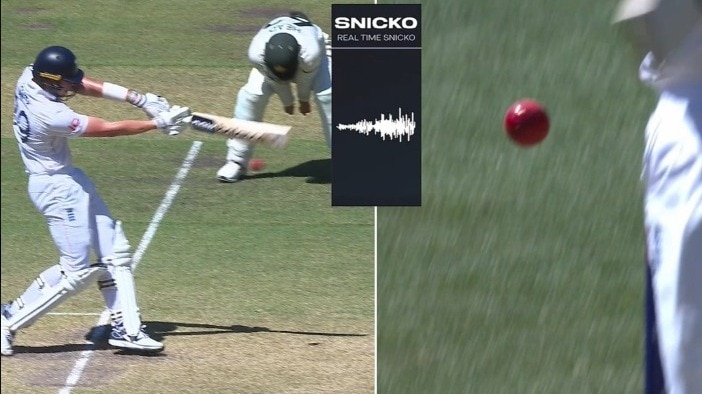
Ashes Snicko Controversy Erupts Again: Stokes Left Fuming at Smith’s Dismissal
The Ashes is a theatre where drama is guaranteed, but in recent years, a new character has taken a leading, and often divisive, role: technology. In a fiery flashback to past disputes, the third Test in Adelaide was plunged into fresh controversy on Day 2, centering on the dismissal of England’s Jamie Smith and the infallibility of the Snickometer. The incident left England captain Ben Stokes visibly seething and reignited a fierce debate about the role and reliability of technology in the sport’s most storied rivalry.
A Dismissal That Defied the Naked Eye
The moment of contention arrived with England building a fragile response to Australia’s first-innings total. Facing a sharp, short delivery from Pat Cummins, wicketkeeper-batter Jamie Smith went for a pull shot. The ball flew through to Alex Carey, prompting an immediate, confident appeal. On-field umpire Nitin Menon, uncertain, sent the decision upstairs for review, primarily to check the cleanliness of the catch.
What followed was a textbook example of technology creating confusion rather than clarity. The initial side-on replays, the tool most trusted by the human eye, told one story:
- A clear, visible gap between the bat and the ball.
- No obvious deviation or sound picked up by the stump mic in real-time.
- Smith’s reaction was one of immediate innocence, a shake of the head.
Yet, the forensic audio analysis of the Snickometer (Snicko) told another. As the ball passed the bat on its graphical timeline, a distinct spike appeared. Despite the visual evidence, third umpire Chris Gaffaney was compelled by that solitary audio spike to overturn the on-field ‘soft signal’ and rule Smith out. The “OUT” flashing on the Adelaide Oval screen was met not with roars, but with a palpable wave of disbelief and frustration from the English camp.
History Repeating: The Cracks in Cricket’s Technological Foundation
This was not an isolated glitch. Merely 24 hours earlier, a similar technological dispute involving Alex Carey had sowed seeds of doubt. This rapid recurrence transformed a single questionable decision into a full-blown crisis of confidence. The core issue is the interpretation of concurrent evidence. Snicko is an incredibly sensitive piece of kit, designed to detect the faintest of noises. However, its sensitivity is also its greatest weakness.
Expert analysts and former players were quick to dissect the flaw. The critical question posed was: what caused the spike? In an environment like a Test match, with bat brushing pad, gloves, or even the batter’s clothing, extraneous noise is constant. The principle of “conclusive evidence” to overturn an on-field call seemed, to many, not met. The visual of daylight created a reasonable doubt that the audio spike alone could not definitively erase. This incident exposed the dangerous precedent of one technology (audio) overriding another (visual) when they conflict, without a clear hierarchy or protocol for such conflicts.
Ben Stokes’ reaction—a mixture of stoic disappointment and simmering anger—spoke for a team feeling aggrieved by a system meant to protect them. His composure was notable, but the message was clear: trust in the Decision Review System (DRS) process was eroding in real-time.
The Ripple Effect: Tension, Momentum, and the Spirit of the Game
The impact of such decisions extends far beyond a single wicket. In the cauldron of The Ashes, where momentum is a priceless commodity, these controversies act as psychological grenades.
- For the Batting Side: It breeds a sense of injustice, a feeling that the contest is no longer purely between bat and ball. This can be galvanizing or utterly deflating.
- For the Fielding Side: While a wicket is taken, it can come with an asterisk, a hollow victory that fuels opponent resentment.
- For the Viewers: It shifts the narrative from sporting excellence to bureaucratic failure, tarnishing the spectacle.
The infamous tweet from a fan, accusing Australia of “cheating” and using “third quality technology,” while extreme, highlights how these technological failures poison the well of sportsmanship. They provide a narrative for conspiracy and bias where, in reality, the culprit is more likely an imperfect system straining under immense pressure. The real damage is to the integrity of the contest, as fans and players alike are left debating the tools of adjudication rather than the skills on display.
The Road Ahead: Can Cricket Fix Its Tech Trust Deficit?
As the series moves forward, the Adelaide controversy will loom large. Predictions for the remainder of this Test and the series are now tinged with this technological anxiety. We can anticipate:
- Hyper-Scrutiny of Every Appeal: Every thin edge will be met with heightened suspicion and longer, more tense DRS reviews.
- Increased Pressure on Third Umpires: Officials like Chris Gaffaney will be under a microscope, forced to play the role of forensic scientist with inconclusive data.
- A Formal Reckoning Post-Series: The International Cricket Council (ICC) will face mounting pressure to review the DRS protocols, particularly the weight given to Snicko versus real-time visuals and the need for a “clear and obvious” standard to overturn decisions.
The solution may lie not in removing technology, but in refining its application. A mandatory requirement for corroborating evidence—where a Snicko spike must be supported by a corresponding deviation on UltraEdge or a clear visual—could restore balance. Alternatively, a return of the on-field umpire’s “soft signal” carrying greater weight could place human judgment, with all its experience and nuance, back at the center of close calls.
The Ashes has always been a battle of skill, nerve, and will. The Adelaide controversy of 2025 has regrettably added a new dimension: a battle of faith in technology. Jamie Smith’s dismissal, set against the backdrop of previous disputes, is a stark warning. For the sanctity of the sport’s greatest rivalry, cricket’s custodians must act to ensure that the final word in the game’s most dramatic moments belongs to the players, not to a disputed spike on a screen. The integrity of the contest depends on it.
Source: Based on news from India Today Sport.