The Ashes Gambit: How a Tea-Time Conversation Redefined a Series
The narrative of an Ashes series is often written in centuries, in five-wicket hauls, and in the crumbling dust of a fifth-day pitch. But sometimes, the most pivotal chapters are composed not on the field, but in the quiet confines of a dressing room, in a moment of crisis and clarity. For Australia in the 2021-22 Ashes, that moment came at tea on day two of the first Test at the Gabba. England, already reeling, may not have known it then, but the course of their destiny was being irrevocably altered not by a blistering spell of fast bowling, but by a conversation—and a volunteered hand.
The Crucible of Crisis: Khawaja’s Spasm and a Void at the Top
Australia’s campaign began under a cloud of uncertainty. The shock omission of Travis Head from the starting XI was a major talking point. The aggressive left-hander, seen as a potential liability against the moving Dukes ball, was left out in favour of a more conservative lineup. Yet, fate has a way of intervening. When Usman Khawaja, a pillar of stability, was struck down by debilitating back spasms during the first Test, Australia faced an immediate problem. They needed an emergency opener for the second innings.
The traditional approach would have been to reshuffle the middle order, perhaps promoting a nightwatchman or asking a makeshift technician to see out the new ball. It was a precarious situation; a misstep could have let a wounded England back into the contest. The atmosphere at the tea break was one of urgent problem-solving. And it was there, amidst the clatter of cups and the tension of a tight match, that Travis Head made his move.
The Volunteer: Head’s Hand and the Birth of a Mindset
Without prompting, Head put his hand up. He volunteered to face the new ball, to walk into the cauldron against a swinging Duke with England’s seamers desperate for a breakthrough. This was more than just a tactical adjustment; it was a statement of intent and a seismic shift in mindset.
Head’s self-promotion signalled two things to the Australian camp and, crucially, to England:
- Unshakeable Confidence: A player deemed not technically suited for English conditions was demanding the toughest assignment. It radiated a belief that permeated the entire squad.
- Aggression as the Best Defence: Head’s game is built on attack. By sending him in, Australia was declaring they would not be cowed, they would not merely survive; they would counter-punch.
While he didn’t score a mountain of runs in that specific innings, the psychological impact was profound. Australia had turned a selection headache into a declaration of aggressive intent. It set a tone that would come to define the series.
The Century That Cemented Control: A “Wonderful” Innings
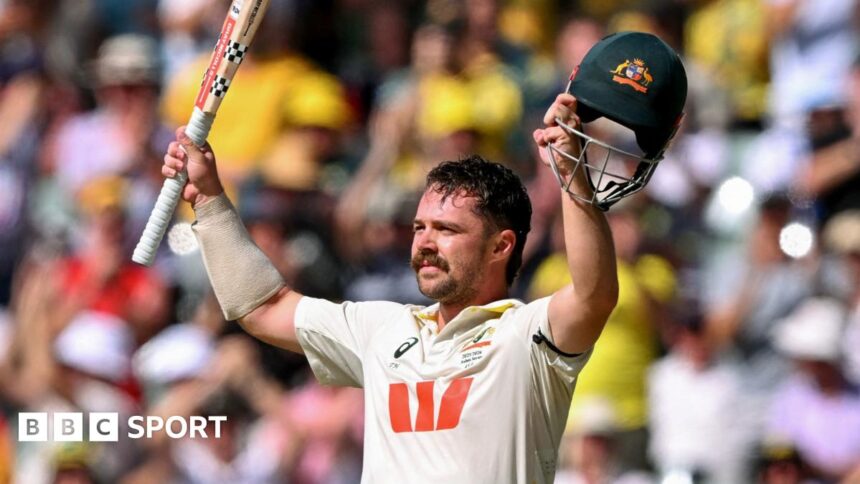
The true fruit of this gambit ripened later in the series. Fast forward to a critical juncture, and we saw the full flowering of the confidence sown at that Gabba tea break. Head, now firmly reinstated in the middle order, played what was widely described as a “wonderful century“—a knock of breathtaking aggression and calculated risk that put Australia firmly in control of a pivotal Test.
This was no gritty, grinding hundred. It was a whirlwind. He took on England’s premier attack, targeting the short ball and dismantling their plans with brutal efficiency. His century came at a strike rate that shattered English morale, turning potential pressure into absolute dominance in a single session. This innings was the direct descendant of that volunteered opening slot. It was the embodiment of the proactive, fearless cricket Australia had chosen to play from the moment of crisis.
Contrast this with England’s approach. As the series unfolded, England’s preparation decisions and on-field strategies appeared reactive, often confused. They debated pitch conditions, rotated seamers, and tinkered with a batting order that lacked the same decisive, aggressive identity. While they “may well have lost this Ashes anyway,” as some observed, Australia’s masterstroke ensured there was never even a flicker of doubt.
Expert Analysis: The Ripple Effect of a Single Decision
From a tactical lens, Head’s move was a masterclass in proactive leadership. It solved an immediate problem while simultaneously establishing a long-term psychological advantage. It told every player in the Baggy Green that roles were fluid, that challenge was to be embraced, and that initiative was valued above rigid planning.
The Ashes series is often won in the mind before it is won on the scoreboard. England arrived with hope but were met with an Australian unit that constantly forced the issue. The tea-time conversation was the catalyst. It transformed a potential weakness—an injury to a key batter—into a demonstration of strength and unity. It allowed players like Head to play with liberated freedom, knowing the team’s strategy was built around attacking the opposition’s morale as much as their wicket-taking areas.
This single act had a ripple effect:
- It solidified team culture, showing that every player was ready to sacrifice for the structure.
- It forced England’s captains and bowlers to constantly rethink their fields and plans.
- It created an aura of Australian invincibility, where solutions seemed to emerge from within their camp effortlessly.
Looking Ahead: A Legacy Beyond the Urn
The legacy of this moment extends beyond the 2021-22 urn. It serves as a blueprint for how modern Test teams can approach adversity. In an era of hyper-analysis and data-driven plans, Australia reminded the world of the irreducible human element: courage, instinct, and the willingness to take a calculated gamble.
For future Ashes contests and indeed for Test cricket globally, the lesson is clear. Series can be swung not just by brilliant individual performances, but by the collective mindset fostered in moments of uncertainty. England will undoubtedly analyse their technical failures, but the deeper lesson lies in that Australian dressing room. The next time a crisis hits—a key injury, a collapsing session—the team that can produce its own “Head moment,” a player willing to put their hand up and change the game’s energy, will hold a decisive advantage.
In conclusion, while the scorecards will forever show the centuries and the five-fors, the true historians of this Ashes will point to a quiet interval at the Gabba. A conversation over tea, a volunteered hand, and a decision to meet fire with fiercer fire. That was the masterstroke. That was the moment Australia didn’t just find an emergency opener; they found the aggressive, unyielding identity that would carry them to absolute dominance. England didn’t just lose a series; they were outmanoeuvred before they even understood the battle had changed.
Source: Based on news from BBC Sport.