Anderson Silva’s Timeless Brilliance: A Vicious Uppercut Seals 2nd-Round TKO of Tyron Woodley
The legend of Anderson Silva refuses to be confined by age, sport, or expectation. In a stunning display of his enduring, otherworldly striking, “The Spider” weaved a masterpiece on Friday night in Miami, dropping former UFC welterweight champion Tyron Woodley with a devastating uppercut and cruising to a emphatic second-round TKO victory. The boxing match, which many framed as a clash of MMA greats in a new arena, quickly transformed into a chilling reminder of Silva’s singular genius.
The Set-Up: A Clash of Combat Sports Titans
The anticipation for Silva vs. Woodley was palpable, built on the formidable reputations of two of MMA’s most dominant champions. Woodley, “The Chosen One,” represented raw, explosive power and wrestling pedigree, seeking to prove his fists could translate to the squared circle. Silva, at 47 years old, entered as an enigmatic icon, a former UFC middleweight king whose boxing flair in MMA was the stuff of highlight reels. The question was whether Silva’s elusive, timing-based artistry could withstand the ferocity of a naturally bigger, younger powerhouse.
From the opening bell, the narrative began to shift. Silva, moving with a familiar relaxed gait, established his jab and controlled distance. Woodley pressed forward, looking to corner the Brazilian and unload his notorious right hand. Yet, the expected bombast was replaced by a tense, technical probe. Silva’s experience in the ring—evident from his win over Julio César Chávez Jr.—shone through, as he parsed Woodley’s movements with a veteran’s calm.
The Moment of Impact: Silva’s Surgical Uppercut
Midway through the second round, the fight reached its violent, decisive crescendo. Woodley, backed against the ropes, attempted to fire back after absorbing a combination. As he dipped his head and loaded up for a counter right hand, Silva unleashed a weapon from his deep arsenal.
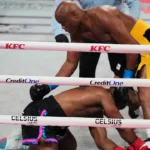
The uppercut was not just thrown; it was teleported. Starting from his hip and traveling upward on a perfect vertical plane, Silva’s fist connected flush on Woodley’s chin as he was in motion. The biomechanics were flawless, and the result was instantaneous. Woodley’s legs betrayed him, buckling violently as he crashed to the canvas. The crowd erupted, witnessing a knockout that belonged on Silva’s legendary UFC reel.
Woodley showed immense heart, beating the count and rising on unsteady legs. But the fight’s spirit had been severed. Silva, the predator sensing the finish, moved in with a serene ruthlessness. A final flurry of pinpoint shots against a defenseless Woodley prompted the referee to intervene at 1:54 of Round 2.
- Precision Over Power: Silva didn’t out-muscle Woodley; he out-synapsed him. The knockout punch was a testament to fight IQ and timing.
- The Distance Dictator: Silva never allowed Woodley to get set or find his range, masterfully controlling the real estate of the ring.
- Clinic in Composure: Unlike Woodley’s tense aggression, Silva operated with a chilling calm, making his offensive bursts even more effective.
Expert Analysis: Deconstructing the Masterclass
This victory was more than a single punch. It was a holistic breakdown. Silva, historically a counter-striker, actually led the dance. He used his jab not just as a rangefinder, but as an offensive tool to disrupt Woodley’s rhythm and draw out reactions. When Woodley reacted, Silva was already gone, or worse for “The Chosen One,” already countering.
The most telling gap was in boxing literacy. Woodley, for all his MMA striking prowess, often stood flat-footed, looking for one fight-altering shot. Silva, by contrast, pivoted, angled out, and threw in fluid combinations. He fought the entire short contest in phases, while Woodley was still searching for a single moment. The uppercut was the logical conclusion of this accumulated advantage—a trap set and sprung by a veteran who has made a career of making elite fighters look ordinary.
For Woodley, the loss raises difficult questions about his pugilistic journey. His power is undeniable, but the nuanced footwork, combination punching, and defensive head movement required in boxing were starkly absent. He was competing in Silva’s world, playing by Silva’s rules, and the legend was several moves ahead.
What’s Next? The Future for Two Legends
The fallout from Miami creates divergent paths for its two combatants.
For Anderson Silva, the world is once again his oyster. This dominant win, following his victory over Chávez Jr., solidifies him as a legitimate and marketable force in the celebrity and crossover boxing scene. Calls for fights against other MMA legends like Vitor Belfort or even a step-up against a seasoned professional boxer will grow louder. His performance proved that his name alone is no longer the draw; it’s the sustained, high-level skill he continues to display. Silva has successfully authored a captivating late-career chapter that defies all athletic norms.
For Tyron Woodley, the path is less clear. Back-to-back knockout losses (including his MMA bout with Jake Paul) are a brutal mental and physical hurdle. The boxing experiment, at this level, may have reached its conclusion. A return to MMA, perhaps for a legacy-focused farewell fight, seems a more likely and sensible option. His legacy as one of the UFC’s most dominant welterweight champions remains intact, but his foray into boxing revealed the vast stylistic chasm between the sports.
Conclusion: An Ageless Wonder Weaves His Final Magic
Anderson Silva’s second-round TKO of Tyron Woodley was not an upset; it was a revelation. In a sport obsessed with youth and power, Silva presented a masterclass in the timeless virtues of technique, timing, and tactical genius. He didn’t just win a boxing match; he delivered a statement that his unique brand of combat artistry is translatable and potent, regardless of the rule set or the date on his birth certificate.
Friday night in Miami was a reminder that while athletes age, mastery does not. It evolves. Silva, with a vicious uppercut that echoed through his storied career, reminded the world why he was once considered untouchable. And in doing so, he proved that even now, on his terms, in his rhythm, he very much still is.
Source: Based on news from ESPN.