Stupid or Valid? The Brook Reverse Sweep That Has Australia on the Brink
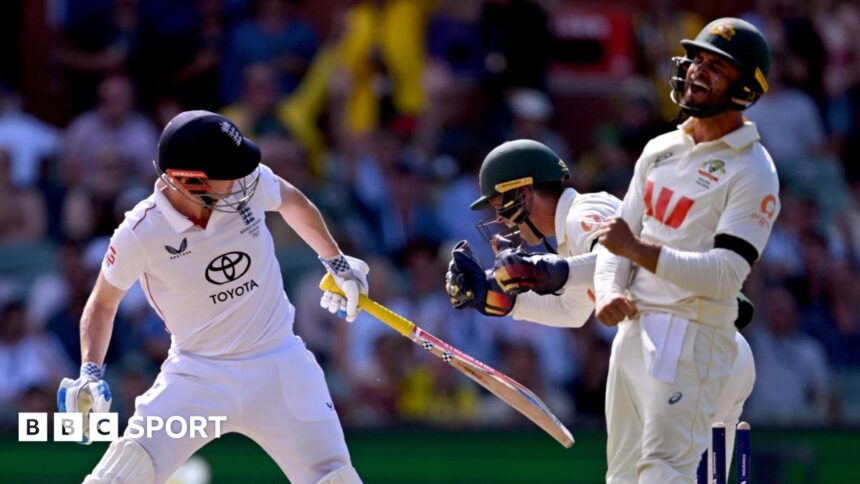
The Ashes is a theatre where moments are not just played; they are etched into legend. On a tense Adelaide Saturday, with the shadows lengthening and a series in the balance, Harry Brook authored a scene that split opinion like a well-pitched leg-break. Facing Nathan Lyon, England’s young gun shaped for an audacious reverse sweep, missed completely, and heard the death rattle behind him. The collective gasp from the Barmy Army was almost audible over the internet. “What’s he done?” echoed the commentary. In that single, fleeting act of aggression, Brook didn’t just lose his wicket. He reignited the oldest debate in cricket: is this Bazball bravery or sheer recklessness? And more importantly, did this moment of madness inadvertently hand Australia the Ashes initiative?
The Crucible Moment: Anatomy of a Dismissal
To understand the fury and the fascination, we must freeze the frame. England, chasing a daunting Australian total, were building a partnership. Brook, having played with characteristic fluency, saw Nathan Lyon toss one up invitingly. The field was set, the game situation pressed. In a split-second calculation, Brook opted not for the orthodox, but for the extravagant—the reverse sweep. The execution failed; the ball skidded through, and the stumps were disturbed. It was a dismissal that looked, in isolation, careless. But in the ecosystem of this England team, no shot exists in isolation. This is the central tenet of the McCullum-Stokes doctrine: unflinching commitment to the chosen path. The failure of the shot, they argue, is not an indictment of the philosophy, but a simple error in execution, no different from nicking a defensive prod to slip.
Yet, the context is king. This was not a session of rampant run-scoring; it was a period requiring consolidation. The dismissal sparked a mini-collapse, shifting momentum palpably towards Australia. The visual was damning: a gifted wicket to a wily opponent. For the traditionalist, it was cricket’s original sin—a lack of respect for the situation. For the modernist, it was the inevitable price of a high-risk, high-reward strategy. Brook walked off, his face a mask of frustration, likely knowing the storm that awaited him in the digital realm.
The Mental Fortress: Crawley’s Ignorance vs. Brook’s Inbox
Here, the narrative splits into a fascinating study of modern cricketing psyches. Contrast Brook’s likely evening with that of his teammate, Zak Crawley. Crawley, England’s often-criticized opener, operates in a self-imposed vacuum. He is not on social media and has often claimed to be oblivious to criticism that has come his way. It is a deliberate, and perhaps wise, insulation from the noise. For Crawley, the performance is analyzed in the dressing room and then left on the field.
For Harry Brook, the experience would be starkly different. As one pundit wryly noted, it might have been for his own good if England team-mate Harry Brook’s passwords were changed before he returned to his hotel. The torrent of hot takes, memes, and outright abuse on platforms like Twitter and Instagram is a brutal, inescapable reality for today’s stars. Where Crawley has built a mental fortress, Brook was about to be besieged. This dichotomy highlights the extreme psychological landscape young players must now navigate. They are asked to play with fearless freedom, yet are instantly subjected to a global, real-time court of public opinion that shows zero mercy for failure. Can genuine fearlessness exist when the cost of failure is a deluge of digital vitriol?
Expert Analysis: Reckless Abandon or Calculated Aggression?
As a journalist who has watched strategies evolve over decades, this moment demands a dispassionate tactical breakdown. Labeling Brook’s shot simply “stupid” is a lazy dismissal. We must ask: was it a valid option?
- The Case for Validity: Brook is a 360-degree player. The reverse sweep is a legitimate scoring shot in his arsenal, one he has executed successfully countless times. Against Lyon, it disrupts length and line, forcing the bowler to second-guess his attack. In the Bazball paradigm, taking down the opposition’s premier spinner is a strategic imperative. The intent was to score, to dominate, to never cede pressure. It was, in theory, a proactive strike.
- The Case for Stupidity: The match situation demanded game sense. The risk-reward ratio was skewed. With a settled partner at the other end and the innings needing a foundation, the percentage play was to work the ball conventionally. The shot selection seemed pre-meditated, ignoring the specific delivery. It presented Australia with a cheap wicket exactly when they needed it, a potentially series-swinging gift.
The truth likely lies in the grey. It was a high-percentage risk in a low-percentage situation. The shot itself is not the issue; its timing was. It was a microcosm of England’s greatest strength and their most glaring weakness: an unwavering belief that can border on myopia.
The Ashes Prognosis: Is Australia Now on the Brink?
So, did Brook’s shot put Australia on the brink? The answer is a qualified yes, but not for the reason most think. The direct cost in runs was significant, but the deeper impact was psychological.
For Australia: It was a massive reinforcement of their traditional belief. It validated their patience, their discipline, and their trust in pressure. It whispered to Pat Cummins and his men that England’s aggression could indeed be their own undoing. It steeled their resolve, proving that even in the face of a blistering assault, classic Test match virtues of line, length, and waiting for the error still hold supreme power.
For England: The danger is not in one lost wicket, but in the seed of doubt. The dressing room will publicly rally around Brook. Privately, however, players might start questioning their methods in crunch moments. Does “no fear” become “no thought”? The balance between aggressive intent and situational awareness is the finest of lines. Brook crossing it so visibly may cause subconscious hesitation in others at critical junctures.
Australia is now on the brink not because of a 22-run deficit, but because they have been handed the ultimate strategic gift: the growing suspicion that England’s philosophy contains the seeds of its own destruction. They will now bowl with the confidence that more such “gifts” are inevitable if they maintain their discipline.
Conclusion: The Uncomfortable Price of Revolution
The debate around Harry Brook’s reverse sweep is not really about one shot. It is a referendum on a cricketing revolution. Stupid or valid? It was arguably both—a valid shot executed stupidly in that precise moment. To dismiss it as merely one is to miss the point entirely.
England’s path under Stokes and McCullum is a thrilling, high-wire act. It rejects the safety net. Brook’s dismissal was the inevitable, very public stumble that such an approach will sometimes produce. The question for the remainder of this Ashes series is whether England have the mental resilience to absorb these moments, to allow a player like Brook to login, face the music, and then walk out and play the exact same way again. If they can, the revolution lives. If they waver, if doubt creeps in, then that single shot in Adelaide will be remembered not as a blip, but as the moment the brink crumbled beneath them. The Ashes, as ever, will be won and lost not just in the hands, but in the minds.
Source: Based on news from BBC Sport.