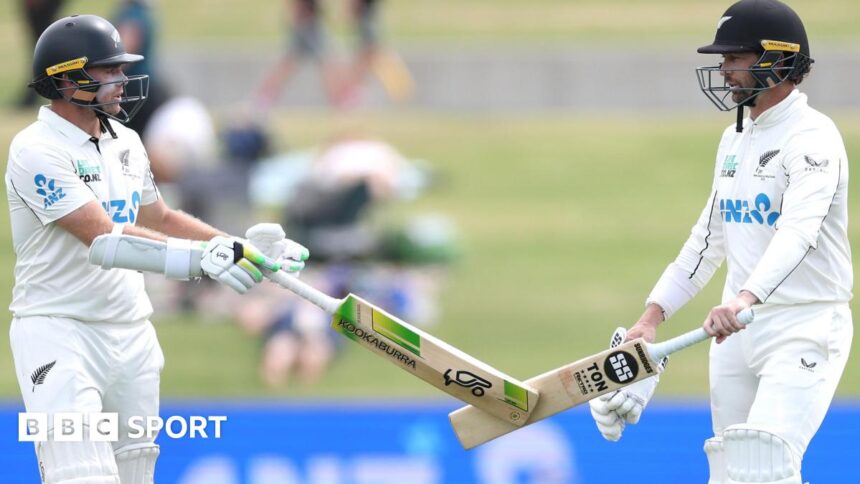
Latham & Conway Inscribe Names in History as New Zealand Openers Shatter Test Record
The hallowed pages of Test cricket’s record book received a fresh, indelible entry at the sun-drenched Bay Oval in Mount Maunganui. In a display of relentless concentration, sublime skill, and near-telepathic partnership, New Zealand’s opening pair of Tom Latham and Devon Conway achieved a feat never before accomplished in 145 years of the sport’s longest format. By each scoring centuries in both innings of the third Test against the West Indies, they transformed a series decider into a historic coronation, placing New Zealand in an unassailable position and setting the visitors a mammoth, record-breaking chase.
A Masterclass in Opening Batting: The Record-Breaking Partnership
While New Zealand ultimately declared, setting the West Indies an improbable 462 to win, the true story of this Test was written in the first hours of days one and four. The foundation of New Zealand’s commanding first-innings total of 575 for 8 declared was a monumental 276-run opening stand. Conway, the left-handed artist, crafted a magnificent 227, a career-best. Latham, the ever-dependable anchor, provided the perfect foil with a composed 137. Their partnership broke the backbone of the West Indies attack, batting with a calm authority that sapped the visitors’ energy.
Yet, that was merely the prelude. Enforcing the follow-on after a spirited West Indies reply of 420, New Zealand captain Tim Southee asked his openers to go again. What followed was a breathtaking display of mental fortitude. On a day-four pitch, against a demoralized bowling attack, Latham and Conway did not just survive; they thrived. Racing to a 100-run partnership in quick time, they simultaneously reached their individual milestones, becoming the first openers in Test history to score twin tons in a match.
- Unprecedented Feat: No opening pair in over 2,500 Test matches had ever both scored a century in each innings.
- Rapid Fire: Their second-innings century stand came at a significantly faster rate than the first, showcasing their ability to shift gears.
- Dual Declaration: Both of their second innings ended not by a bowler, but by the team’s declaration at 306 for 2, a symbolic testament to their total command.
Expert Analysis: Deconstructing the Duo’s Dominance
The success of the Latham-Conway axis is no accident. It is a product of complementary styles, profound temperament, and a deep understanding of New Zealand’s batting philosophy. Tom Latham is the archetypal modern opener: unflappable, strong off his pads, and a master at leaving the ball. His game is built on risk mitigation, wearing down the new ball’s shine and the bowlers’ patience. His twin centuries were studies in accumulation, turning good deliveries into singles and capitalizing on width.
At the other end, Devon Conway provides the elegant aggression. A late bloomer in international cricket, his game is rich with crisp drives, powerful cuts, and a knack for converting starts into massive scores. His double-century in the first innings was a masterpiece of controlled aggression. Together, they create a “problem of ends” for opposing captains. Bowling tight to Latham often frees up scoring opportunities for Conway, and vice-versa. Their running between the wickets is instinctive, turning ones into twos and constantly applying pressure.
This historic performance also underscores New Zealand’s strategic depth. With the stalwart Kane Williamson absent, the onus was on the senior core to stand up. Latham and Conway did more than that; they delivered a knockout blow. Their record-setting stand has not only put New Zealand on the brink of a series victory but has also solidified their positions as one of the world’s most formidable opening pairs.
The Mountain to Climb: West Indies’ Record Chase and Predictions
Set a target of 462, the West Indies face a task of Himalayan proportions. No team has ever successfully chased more than 418 in the fourth innings of a Test match. The visitors begin their final day at 43 for 0, requiring a further 419 runs with all ten wickets in hand. The pitch, while still good for batting, is showing signs of wear, and the psychological weight of the record chase is immense.
Realistically, a West Indies victory would constitute one of the greatest heists in Test history. Their hopes likely rest on one of two scenarios: a miraculous, collective batting performance led by the likes of Kraigg Brathwaite and the centurion from the first innings, Kavem Hodge, or the intervention of the weather. Forecasts, however, suggest a full day’s play is expected.
The more probable outcomes are a New Zealand victory or a gritty West Indies draw. The Kiwi bowling attack, led by the relentless Tim Southee and the crafty Kyle Jamieson, will be hunting in a pack, knowing early wickets will shatter any remote hope. The key battle will be the first hour of day five. If the West Indies openers can survive and build a platform, they can dream of an epic rearguard. If New Zealand strikes early, the collapse could be swift.
A Legacy Forged in the Bay Oval Sun
The third Test at Mount Maunganui will be remembered not for its result, but for the history made by two men in black caps. Tom Latham and Devon Conway have entered a unique pantheon, achieving a opening-batting milestone that eluded legendary pairs like Hobbs and Sutcliffe, Greenidge and Haynes, or Hayden and Langer.
Their achievement is a testament to the strength and consistency of New Zealand cricket. In an era often dominated by flashier teams, the Black Caps have built a reputation on resilience, teamwork, and excellence in fundamentals. The Latham-Conway record is the ultimate expression of that philosophy: two selfless, supremely skilled batters working in flawless harmony for the good of the team, and in the process, etching their names into eternity.
As day five dawns, New Zealand stands on the cusp of a series win. But regardless of the final session’s outcome, this Test belongs to the openers. They have provided a masterclass in technique, temperament, and partnership, a timeless reminder of why Test cricket, with its layers of narrative and history, remains the sport’s purest and most compelling form.
Source: Based on news from BBC Sport.