The Silent Protest: Are Multi-Club Ownership Models Alienating the Very Fans They Promise to Elevate?
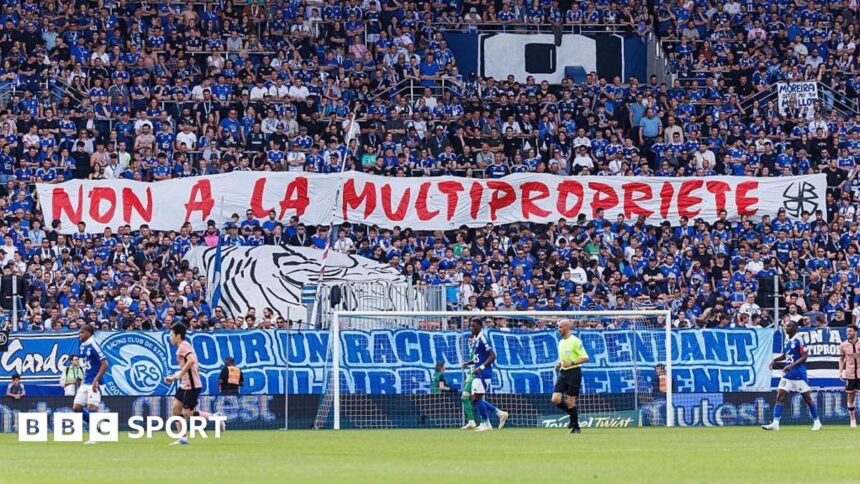
The roar of the crowd is football’s lifeblood. At the Stade de la Meinau, however, a profound silence has spoken volumes. For the first 15 minutes of recent matches, Strasbourg’s ultras have staged a mute protest, their voices withheld, their banners unfurled in stark condemnation. The target of their discontent is not a rival team or a poor run of form, but the very structure that owns their club: BlueCo, the consortium that also owns Chelsea FC. This powerful act of defiance from the stands of Alsace poses a critical question for the modern game: Is the rapidly expanding multi-club ownership model beginning to turn off the fans it claims to benefit?
The Strasbourg Paradox: Success on the Pitch, Discontent in the Stands
On paper, the BlueCo investment in Racing Club de Strasbourg Alsace looks like a football fairy tale. Since the 2023 takeover, the club has been transformed from a perennial relegation battler into a competitive Ligue 1 side. They finished top of their UEFA Conference League group last month. A monumental £157m revamp of the Stade de la Meinau is underway, promising world-class facilities and increased capacity. The transfer market activity has been brisk, with a pipeline of talented players, many with Chelsea connections, flowing into the squad. By most sporting and infrastructural metrics, this is a success story.
Yet, the ultras’ silent protest cuts to the heart of a deeper conflict. Their banners, reading “Soul For Sale” and “Our Blood, Your Money,” articulate a fear that transcends league tables and stadium upgrades. The core issue is one of identity erosion and loss of sporting sovereignty. For these fans, the club is not an asset in a portfolio but a sacred community institution. They perceive the multi-club model not as partnership, but as subservience—a fear that Strasbourg’s primary purpose has shifted from pursuing its own glory to serving the strategic needs of its powerful London sibling.
- Sporting Integrity: Is Strasbourg’s success truly its own, or is it a manufactured outcome of a closed network?
- Transfer Policy: Does the loaning of young Chelsea talents develop Strasbourg, or does it primarily develop Chelsea’s assets?
- Long-term Vision: Is the club’s project built on sustainable growth, or is it subject to the whims of a distant ownership group’s broader strategy?
A Global Trend Meets Local Backlash
Strasbourg is not an isolated case; it is the canary in the coal mine for a global phenomenon. The City Football Group (Manchester City, New York City FC, Girona, etc.), Red Bull’s network, and the growing portfolios of investment firms like Eagle Football (Lyon, Botafogo, Molenbeek) are reshaping football’s geography. Proponents argue these networks create efficiencies, share expertise, and provide smaller clubs with financial stability and access to talent previously beyond their reach.
However, the fan backlash is becoming a consistent counter-rhythm. Strasbourg’s protests echo sentiments heard elsewhere:
- Fans of FC Liefering and RB Leipzig have faced tensions over their Red Bull linkages.
- Girona’s miraculous La Liga campaign has been shadowed by questions about their ties to Manchester City.
- At Chelsea itself, some supporters view the multi-club project with skepticism, wary of resources and focus being diverted.
This growing discontent highlights the fundamental clash between football as a globalized business and football as a local cultural entity. For owners, a club is a node in a network. For fans, it is the node itself—the entire world. The model’s economic logic often fails to account for the emotional, historical, and communal capital that constitutes a club’s soul.
Expert Analysis: The Unquantifiable Cost of a Lost Soul
The risk for multi-club owners is misjudging the fanbase as a purely transactional customer base. “Football fandom is not a rational consumer choice,” explains Dr. Emily Grant, a sports sociologist. “It’s an identity, a inheritance, a piece of one’s self. When you commodify that and integrate it into a corporate structure, you attack the very foundation of the loyalty you’re banking on. The stadium upgrades and winning seasons are welcome, but they are seen as shiny wrapping on a hollow box if the core identity is compromised.”
The strategic pitfalls are significant. A network’s perceived success can quickly unravel if its constituent fanbases become alienated. Empty seats, toxic atmospheres, and public relations battles undermine the commercial and sporting brand the model seeks to build. Furthermore, regulators at UEFA and domestic leagues are scrutinizing the model more closely, concerned about conflicts of interest, integrity of competition, and the potential for collusion. The sustainability of the multi-club project depends as much on social license as it does on financial capital.
Strasbourg’s situation is particularly instructive because the benefits are so visibly present. The protest isn’t born from failure; it’s born from a fear of lost autonomy amidst that success. It’s a warning that even a “good deal” can feel like a bad bargain if the price is perceived to be a club’s independent spirit.
The Future of Fandom: Coexistence or Collision?
So, where does this leave the multi-club model? It is unlikely to disappear; the financial and strategic incentives are too powerful. The question is whether it can evolve to accommodate fan sentiment or if the rift will widen. Predictions for the coming years point to a period of intense negotiation—both in the boardroom and in the stands.
We can expect to see:
- Increased Fan Activism: Strasbourg’s silent protest will inspire other supporter groups to organize more sophisticated forms of dissent.
- Regulatory Tightening: UEFA will be forced to strengthen its rules on multi-club ownership, particularly regarding player transfers and competition integrity.
- The “Localized Autonomy” Experiment: The most savvy ownership groups may grant greater operational independence to satellite clubs, emphasizing local management and distinct identities to placate fans.
- A Breaking Point: A major controversy—a perceived manipulated transfer or a suspicious on-field result between linked clubs—could trigger a regulatory and public relations crisis for the entire model.
The ultimate challenge for multi-club empires is to prove they are building more than just a network of franchises. They must demonstrate they are nurturing unique, authentic clubs that happen to be connected, rather than homogenized subsidiaries. This requires transparent communication, genuine community engagement, and a visible commitment to each club’s individual legacy and ambitions.
Conclusion: The Soul of the Game is Not for Sale
The silent first 15 minutes in Strasbourg is a powerful metaphor. It is the sound of a community pausing to ask what it is losing in the relentless pursuit of growth. The multi-club ownership model, for all its financial logic and sporting potential, is facing its most potent adversary: the emotional, irrational, and unyielding love of a club’s supporters. While fans appreciate improved facilities and on-pitch success, the banners in Alsace make it clear that these are not substitutes for sovereignty and soul.
The model is at a crossroads. It can choose to ignore this grassroots backlash at its peril, treating fans as inconvenient protestors. Or, it can listen to the silence and understand it as a plea for respect. The future of football will be shaped by whether the architects of these global networks learn that the most valuable asset on a balance sheet is also the most fragile: the unwavering, but not unconditional, love of the fans. That is the one thing money cannot buy, and the one thing silence can so powerfully defend.
Source: Based on news from BBC Sport.