The Final Serve: Milos Raonic, the Canadian Cannon, Retires From Tennis
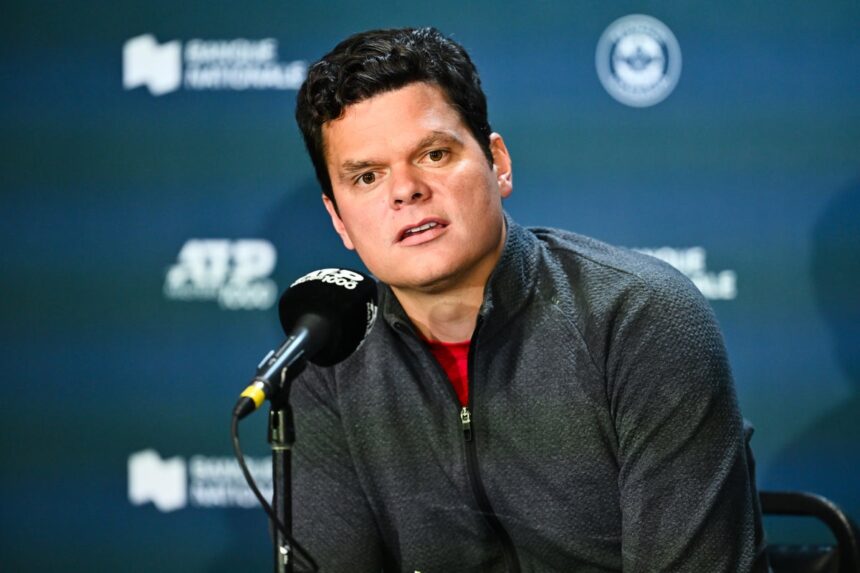
The echo of a thunderous serve, once a defining sound of modern tennis, has finally faded into silence. Milos Raonic, the man who brought a nation to the precipice of Grand Slam glory and whose power game struck fear into the sport’s elite, has announced his retirement. At 35, the former Wimbledon finalist steps away from the professional tour, closing a career defined as much by its explosive potential as by the relentless injuries that curtailed it. His last competitive match was an 18-month-old memory from the Paris Olympics, a fittingly bittersweet epilogue for a player whose body could no longer keep pace with his towering ambition.
A Legacy Forged in Power and Precision
Milos Raonic did not just hit a tennis ball; he launched it with ballistic force. In an era transitioning from relentless baseline rallies back to a premium on first-strike tennis, Raonic was a pioneer of the new power game. Standing at 6’5″, he wielded his serve like a medieval warhammer—a weapon of mass disruption that regularly clocked over 140 mph and left opponents feeling like spectators. But to label him merely a server would be a disservice. He built a formidable, if less celebrated, all-around game: a crushing forehand, improved net skills, and a strategic mind that evolved under coaches like Ivan Ljubičić and Carlos Moyá.
His crowning achievement came on the sport’s most hallowed lawn. In 2016, Raonic carved a path through the Wimbledon draw, defeating Roger Federer in a thrilling five-set semifinal. That victory propelled him into a showdown with Andy Murray in the final. Though he fell to the Scotsman, Raonic had achieved something monumental: he became the first Canadian man to reach a Grand Slam singles final in the Open Era. He carried the hopes of a nation, inspiring a generation of Canadian players who would later form the “Canadian tennis tsunami.”
- Historic Wimbledon 2016 Run: Semifinal victory over Federer, finalist against Murray.
- Pioneering Playing Style: Arguably the most dominant pure server of his generation.
- Canadian Trailblazer: Paved the way for future stars like Felix Auger-Aliassime and Denis Shapovalov.
The Relentless Battle: A Body Betrayed
Raonic’s career narrative, however, is inextricably linked to a heartbreaking subplot: injury. The decade following his Wimbledon zenith became a grueling cycle of brilliance, breakdown, and rehabilitation. His powerful, high-torque style placed immense strain on his frame. He endured a catalog of ailments that would read like a medical textbook:
- Multiple right foot surgeries
- Chronic right leg and calf issues
- Persistent back problems
- A debilitating shoulder injury that ultimately sealed his fate
Each comeback was met with hope, and often flashes of his old self—like his run to the Australian Open quarterfinals in 2021 or his final title in Brisbane that same year. But the physical toll was cumulative. His last act was a courageous, and perhaps symbolic, appearance for Canada at the 2024 Paris Olympics. The shoulder issue that sidelined him after that loss to Germany’s Dominik Koepfer proved to be the final obstacle he could not overcome. For 18 months, the tennis world waited for the cannon’s return. On Sunday, with poignant clarity, Raonic confirmed the wait was over.
Analysis: The “What If” That Defines a Career
From a journalistic and analytical standpoint, Raonic’s retirement forces us to confront the tantalizing “what if.” What if his body had cooperated? In a period dominated by the “Big Four,” Raonic was part of a small vanguard—alongside Stan Wawrinka and Juan Martín del Potro—that proved they could be beaten on the biggest stages. His game was specifically tailored for grass and hard courts, and at his peak, he was a threat to win any major outside of Paris.
Expert analysis suggests Raonic’s impact is twofold. Firstly, he demonstrated the viability of a serve-centric strategy in the 21st century, influencing coaching and player development. Secondly, his career is a stark case study in the physical demands of the modern power game. His injuries were not flukes; they were the consequence of pushing the human body to its limits to compete at the highest level. His retirement statement, calling tennis his “love and obsession,” underscores the cruel paradox: the very intensity that drove him to the top also accelerated his journey to its end.
The Future of the Power Game and Raonic’s Lasting Impact
As Raonic departs, the landscape of tennis continues to evolve. The pure serve-volleyer is extinct, but the big server remains a potent force. Players like Matteo Berrettini, Hubert Hurkacz, and even the younger, taller talents coming through the ranks owe a debt to Raonic’s blueprint. He proved that with a world-class serve and steady improvement from the baseline, a player could reach a Grand Slam final.
For Canadian tennis, his legacy is immeasurable. He was the breakthrough artist. Before Bianca Andreescu, Leylah Fernandez, and the current crop of men, there was Milos, showing it was possible. His professionalism, quiet determination, and explosive game put Canadian tennis firmly on the map and inspired the infrastructure and investment that now fuels its success.
Predictions for his post-playing life vary. Given his analytical mind and deep respect for the sport, a coaching or commentary role seems a natural fit. He may also choose to step away entirely, focusing on business ventures and his private life. Regardless, his voice would be a valuable one in the tennis ecosystem.
Conclusion: The Echo of the Ace
Milos Raonic’s retirement is not a surprise, but it resonates with a profound sense of unfinished business. He retires with eight ATP titles, a Wimbledon finalist plaque, and a world No. 3 ranking to his name—stellar achievements by any measure. Yet, the lingering feeling is that there was more in the tank, more aces to be fired, more history to be written had fortune been kinder.
In the end, his career is a powerful human story of triumph and resilience. He reached the summit of his sport, carried a nation’s dreams, and fought with immense dignity against a cascade of physical setbacks. His final social media post captured it perfectly: “This is a moment you know will come one day, but somehow you never feel ready for it.” The tennis world wasn’t ready for his injuries, and it isn’t fully ready for his departure. But we are left with the indelible memory of a gentle giant whose serve roared, who changed Canadian sports forever, and who, for a brilliant moment in the summer of 2016, had all of Centre Court holding its breath.
Source: Based on news from Yahoo Sports.