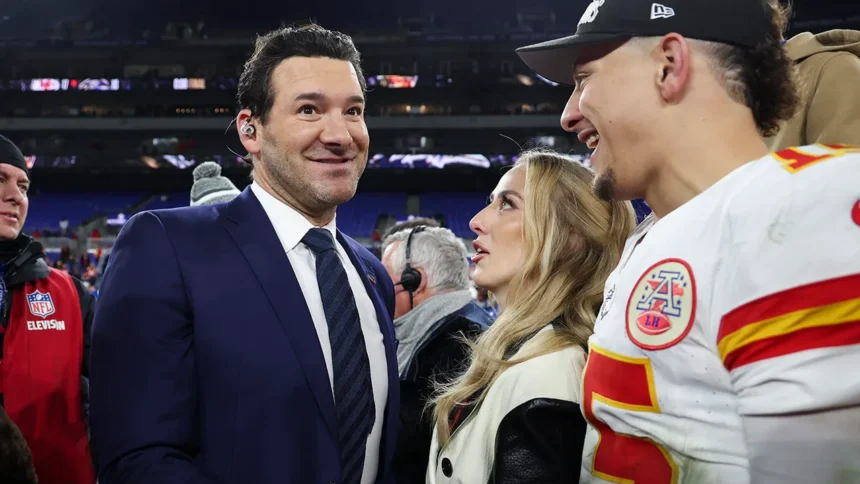
Tony Romo’s Broadcast Style Under Fire Again: The Unraveling of a Once-Promising Analyst?
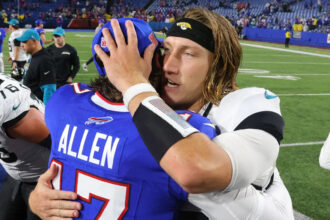
The transition from elite athlete to elite broadcaster is a narrow tightrope, one that few navigate without a wobble. For Tony Romo, the former Dallas Cowboys quarterback whose prescient, energetic commentary once felt like a revelation for CBS Sports, that wobble has turned into a very public stumble. During the Buffalo Bills’ decisive 31-17 Wild Card victory over the Jacksonville Jaguars, it wasn’t just the Jacksonville defense that was under assault; it was Romo’s credibility as a top-tier analyst, as his performance sparked a fresh wave of criticism from fans and media watchers alike, calling into question the future trajectory of his broadcasting career.
From Prophet to Parody: The Evolution of a Broadcast Style
When Tony Romo first entered the booth in 2017, he was hailed as a wunderkind. His ability to predict plays before the snap, born from his recent experience as an NFL quarterback, was a novel and thrilling addition to football broadcasts. He brought an infectious, almost childlike enthusiasm to the role. However, what was once celebrated as refreshing has, for a growing segment of the audience, curdled into caricature. The Wild Card game in Buffalo served as a concentrated dose of the elements that now define the “Romo Experience” for critics.
The broadcast was punctuated by his signature bizarre noisemaking—unintelligible grunts, exaggerated gasps, and staccato bursts of sound meant to convey excitement but often landing as distracting noise. This auditory backdrop framed an analysis of the playoff game that frequently veered into the tangential or overly simplistic, a far cry from the sharp, predictive insight that was his hallmark. The contrast was particularly stark on a weekend where other booths provided crisp, focused commentary, turning Romo’s antics into a glaring point of comparison.
Social Media Erupts: A Fanbase Grows Frustrated
In the modern sports landscape, the immediate reaction to any broadcast occurs in real-time on social media platforms. The court of public opinion convened swiftly during the Bills-Jaguars game, and the verdict was harsh. NFL fans took to X (formerly Twitter), Reddit, and sports forums to voice their mounting frustration.
- Criticism from NFL fans focused on his perceived lack of preparation, with many noting he often misidentified players or seemed unclear on basic defensive schemes.
- Others lamented the constant verbal clutter, arguing it detracted from the game’s natural drama and the work of his more measured play-by-play partner, Jim Nantz.
- A common sentiment was nostalgia for the “early Romo,” with fans posting side-by-side comparisons of his detailed 2018 analysis versus his more scattered 2024 commentary.
This was not an isolated incident but rather the crescendo of a season-long grumble. The “NFL on FOX” crew, discussing the Chicago Bears’ win earlier in the day, represented a different, more analytical style, inadvertently highlighting the divergent path Romo has taken. The social media firestorm underscores a critical challenge for networks: when a broadcaster becomes the story for the wrong reasons, it can overshadow the product on the field.
Diagnosing the Broadcast Breakdown: What Happened to Tony Romo?
So, how did the analyst once gifted a historic $180 million contract by CBS find himself in this position? Expert media analysis points to a confluence of factors. First, the “predictive gimmick” has a limited shelf life. Defenses and offensive coordinators studied Romo’s own film as a player; they’ve certainly adapted to his broadcasting schtick. The league evolved, but Romo’s central trick remained static.
Second, there’s the issue of workload and focus. Romo maintains a high-profile, busy life with golf tournaments, business ventures, and a family. Some observers question if the deep, grueling film study required to maintain elite-level analysis has taken a backseat. Furthermore, his style may have succumbed to self-parody. The whoops and exclamations that were once spontaneous now feel forced and over-amplified, perhaps in an attempt to recapture the initial magic or to manufacture excitement in less compelling games.
Most damningly, his broadcasting chops are now being compared unfavorably to a new generation of analysts. Former players like Greg Olsen (who called the Bears game for FOX) and even Romo’s own successor at CBS, Matt Ryan, are entering booths with a focus on clear, concise, and deeply technical explanation. This next wave is setting a new standard that makes Romo’s current approach seem outdated and unserious.
The Road Ahead: Predictions for Romo’s Booth Future
The critical reaction to the Wild Card game is a significant moment in Tony Romo’s broadcasting career. It moves the conversation from casual fan complaint to a legitimate topic within the sports media industry. Predicting the next step requires looking at the stakeholders.
CBS Sports is heavily invested in Romo, both financially and as a centerpiece of their #1 NFL team. A sudden, dramatic change is unlikely. However, the network is not blind to audience sentiment. The most probable immediate outcome is an internal “course correction.” Producers will likely sit down with Romo before the 2024 season, urging a recalibration—less noise, more nuance, a return to the film room. They may subtly adjust audio levels or direct Nantz to steer conversations more firmly.
Long-term, the clock may be ticking. If ratings or affiliate feedback begins to reflect the social media discontent, CBS will be forced to act. Romo could be shifted off the A-team, a move that would send shockwaves through the industry but would signal the network is prioritizing broadcast quality over brand loyalty. Another possibility is a mutual agreement for an early exit from his massive contract, allowing both parties a fresh start.
Conclusion: A Crossroads in the Booth
Tony Romo’s performance during the Bills-Jaguars playoff game was more than a bad night; it was a stark symbol of a commentator at a professional crossroads. The very qualities that made him a star—his unfiltered enthusiasm and quarterback’s intuition—have, when left unchecked, become his biggest liabilities. The playoff game sparked criticism that can no longer be dismissed as mere nitpicking. It represents a clear and present challenge to his role as a top-tier analyst.
The path forward is clear, though not easy. Romo must decide if he is willing to evolve, to strip away the sizzle and return to the substantive steak of analysis that first won him acclaim. The alternative is a continued descent into self-parody, where his broadcasts become remembered more for their distracting sound effects than for illuminating the beautiful complexity of the sport he once mastered. For fans, broadcasters, and the networks that pay them, the Tony Romo experiment remains one of the most fascinating—and now, most precarious—stories in sports media today.
Source: Based on news from Fox Sports.