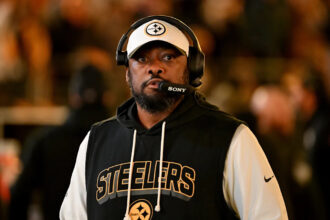
Rodgers Rallies to Tomlin’s Defense: Calls Hot Seat Talk an ‘Absolute Joke’
The cacophony of discontent in Pittsburgh was impossible to ignore. As the Houston Texans dismantled the Steelers 30-6 in the AFC Wild Card round, a familiar, grim soundtrack echoed through Acrisure Stadium: “Fire Tomlin.” For the first time in Mike Tomlin’s storied 17-year tenure, a significant portion of the fanbase voiced its frustration with the NFL’s longest-tenured active coach after a fifth consecutive playoff loss, all by double digits. In the wake of this seismic moment, an unlikely ally has emerged from the NFL fraternity, delivering a forceful and unequivocal defense. New York Jets quarterback Aaron Rodgers, on his weekly appearance on “The Pat McAfee Show,” labeled the notion of Tomlin being on the hot seat as an “absolute joke,” igniting a crucial debate about legacy, expectations, and the modern NFL’s impatient culture.
The Crucible of Consistency in an Impatient League
To understand the weight of Rodgers’ comments, one must first grapple with the duality of Mike Tomlin’s resume. On one side lies a mountain of evidence supporting his Hall of Fame-caliber career. His record of non-losing seasons—extended to 17 straight with this year’s 10-7 finish—is a staggering feat of consistency unmatched in the modern era. He has a Super Bowl ring, a second appearance, and a .632 regular-season winning percentage. He is a master motivator and a proven leader of men, navigating quarterback controversies, tragic events, and roster overhauls with a steady, unflinching demeanor.
Yet, the other side of the ledger reveals the source of the frustration. The playoff record has grown undeniably stale. The lack of postseason success since the 2016 season, characterized by these lopsided losses, suggests a team that often finds its ceiling in simply making the tournament, not advancing in it. The offensive philosophy has frequently been criticized as outdated. For a fanbase weaned on the glory of the 1970s and the success of the 2000s, this era feels like purgatory: too good to bottom out, not sharp enough to truly contend. This is the complex landscape Rodgers stepped into with his pointed defense.
Rodgers’ Reality Check: A Player’s Perspective on Greatness
Aaron Rodgers, a four-time MVP with his own complicated legacy, spoke not as a media pundit but from the perspective of a player who has battled against Tomlin’s teams for nearly two decades. His defense was rooted in a deep respect for the difficulty of Tomlin’s job and the rarity of his accomplishments.
“The idea that Mike Tomlin is on the hot seat is an absolute joke,” Rodgers stated emphatically. He framed Tomlin’s consistent success not as a failure to achieve greatness, but as the very definition of it in a league designed for parity. “What he’s done, the consistency that he’s had, despite all the changes… that’s the mark of a great coach,” Rodgers argued.
Rodgers highlighted several key points that often get lost in the heat of playoff disappointment:
- Organizational Stability: He contrasted Pittsburgh’s sustained model with the “circus” environments and constant turnover plaguing other franchises.
- The Human Element: Rodgers emphasized Tomlin’s ability to connect with and manage diverse personalities across generations, a skill that doesn’t appear on a stat sheet.
- The Parity Principle: He reminded listeners that in the NFL, simply making the playoffs is an enormous challenge, one Tomlin meets virtually every single year.
This player-centric view challenges the fan and media narrative, suggesting that those inside the league understand Tomlin’s value in a way outsiders may not fully appreciate.
Beyond the Record: The 2023 Case Study and Systemic Issues
The 2023 season serves as the perfect microcosm of the Tomlin debate. The Steelers began 7-4, then collapsed to a three-game losing streak where they were thoroughly outclassed. They rallied to win their final three games against inferior opponents to sneak into the playoffs, only to be humiliated by Houston. This rollercoaster pattern has become familiar.
The issues against the Texans were systemic, not a one-off bad day. A porous offensive line, predictable play-calling from since-fired offensive coordinator Matt Canada (and his interim successors), and critical defensive lapses have been season-long themes. The question becomes: how much falls on the head coach? Critics argue that after 17 years, the buck must stop with Tomlin for the recurring offensive failures and lack of playoff preparedness. His supporters, like Rodgers, would counter that Tomlin’s leadership is the very reason the team was even in a position to host a playoff game despite glaring roster flaws and quarterback instability.
The core of the tension is a philosophical divide: Is consistent competitiveness without a true championship threat enough? Or has the standard in Pittsburgh become “Super Bowl or bust,” rendering division-round exits and wild-card berths ultimately unsatisfactory?
The Future: Predictions for Tomlin and the Steelers’ Crossroads
So, what happens next? Despite the chants and the growing external noise, a dramatic change is unlikely in the immediate future. The Rooney family values stability above almost all else, and Tomlin has one year remaining on his contract. However, 2024 now looms as the most pivotal season of his career.
Here are the most likely paths forward:
- The “Run It Back” Reset (Most Likely): Tomlin returns, overseeing a critical offseason. This includes hiring an innovative offensive coordinator with full autonomy, making a definitive decision on quarterback Kenny Pickett’s future, and aggressively addressing the offensive line. The mandate will be clear: show tangible, modern offensive progress and win a playoff game.
- The Mutual Parting After 2024: If next season follows a similar script—a messy playoff berth or, worse, a losing record—the organization and Tomlin could mutually agree that a change is needed. This would allow for a dignified transition rather than a firing.
- The Unexpected Shake-Up (Least Likely): Only a complete breakdown or Tomlin’s own desire for a new challenge would precipitate a change this offseason. The Rooneys are not reactionary owners.
The prediction here is that Mike Tomlin will be the Steelers’ head coach in 2024, armed with a renewed sense of urgency to modernize the offense. The pressure, however, has never been higher.
Conclusion: The Value of the Steady Hand in a Storm
The “Fire Tomlin” chants represent a real and understandable frustration from a passionate fanbase. Five straight playoff losses are unacceptable by the Steelers’ gold-standard history. Yet, Aaron Rodgers’ passionate defense serves as a vital counter-narrative, a reminder from inside the locker room of what true coaching excellence looks like over the grueling marathon of an NFL season.
Firing Mike Tomlin would be the ultimate “grass is greener” gamble. It would mean trading a known entity of profound consistency for the dizzying carousel of coaching uncertainty that defines the bottom half of the league. The challenge for Tomlin and the Steelers is not to prove they can be good—they do that every single year. The challenge, now more urgent than ever, is to prove they can be great again. The solution isn’t to discard one of the NFL’s best coaches, but to finally provide him with the offensive structure and firepower to match his defensive prowess and leadership. The seat may be warming, but as Rodgers rightly pointed out, the idea that Tomlin’s job should be in imminent danger is, for now, a reactionary overstep. The 2024 season will be the ultimate referendum.
Source: Based on news from ESPN.