Offside or Not? The VAR Inconsistency Plaguing English Football
The beautiful game is increasingly defined by the cold, clinical eye of technology. Yet, for all its promise of clarity, the Video Assistant Referee (VAR) system is sowing as much confusion as it resolves. This was laid bare over 24 chaotic hours in the Carabao Cup semi-finals, where two strikingly similar offside situations involving interfering players led to two diametrically opposed decisions. The fallout has left fans, pundits, and clubs asking the fundamental question: if VAR cannot deliver consistency, what is its purpose?
A Tale of Two Semi-Finals: City Denied, Arsenal Awarded
The stage was set at Anfield on Wednesday. Manchester City, locked in a tense battle with Liverpool, thought they had snatched a crucial advantage when Nathan Aké poked home from close range. The on-field decision was a goal. VAR then intervened, scrutinizing the build-up. The focus fell on Manuel Akanji, who, from an offside position, was adjudged to have blocked Liverpool defender Virgil van Dijk as he attempted to clear. The key phrase from the officials: interfering with an opponent. The goal was chalked off, sparking furious debate over the subjectivity of the call.
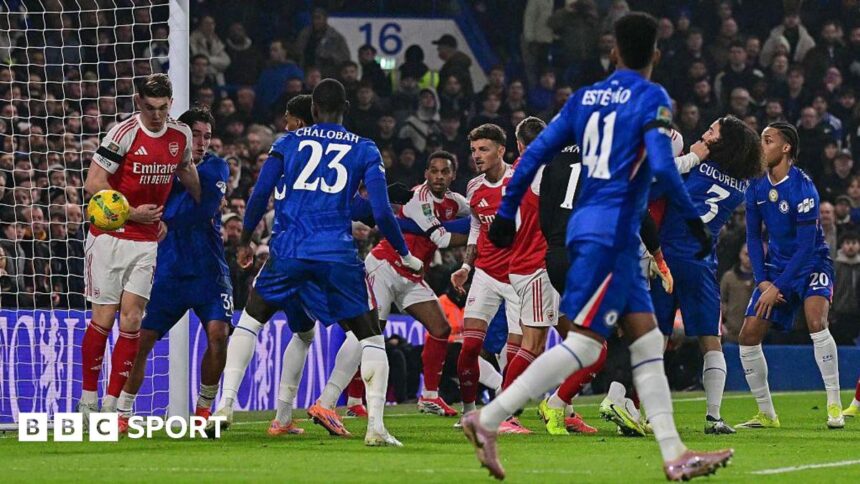
Fast forward 24 hours to the Emirates Stadium. Arsenal’s Ben White bundled the ball over the line against Chelsea, giving the Gunners an early lead. Chelsea’s players immediately protested, pointing to Viktor Gyökeres. The Swedish striker, in an offside position, made a clear movement towards the ball as it flew across the six-yard box, arguably challenging Chelsea goalkeeper Đorđe Petrović. It was a mirror image of the Akanji incident—a player in an offside position involved in the active phase of play. This time, after a review, the verdict was different. The VAR ruled Gyökeres had no material impact on the play, and the goal stood. The football world was left dumbfounded.
Deconstructing the Law: Interference in the Eye of the Beholder
At the heart of this controversy lies Law 11 of the game: Offside. It’s not merely about a player’s position, but their involvement. A player can be penalized for:
- Interfering with play: playing or touching a ball passed or touched by a teammate.
- Interfering with an opponent: preventing an opponent from playing or being able to play the ball by clearly obstructing the opponent’s line of vision or challenging an opponent for the ball.
- Gaining an advantage: playing a ball that rebounds or is deflected off the goalpost, crossbar, or an opponent.
The critical, and fatal, flaw is the interpretation of phrases like “clearly obstructing” and “challenging an opponent.” This is where subjectivity reigns supreme. In the City incident, the officials deemed Akanji’s positioning and movement constituted a challenge on Van Dijk. At Arsenal, they decided Gyökeres’s presence and lunge did not constitute a challenge on Petrović. The lack of a consistent threshold for what constitutes “interference” turns each decision into a high-stakes roll of the dice. Supporters crave a black-and-white rule, but the application exists in a frustrating, debate-fueling shade of grey.
The Human Element: VAR as a Catalyst for Inconsistency
Many believed VAR would eliminate human error. Instead, it has often simply relocated it from the pitch to a dimly lit room at Stockley Park. The system has exposed the varied philosophical approaches different officials take to the same law. One VAR official may operate on a principle of “clear and obvious,” only overturning the on-field call if the interference is blatant. Another may take a more literal, proactive approach, searching for any potential infringement.
This creates a postcode lottery of decisions. The outcome of a pivotal cup semi-final can hinge on which VAR team is on duty that night and their personal interpretation of a deeply subjective clause. The technology provides the evidence, but the human brain must judge it. Without a unified, stringent protocol for judging “interfering with an opponent,” these twin incidents will continue to occur, eroding faith in the system faster than it can build it.
The Road Ahead: Predictions and Necessary Reforms
So, where do we go from here? The immediate prediction is grim: more controversy. As the Premier League title race and cup competitions intensify, every marginal decision will be magnified. The narratives around “VAR luck” will become entrenched, with every club believing they are hard done by. The pressure on officials will reach boiling point.
To salvage the situation, meaningful reform is needed. This must go beyond tweaks and demand a fundamental review:
- Transparent Communication: The Premier League must mandate the public release of the VAR audio for major incidents, as seen in international tournaments. Hearing the officials’ reasoning in real-time fosters understanding, even if disagreement remains.
- Clarification of the Laws The International Football Association Board (IFAB) must work to provide clearer, more objective definitions for “interfering with an opponent.” Can a player’s mere presence in the goalkeeper’s eyeline be quantified? Should there be a distance metric?
- Unified Training: A concerted, global effort to standardize the interpretation of these laws among all VAR officials is non-negotiable. Consistency must be drilled in as the highest priority.
Conclusion: The Search for Footballing Justice
The parallel universes of Manchester City’s disallowed goal and Arsenal’s awarded one have become the defining case study for VAR’s failure to deliver its core promise: consistency. Football has always thrived on passionate debate, but that debate should be about moments of skill and tactical genius, not the inconsistent application of a technological aid. Supporters can accept a wrong decision if it is made in real-time by a human referee. What they cannot accept is a wrong, or seemingly contradictory, decision made after several minutes of forensic analysis. The system is at a crossroads. Without a concerted push for clarity, transparency, and uniformity, VAR will continue to be a source of division, not a tool for justice. The beautiful game deserves better.
Source: Based on news from BBC Sport.