Was Chelsea’s Penalty at Palace a VAR Error or a Referee’s Courageous Call?
The Video Assistant Referee system promises a cold, clinical correction of clear and obvious errors. Yet, as another Premier League weekend demonstrated, its application remains a profoundly human drama, fraught with interpretation, persuasion, and the weight of a split-second decision. At the heart of this weekend’s storm was referee Darren England, whose 48-hour journey from Stockley Park to Selhurst Park spotlighted the persistent, agonizing ambiguity at the intersection of technology and the handball law. The decision to award Chelsea a pivotal penalty against Crystal Palace wasn’t just a match-altering moment; it was a case study in the modern officiating dilemma.
- The Darren England Dichotomy: A Weekend of Reversed Roles
- Anatomy of a Controversial Call: Natural Position or Penalty Offence?
- Expert Analysis: The Shifting Sands of Interpretation
- Predictions: What This Means for the Future of VAR and Handball
- Conclusion: A Correct Harshness or a Technological Misstep?
The Darren England Dichotomy: A Weekend of Reversed Roles
To understand the significance of Sunday’s call, one must rewind to Saturday. Darren England, operating as VAR for Manchester City’s clash with Everton, advised on-field referee Farai Hallam to review a potential handball against Toffees defender Amadou Onana. Hallam, taking charge of his first Premier League game, made a bold and independent choice: he rejected England’s advice, sticking with his on-field decision of no penalty. It was a stunning assertion of the on-field referee’s primacy, a rare moment where the man in the middle overruled the voice in his ear.
Fast forward 24 hours, and the roles were perfectly reversed. At Selhurst Park, England was now the on-field referee. When a Joao Pedro shot struck the arm of Crystal Palace defender Jaydee Canvot in the 17th minute, VAR Michael Salisbury recommended a review. England marched to the pitchside monitor, embarking on a nearly two-minute odyssey of replays. Reports suggest he took a lot of persuading, wrestling with the footage before ultimately pointing to the spot. The man who had his VAR advice dismissed one day was, the next, the referee being persuaded by VAR to change his mind.
Anatomy of a Controversial Call: Natural Position or Penalty Offence?
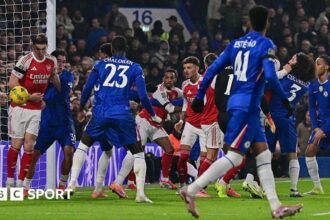
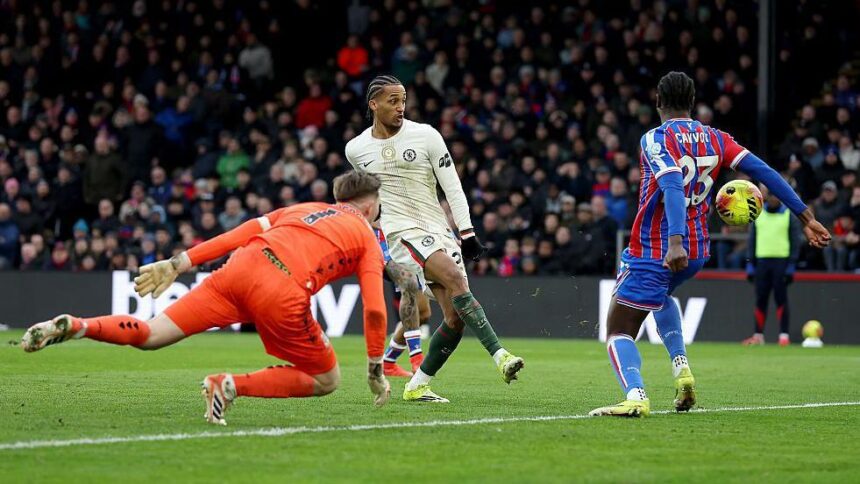
The incident itself is a Rorschach test for football fans. In the 16th minute, Chelsea’s Joao Pedro unleashed a shot from inside the box. Palace’s Jaydee Canvot, attempting to block, turned his body. The ball struck his arm, which was down by his side, not visibly extended away from his torso.
- The Case FOR a Penalty: Proponents of the call argue that Canvot’s action of turning his body made his silhouette larger. The arm, while not wildly outstretched, was not tucked into his chest. Crucially, the shot was goal-bound, and the contact definitively blocked a clear scoring opportunity. Under the strictest interpretations of the law, which considers whether the player’s body has been made “unnaturally bigger,” a penalty can be given.
- The Case AGAINST a Penalty: Critics see a defender in a natural running and blocking motion. The arm’s position is described as a natural position, a consequence of biomechanics. There was no deliberate movement of the arm toward the ball, and the proximity was extremely close. For many, this represents the kind of incidental, unavoidable contact that should not be penalized, lest defenders be forced to play with their arms tied behind their backs.
This is the grey zone. The law states a handball offence occurs if a player “deliberately touches the ball with their hand/arm” or if their arm is in a position that “makes their body unnaturally bigger.” The term “unnaturally bigger” is the vortex of the debate. England’s lengthy deliberation at the monitor underscores just how subjective this judgment remains, even with multiple camera angles and slow-motion replays.
Expert Analysis: The Shifting Sands of Interpretation
Speaking to sources within the game, the consensus is that this decision sits on the harsher end of the spectrum but is not an outright VAR error in the technical sense. VAR’s remit is to intervene for a “clear and obvious error.” Given the divisive nature of the incident, it’s difficult to categorize the on-field “no penalty” call as clearly and obviously wrong.
“What we witnessed was not technology failing, but the enduring problem of interpretation,” notes a former Premier League official. “Darren England was sent to the screen with a likely directive from VAR that a potential error had occurred. His two-minute review wasn’t just about seeing the incident; it was a mental battle between his initial instinct and the pressure of the re-refereeing process. The fact he needed so much persuading tells you everything about the marginal nature of the call.”
The incident also highlights a tactical nuance. Defenders are increasingly coached to block shots with a “slim” profile, arms tightly controlled. Canvot’s more natural posture, while not egregious, fell into a risk zone that officials are increasingly penalizing, especially when the blocked shot is headed for goal.
Predictions: What This Means for the Future of VAR and Handball
This weekend’s events, centered on one official’s strange journey, will have ripple effects.
- Increased Pressure on On-Field Referees: Farai Hallam’s Saturday stand may empower more referees to trust their initial view, potentially leading to fewer pitchside monitor overturns. Conversely, England’s Sunday experience shows how hard it is to resist the VAR review process once engaged.
- More Controversy, Not Less: Until the handball law is simplified or defined with less subjectivity, these debates will rage. The “unnaturally bigger” clause is a permanent source of conflict.
- A Focus on “Phase of Play”: Future guidance may place greater emphasis on the consequence of the handball. Was it a goal-bound shot? Did it directly deny a clear opportunity? This outcome-based thinking, already informally applied, may become more formalized, making penalties for blocks like Canvot’s more common.
Conclusion: A Correct Harshness or a Technological Misstep?
So, was Chelsea’s penalty a VAR error? In the strictest protocol sense, probably not. VAR identified a subjective incident for review, and the referee, after significant personal deliberation, changed his decision. The system “worked” as designed. However, was it the *right* decision in the spirit of the game? That is a far more contentious question.
The award was harsh but defensible under the letter of a notoriously difficult law. It punished a defender for an instinctive action in a high-speed situation, which many feel is an overreach. Darren England’s weekend saga exemplifies the modern referee’s plight: caught between real-time instinct and forensic review, between autonomy and a technological nudge, all while trying to interpret a law that often defies consensus.
The final whistle at Selhurst Park didn’t settle the debate; it merely added another complex chapter. The search for clarity in football’s grey areas continues, and as long as the human element of judgment remains—both on the pitch and in the VAR booth—controversy will never be more than a blocked shot away.
Source: Based on news from Yahoo Sports.