Results, Results: The Pep Guardiola Era vs. The Manchester United Managerial Merry-Go-Round
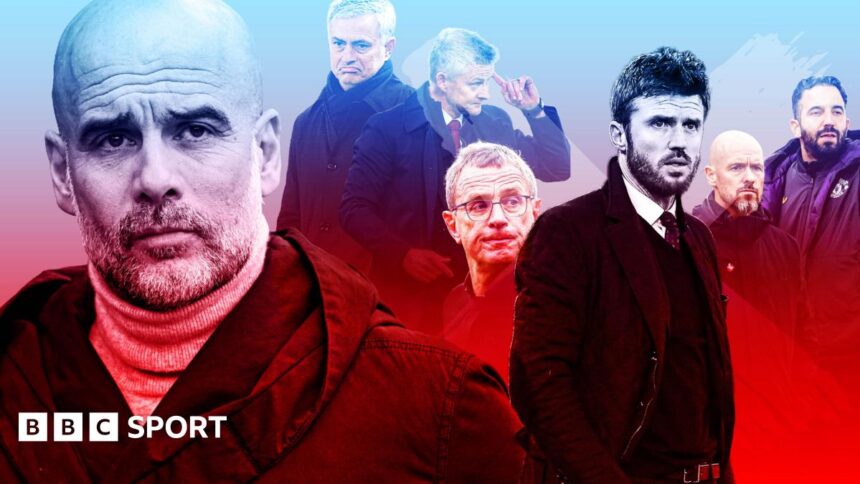
When Pep Guardiola strides into the technical area at Old Trafford this weekend, he will do so as a monument to sustained excellence. Opposite him, in the home dugout, will stand Michael Carrick, a club legend stepping into an impossible interim role. This scene is more than just the 198th Manchester derby; it is a stark, living tableau of the divergent paths these two giants have taken over the past decade. For Guardiola, this match represents another chapter in a meticulously authored dynasty. For Manchester United, Carrick is merely the latest scribble in a chaotic, unfinished manuscript. He will become the sixth different Manchester United manager that Guardiola has faced since arriving in Manchester in 2016—a statistic that tells the entire story of stability versus strife, vision versus vanity, and a relentless pursuit of perfection against a desperate scramble for relevance.
A Decade of Dominance: One Architect, Many Tenants
Guardiola’s reign at the Etihad is defined by a philosophical constancy that has weathered tactical evolutions, squad rebuilds, and intense Premier League pressure. His project was built on a clear identity, backed by a coherent sporting structure, and given the most precious commodity in modern football: time. Contrast this with the revolving door at Old Trafford. Guardiola has been the constant, while United have cycled through a procession of bosses, each tasked with instant revival, each ultimately consumed by the club’s internal turbulence.
Let’s trace the procession Guardiola has outlasted:
- Jose Mourinho (2016-2018): The fiery antagonist. Their clashes were box-office, but while Mourinho won sporadic battles, Guardiola was winning the war, claiming the 2017/18 title with a record 100 points.
- Ole Gunnar Solskjaer (2018-2021): The sentimental choice. Solskjaer promised a return to the “United way” and delivered some memorable moments, but his project ultimately lacked the tactical rigor to consistently challenge Guardiola’s machine.
- Ralf Rangnick (2021-2022 Interim): The “interim consultant.” A confused appointment that symbolized United’s muddled thinking. Rangnick’s brief tenure was a forgettable stopgap.
- Erik ten Hag (2022-2024): The latest project. Promising initial signs gave way to familiar patterns of inconsistency and discord, leading to his dismissal earlier this week.
- Ruben Amorim (2024, briefly): The non-starter. Hired with fanfare after Ten Hag’s exit, Amorim’s reign lasted a matter of months, a shocking misstep that has led to Carrick’s emergency appointment.
- Michael Carrick (2024 Interim): The latest custodian. Thrust into the spotlight for his first-ever managerial job in the fiercest of cauldrons.
This list is a chronicle of institutional instability. Each change brought a new philosophy, new signings, and a new cycle of hope and disappointment. Meanwhile, at City, the foundation never shook.
The Blueprint: How Guardiola Built to Last
Guardiola’s success is not accidental; it is engineered. His ability to outlast every United challenger stems from a synergy between manager and club that United have desperately lacked. The key pillars are undeniable:
Tactical Evolution, Not Revolution: Guardiola’s core principles—possession as a defensive tool, intense pressing, positional fluidity—have remained. Yet, he has masterfully adapted his shapes and personnel, from full-backs moving into midfield to the use of a rampant false nine. He refreshes his team while keeping its soul intact.
Ruthless Squad Management: Sentiment is scarce. Club legends like Yaya Toure, Vincent Kompany, and Sergio Aguero were phased out with respect but without hesitation. The squad is perpetually refreshed, with a blend of world-class talent and hungry academy graduates, all drilled in the same system.
Structural Serenity: The football hierarchy, from the boardroom to the analytics department, is aligned. This allows for long-term planning in transfers and contracts, creating an environment where the manager can purely focus on coaching.
This environment breeds a winning mentality that becomes self-sustaining. Players join City knowing the standard, the style, and the expectation. There is no need for a cultural reset every two years because the culture is ingrained and protected by the man at the helm.
The Red Vortex: A Cycle of Chaos and False Dawns
United’s side of the story is a masterclass in how not to run a football club. Each managerial appointment has been a reaction, often to the previous failure, rather than part of a coherent plan.
Mourinho was hired to win immediately, Solskjaer to heal the club’s spirit, Rangnick to provide a temporary fix, ten Hag to implement a modern pressing game, and Amorim was a bold, data-driven gamble that backfired spectacularly. This inconsistency from the top has cascaded down:
- A disjointed, imbalanced squad with no clear identity.
- A transfer policy that veers from galactico signings to overpays for past-their-prime stars.
- A constant state of transition, where new managers must spend precious time undoing the work of their predecessor.
The result is a club that has become a reactive institution, lurching from crisis to crisis, while their neighbors operate with the calm, proactive assurance of a superpower. The derby is no longer just a game; it is an annual audit of these contrasting models, and the audit reports have been damning for United for years.
Derby Day Preview: Calm Meets Chaos
Saturday’s encounter is perhaps the most symbolic derby yet. Guardiola’s City arrive with their typical relentless pursuit of the title, a well-oiled machine seeking another three points. Every pass, every press, every movement will be a product of years of meticulous work.
Michael Carrick’s United, however, are in total disarray. His first game in charge comes amid a storm. What can he possibly implement in a few days? The likely approach will be one of damage limitation: a low block, hoping for moments on the counter-attack or from set-pieces, and an appeal to the players’ pride. The focus will be on effort and organization—basic concepts that should be a given at a club of United’s stature.
Key Prediction: The gulf in preparation and clarity will be decisive. City’s control and patience will likely overwhelm a United side low on confidence and tactical cohesion. Expect Guardiola’s men to dominate possession, probe for weaknesses, and eventually break through. A United upset would require individual brilliance and defensive heroics of the highest order, a flicker of chaos against the machine.
Conclusion: The Ultimate Testament to a Legacy
The fact that Pep Guardiola is preparing to face his sixth Manchester United manager is the ultimate testament to his, and Manchester City’s, era-defining success. It is a record that speaks louder than any trophy lift. It encapsulates the virtues of patience, vision, and elite-level consistency. For United, the statistic is an indelible mark of failure, a symbol of a lost decade spent chasing ghosts and quick fixes while their rival built an empire.
As the two teams walk out at Old Trafford, the narrative is set. On one side, a philosopher-king approaching a decade of dominion. On the other, a loyal soldier handed the keys to a kingdom in ruins. The result on Saturday will be fleeting, but the underlying story—of how Guardiola outlasted them all—is the defining footballing parable of modern Manchester. For City, it’s always about the next result, and the next title. For United, until they find their own version of stability, it will remain only about the next manager.
Source: Based on news from BBC Sport.