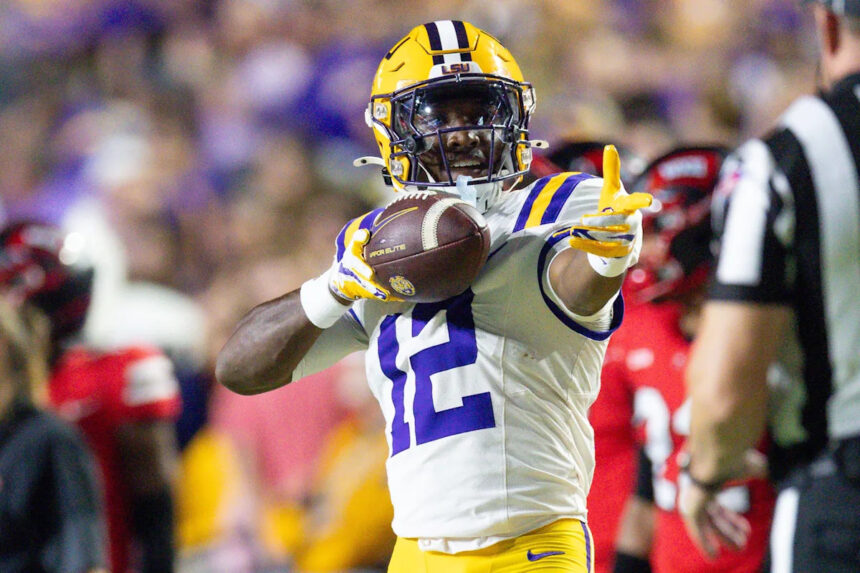
Ohio State Bolsters Receiver Room with Transfer Portal Addition of LSU’s Kyle Parker
In the high-stakes world of college football roster construction, the closing of the spring transfer portal window doesn’t signal the end of movement—it signals the beginning of strategic final touches. For the Ohio State Buckeyes, a program with national championship aspirations etched into every drill, the final weekend of the portal period yielded a calculated, under-the-radar acquisition. According to recruiting analyst Hayes Fawcett, former LSU wide receiver Kyle Parker has committed to Ohio State, adding another layer of talent and experience to what is already considered the nation’s most formidable wide receiver room.
While the name might not ignite the immediate frenzy of a five-star freshman signing, Parker’s arrival is a classic Ryan Day-era move: identifying proven Power Five talent to create depth, foster competition, and insulate against the inevitable attrition of a long season. This isn’t a desperation grab; it’s a chess move in a game where having the deepest, most skilled arsenal of pass-catchers is non-negotiable. Parker, a former four-star prospect, isn’t coming to Columbus to simply fill a jersey. He’s entering a fascinating positional puzzle that could have significant ripple effects on the Buckeyes’ offensive configuration this fall.
Who is Kyle Parker? Analyzing the Buckeyes’ New Weapon
To dismiss Kyle Parker’s production at LSU as merely pedestrian would be to ignore the context of his environment. In 2023, operating in a crowded SEC receiver room and sharing targets with Malik Nabers and Brian Thomas Jr.—both likely first-round NFL Draft picks—Parker quietly carved out a valuable role. He hauled in 31 receptions for 330 yards and four touchdowns. His skillset is defined by reliability and a nuanced understanding of the slot position.
Here’s a breakdown of Parker’s profile and fit:
- Proven SEC Production: Caught passes in the nation’s toughest conference, with his four touchdowns showcasing a nose for the end zone.
- Elite High School Pedigree: A former four-star recruit from Lovejoy High School in Lucas, Texas—the same program that produced current OSU linebacker Payton Pierce. He was ranked as the No. 47 receiver in the 2023 class.
- Transfer Portal Valuation: Rated as the No. 68 overall pass-catcher available in the portal by 247Sports, indicating a player with significant upside in a new system.
- Primary Position: Operated mainly out of the slot at LSU, demonstrating quickness in short areas, reliable hands over the middle, and an ability to work against zone coverage.
Parker is not a burner who will consistently take the top off a defense. Instead, he profiles as a savvy, chain-moving receiver who can excel on third down and in the red zone—areas where precision and trust between quarterback and receiver are paramount.
The Slot Receiver Conundrum: Parker, Inniss, and the Impending Henry Jr. Wave
Parker’s commitment throws a fascinating wrinkle into Ohio State’s receiver depth chart, specifically at the slot position. Last season, Brandon Inniss emerged as the primary option in the slot, showing flashes of his own high-profile potential. The arrival of Parker creates immediate competition and offers the coaching staff flexibility. Two primary scenarios now exist, both laden with potential.
Scenario 1: Parker Wins the Slot, Inniss Moves Outside. If Parker’s experience and polish translate quickly to Ohio State’s system, he could stake a claim to the starting slot job. This would allow the Buckeyes to explore moving the dynamic Inniss to an outside receiver position. Inniss possesses the size and athleticism to play outside, and such a move could diversify the offense, creating mismatches with his physicality against smaller cornerbacks. This scenario would see Parker as a key starter, with Inniss joining Emeka Egbuka and Carnell Tate in a devastating three-wide set.
Scenario 2: Inniss Holds the Slot, Parker Becomes Elite Depth. The more likely immediate outcome may see Inniss retaining his role, with Parker serving as an overqualified backup and key rotational piece. This is where the true value of the transfer shines. In today’s college football, your fourth, fifth, and sixth receivers are not mere practice players; they are starters-in-waiting who will play crucial snaps. Parker provides a safety net and a known commodity that allows the staff to manage workloads without a dramatic drop-off in production.
Looming over all of this is the arrival of five-star freshman Chris Henry Jr. this summer. The son of the late Bengals star is a generational talent who will demand playing time. His versatility means he could be factored in outside or in the slot, further intensifying the competition. Parker’s presence ensures that Henry Jr. is not forced into action before he’s ready, allowing for a more natural development curve while simultaneously pushing every player in the room.
Strategic Depth: Why the Parker Move is a Masterstroke for 2024
On the surface, adding a receiver to a room featuring Egbuka, Tate, Inniss, and Jayden Ballard might seem redundant. But for a team with Ohio State’s goals, it is a necessity. The 2023 season was a stark lesson in the fragility of a receiving corps, even one dripping with talent. Injuries happen. The transfer portal giveth, and it can taketh away. By adding Parker, Ohio State achieves several critical objectives:
- Insurance Policy: He is a ready-made, Power Five starter who can step in without the offense skipping a beat should injury strike.
- Practice Elevation: Iron sharpens iron. Parker’s experience and skill will raise the level of competition in every practice, making the entire unit better.
- Portal Proofing: In an era of constant roster fluctuation, securing a player of Parker’s caliber *after* the portal closes is a win. It solidifies the group for the entire season, barring any unexpected departures.
- Quarterback Comfort: Whether it’s Will Howard, Devin Brown, or Julian Sayin taking the snaps, having a reliable, experienced safety valve like Parker in the middle of the field is a quarterback’s best friend.
This move is less about finding a superstar and more about eliminating a potential weakness. It turns a position of strength into an impregnable fortress. The coaching staff is not just building a starting lineup; they are constructing a roster capable of withstanding the 12-game grind of a Big Ten schedule and the pressurized environment of the College Football Playoff.
Final Verdict and What’s Next for the Buckeyes
The commitment of Kyle Parker will not dominate the headlines in the way a quarterback or edge rusher transfer might. However, for those who understand the nuances of building a championship-caliber team, it is a signature move of the modern era. He is a high-floor player who provides immediate stability and intense competition at a premium position.
Predicting the exact outcome of the slot receiver battle is premature before summer camp even begins. What is certain is that Parker will have a legitimate opportunity to earn significant playing time. His most probable and valuable role may be as the quintessential “WR4″—a player who would start for 90% of Power Five programs but at Ohio State becomes the ultimate luxury, a weapon deployed in specific packages and a guardian against any drop-off in offensive firepower.
As the transfer portal window officially slams shut, Ohio State’s work may not be completely finished. The focus now shifts to any potential late additions, particularly along the offensive line or in the secondary. But with the securing of Kyle Parker, the Buckeyes have already addressed a subtle but critical need. In the relentless pursuit of a national title, it’s not always the flashiest moves that make the difference. Sometimes, it’s the shrewd, calculated addition of a proven SEC receiver who makes an already elite unit truly unstoppable. The depth chart just got more interesting, and the Ohio State offense just got a whole lot deeper.
Source: Based on news from Yahoo Sports.