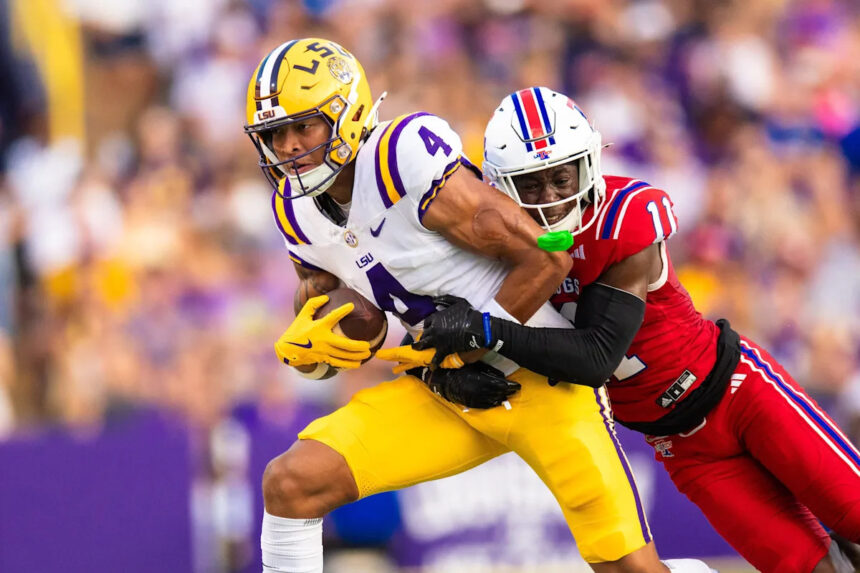
Nic Anderson’s SEC Odyssey: From LSU to Kentucky, a Receiver Seeks His Final Act
The life of a college football transfer in the modern era is one of constant motion, a search for the right fit, the right scheme, and the right opportunity to unlock potential. Few journeys embody this nomadic reality quite like that of wide receiver Nic Anderson, whose career path is now etching a unique zigzag across the Southeastern Conference map. After stints at Oklahoma and LSU, Anderson has found his next destination, committing to the Kentucky Wildcats and marking his third SEC school in as many years. This move isn’t just a simple roster transaction; it’s a critical pivot point for a once-heralded recruit seeking to reclaim his trajectory and for a Kentucky program aggressively building through the portal under Mark Stoops.
A Career Forged in Norman, Derailed by Injury
To understand Anderson’s present, you must first look to his promising past at Oklahoma. Signed as a coveted four-star prospect in the 2022 class, Anderson possessed the prototype size and ball skills that make coaches dream. His sophomore campaign in Norman was a legitimate breakout: 38 receptions for 789 yards and 10 touchdowns, establishing him as a potent deep threat and red-zone nightmare for Big 12 defenses. He wasn’t just productive; he was explosive, averaging a staggering 20.8 yards per catch. The trajectory pointed squarely toward stardom.
However, the 2024 season brought a harsh detour. An injury, the specifics of which were closely guarded, significantly limited his capabilities and playing time. The player who once dominated secondaries was now a spectator, and the frustration culminated in his decision to enter the transfer portal for the first time. It was a classic case of “what could have been,” leaving a tantalizing talent available for a program willing to bet on his recovery.
The LSU Interlude: A Muted Season in Baton Rouge
LSU, under Brian Kelly, won the recruitment battle, bringing Anderson into a receiver room known as “WRU” for its prolific output. The fit seemed logical: a need for experienced playmakers to complement their stars. Yet, Anderson’s single season in Baton Rouge never reached the heights of his Oklahoma peak. Statistically, it was a quiet year: 12 catches for 106 yards and two touchdowns across 10 games and three starts. The critical, unanswered question that hung over his season was his health. Was he ever at 100%? Analysts and fans alike debated whether the spring practice reports of him looking sharp translated to full-game fitness during the fall, or if he was perpetually playing catch-up from the previous year’s setback.
His departure from LSU this offseason was part of a larger exodus of pass-catchers, a room reshaped by both graduation and portal entries. Notably, while Anderson sought new pastures, LSU head coach Brian Kelly opted for a different portal strategy, focusing elsewhere. This left a player still ranked as the No. 61 wide receiver in the transfer portal by Rivals’ Industry Rankings to find a third chance to prove himself.
Why Kentucky? The Scheme and Opportunity Fit
On the surface, Kentucky might not seem the obvious choice for a receiver looking to boost his draft stock. The Wildcats’ offensive identity under Stoops has been traditionally ground-centric. But look closer, and Anderson’s decision is a shrewd calculation. Kentucky is in the midst of an offensive overhaul, bringing in Bush Hamdan as the new offensive coordinator. Hamdan’s system, influenced by his time at Boise State and Washington, promises more balance and creativity in the passing game. For Anderson, it represents a clean slate and a clear opportunity to be a featured weapon in a scheme looking to make a statement.
Furthermore, Kentucky has made no secret of its intent to weaponize the transfer portal at the skill positions. They are building a veteran, competitive room designed for immediate impact. Anderson brings something they lack: proven, high-end SEC size and a resume that includes a true 700-yard season. He won’t be handed a job, but the path to significant snaps is far more visible than it might have been in a more crowded, established receiver corps elsewhere.
- Scheme Fresh Start: New OC Bush Hamdan’s system needs a go-to “X” receiver, a role Anderson’s 6’4″ frame is built for.
- Immediate Role Potential: Kentucky lost its top receivers from 2024, creating a vacuum of production and experience.
- Proven Production: Despite recent struggles, his 2023 Oklahoma tape shows a ceiling Kentucky’s current roster hasn’t demonstrated.
- Development Reputation: Kentucky has a strong track record of developing transfer talent, particularly on defense, and is aiming to replicate that on offense.
Expert Analysis: The Risk and Reward for Both Sides
This transfer is a fascinating high-risk, high-reward scenario for both Anderson and the Kentucky Wildcats.
For Anderson: This is likely his final audition. Having played at three major programs, the narrative of “untapped potential” only lasts so long. NFL scouts will want to see the 2023 Oklahoma version, not the 2024 LSU version. He must demonstrate that he is fully healthy, mentally resilient, and capable of being a consistent, dominant force in the nation’s toughest conference. The pressure is immense, but the platform is perfect. Succeeding in the SEC, at a third school, would be a powerful testament to his character and skill.
For Kentucky: The Wildcats are taking a calculated gamble on a player’s medical history. If Anderson regains his form, he could be the single most important addition to their offense, providing a reliable, big-bodied target for quarterback Beau Allen or Georgia transfer Brock Vandagriff. He would instantly elevate their passing game from a weakness to a legitimate threat. If the injury concerns persist or his production remains muted, it becomes another portal miss in a position where they invested heavily. Coach Stoops and OC Hamdan are betting on their culture and their ability to unlock a premium talent.
Predictions for the 2025 Season in Lexington
Setting realistic expectations is key. It’s unreasonable to expect Anderson to immediately post 1,000-yard numbers in an offense and conference known for its physicality. However, a successful season for Anderson at Kentucky would look like this:
- Becoming the team’s primary red-zone threat, using his size to haul in 6-8 touchdowns.
- Providing a consistent chain-moving presence on third downs.
- Averaging over 15 yards per reception, re-establishing his big-play capability.
- Finishing the season as Kentucky’s clear leader in receiving yards, likely in the 650-850 yard range.
More than stats, his impact will be measured by how he forces defenses to adjust, opening lanes for Kentucky’s stable of running backs and creating opportunities for other receivers. If he stays healthy, he will be the focal point of Kentucky’s aerial attack and could play himself back into late-round NFL draft consideration.
Conclusion: The Final Chapter of a Collegiate Journey
Nic Anderson’s winding road from Oklahoma to LSU to Kentucky is a microcosm of modern college football. It’s a story of promise, adversity, resilience, and the relentless pursuit of the right opportunity. His career has been a rollercoaster of spectacular highs and injury-induced lows. Now, in Lexington, he finds himself at a program hungry for offensive playmakers and led by a coach who has built a reputation on maximizing talent.
For Kentucky, this is more than just adding a receiver; it’s a statement of intent for their new offensive direction. For Anderson, it’s the final, best chance to author the ending his talent always promised. The SEC has watched him in two different uniforms. The third, Kentucky blue, will determine whether his story is remembered as a cautionary tale of “what if” or a triumphant saga of perseverance and ultimate success.
Source: Based on news from Yahoo Sports.