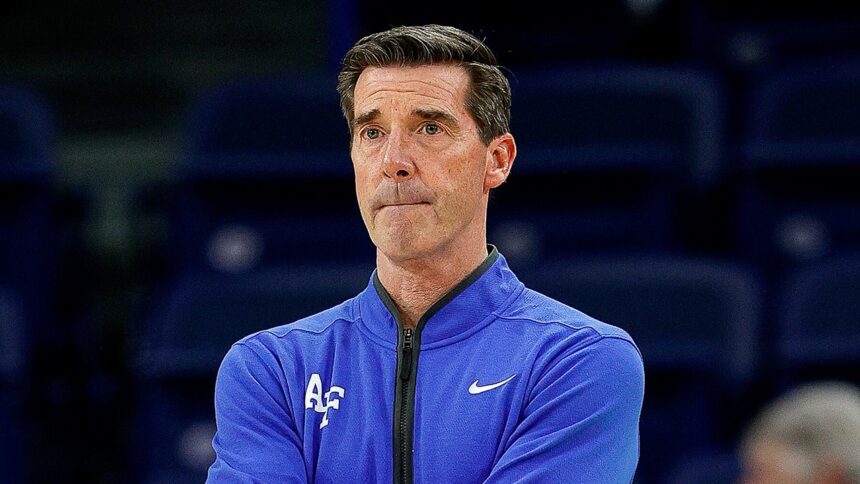
Air Force Basketball Coach Joe Scott Suspended Indefinitely Amid Investigation into Treatment of Cadet-Athletes
In a stunning development that has sent shockwaves through the collegiate sports landscape, the United States Air Force Academy has suspended head men’s basketball coach Joe Scott indefinitely. The suspension, announced Saturday, is pending a thorough investigation into the treatment of cadet-athletes under his leadership. This move places a glaring spotlight on the unique and demanding intersection of elite military discipline and high-stakes Division I athletics, raising profound questions about leadership, culture, and the welfare of those who are training to serve their country.
The academy’s terse statement offered no specifics, noting only that assistant coach Joe Jordan will assume interim head coaching duties and that “no further information was releasable at the time.” This veil of secrecy is characteristic of military protocol but fuels intense speculation about the nature of the allegations against Scott, a 60-year-old coach currently in his second stint leading the Falcons. The abruptness of the suspension, mid-offseason, suggests the allegations are of a serious and immediate concern to academy leadership.
The Scott Era: A Legacy Now Under a Microscope
Joe Scott’s history with Air Force basketball is complex and deeply woven into the program’s modern identity. His first tenure, from 2000 to 2004, is legendary in Colorado Springs. He is the architect of the “Princeton offense” era that culminated in a magical 2003-2004 season, where the Falcons won 22 games, captured the Mountain West Conference regular-season title, and earned an NCAA Tournament berth. That team, celebrated for its intelligence, precision, and grit, epitomized the ideal of the scholar-soldier-athlete.
After departing for Princeton and later Denver, Scott returned to Air Force in 2020, hailed as a prodigal son who could restore the program’s fading fortunes. The challenge was immense: replicating a past success in a transformed collegiate athletics environment. The results on the court have been a struggle, with the team failing to post a winning record since his return. Now, the investigation shifts the focus entirely away from wins and losses to the environment within the program itself.
The central, unanswered question is: what constitutes unacceptable “treatment” in this specific context? The Air Force Academy is not a typical university. Its mission is to develop leaders of character for the U.S. Air and Space Forces. Its daily life is defined by rigorous military training, academic pressure, and an unwavering commitment to a core value set: “Integrity First, Service Before Self, Excellence in All We Do.” The basketball program exists within this crucible.
- Cadet-athletes face a dual burden unparalleled in college sports: the demands of Division I competition alongside the relentless rigors of military cadet life.
- Coaching at a service academy requires a nuanced balance of tough love and mentorship, pushing athletes to their limits while ensuring those methods align with the institution’s character-building mission.
- The investigation will likely scrutinize whether Scott’s methods, perhaps acceptable in a purely civilian setting, crossed a line within the Academy’s unique ethical and leadership framework.
Expert Analysis: The Uniquely Charged Atmosphere of Service Academy Sports
To understand the gravity of this suspension, one must look beyond the basketball court. “Coaching at a service academy is the toughest job in college sports,” says a former athletic department official at a sister academy who spoke on condition of anonymity. “You’re not just developing players; you’re molding future officers. The margin for error in leadership style is razor-thin. What might be seen as intense coaching elsewhere can be perceived as contradictory to the core values here.”
The treatment of cadet-athletes is a perennial and sensitive topic. These young men and women have fewer avenues for relief or transfer than their civilian peers. Leaving the program often doesn’t mean just changing schools; it can mean a fundamental shift in their life trajectory and service commitment. This power dynamic places an extraordinary responsibility on coaches to be stewards of both talent and character.
The investigation will be multifaceted. It will certainly involve interviews with current and potentially former players, staff, and a review of practice footage and internal communications. The adjudicating body will be less concerned with NCAA rules and more focused on the Air Force Academy’s Honor Code and leadership directives. The outcome hinges on a determination of whether Scott’s conduct was merely harsh or fundamentally at odds with the institution’s mandate to foster “dignity and respect.”
Predictions and Potential Ramifications for Air Force Basketball
The immediate future for Air Force basketball is one of profound uncertainty. With Joe Jordan taking the reins on an interim basis, the program faces a critical offseason of recruiting, player development, and roster management under a cloud. The potential ramifications are wide-ranging:
- Player Retention: The current cadet-athletes, who chose Air Force in part because of its unique environment, may experience a crisis of confidence. The possibility of transfers, though complex at a service academy, could decimate the roster.
- Recruiting Collapse: Competing for talent is already a monumental challenge for service academies. An ongoing investigation into player treatment is a devastating narrative on the recruiting trail, potentially setting the program back years.
- Institutional Scrutiny: This incident will likely trigger a broader review of all athletic programs at the Academy to ensure coaching philosophies are in lockstep with the military’s leadership principles.
- Permanent Change: If the investigation substantiates allegations of misconduct, it is difficult to envision a path for Scott’s return. The Academy’s commitment to its values and its cadets must be seen as absolute. A clean break and a national search for a leader who can navigate this unique terrain would be the most probable outcome.
The timing is also precarious. As the college sports world grapples with athlete empowerment and transfer freedom, this crisis at Air Force underscores that the most vulnerable athletes may be those bound by service commitments, making the ethical conduct of their coaches even more paramount.
Conclusion: A Defining Moment for Culture and Character
The indefinite suspension of Joe Scott is more than a sports headline; it is a stark reminder of the extraordinary covenant between a service academy and those entrusted to its care. The Air Force Academy does not produce professional athletes; it produces officers and pilots. Its basketball program, like all its endeavors, is ultimately a vehicle for leadership development.
This investigation will test the Academy’s resolve to live by its own stated values. It presents a defining moment: will it protect the institution’s reputation, or will it protect the welfare and dignity of its cadet-athletes? The two should be inseparable. As the probe unfolds behind closed doors, the entire college sports world will be watching to see how this revered institution handles a crisis at the heart of its mission. The outcome will resonate far beyond the hardwood of Clune Arena, speaking volumes about the price of success, the boundaries of leadership, and the sacred trust inherent in educating those who have volunteered to defend the nation.
Source: Based on news from Fox Sports.