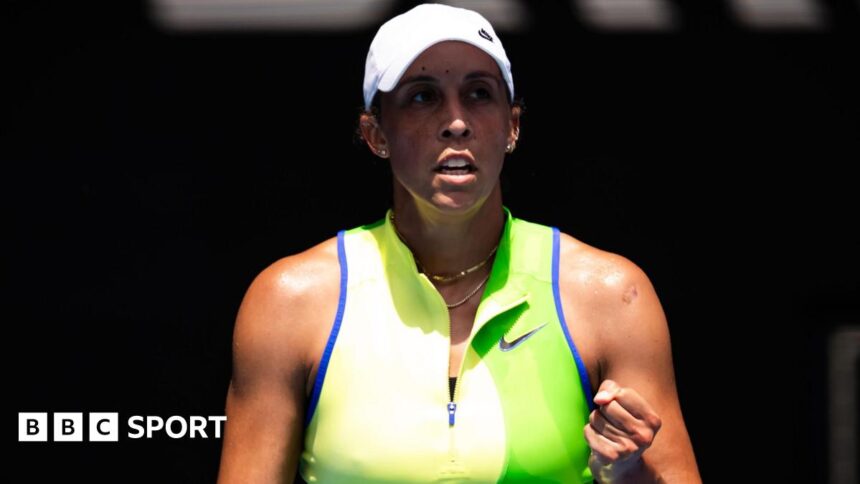
‘Timid’ Keys Overcomes Opening Jitters to Launch Australian Open Title Defence
The walk back onto Rod Laver Arena as defending champion is a journey laden with ghosts and glory. For Madison Keys, that first step into the Melbourne spotlight she conquered a year ago was heavier than expected. In a tense, opening-round battle that defied the script, the fourth-oldest first-time major winner in history didn’t just face an unknown qualifier; she confronted the immense weight of expectation, her own nerves, and the daunting phantom of her own fairytale. Her 7-6(3), 6-2 victory over Ukraine’s Oleksandra Oliynykova was less a statement of intent and more a raw, revealing lesson in the gritty art of championship survival.
The Unseen Opponent and the Weight of the Crown
If the pressure of defending a maiden Grand Slam title wasn’t formidable enough, Keys was handed a uniquely disorienting first test: a mystery. Oleksandra Oliynykova, a 27-year-old ranked 150th in the world, was making her Grand Slam main-draw debut. In the modern game, where data and match footage are sacred preparation tools, Keys found herself navigating in the dark. “I was definitely more nervous than I normally am,” Keys confessed post-match, highlighting the unique challenge. The lack of actionable intelligence on her opponent’s game meant Keys wasn’t just playing Oliynykova; she was battling the unknown, all while the spectre of her 2023 triumph loomed large.
The start was jarring. The powerful, free-flowing game that bulldozed the field last January seized up. Unforced errors flew from Keys’ racquet as the composed, defensive Oliynykova absorbed pace and extended rallies. Before the Melbourne crowd could settle, Keys found herself staring at a 0-4 deficit, the title defence threatening to become the shortest in recent memory. The contrast was stark: the veteran champion looked timid and edgy, while the debutant played with the liberating nothing-to-lose freedom Keys herself enjoyed twelve months prior.
Expert Analysis: The Anatomy of a Comeback
This match provided a masterclass in the mental shift required from hunter to hunted. Keys’ initial struggle wasn’t purely technical; it was existential. The big-hitting game that defines her success is built on rhythm and confidence. Against an opponent whose style she couldn’t pre-visualize, that confidence evaporated. Oliynykova’s deep, looping balls and relentless defence disrupted Keys’ timing, forcing her to generate all her own pace—a task that grows exponentially harder under a blanket of nerves.
However, the comeback revealed the champion’s steel that was forged last year. Keys’ path to victory hinged on two critical adjustments:
- Emotional Reset: After the 0-4 start, Keys visibly focused on controlling her breathing and body language. She simplified her goals, point by point, divorcing herself from the macro-pressure of the title defence.
- Tactical Patience: She gradually traded sheer power for smarter court positioning and began using her formidable forehand to construct points, rather than end them immediately. Winning the first-set tiebreak was the crucial catalyst, allowing her innate power to finally flow unshackled in the second set.
“It’s a completely different feeling walking out as the defending champion,” Keys noted, articulating the unique psychological hurdle. Her ability to navigate that feeling, however imperfectly, may prove more valuable than a straightforward blowout.
Predictions: What This Means for Keys’ Title Defence
While the scoreline will ultimately read as a straight-sets win, the narrative is far more complex. For Keys, this shaky start could be a blessing in disguise. A dominant win might have masked lingering anxieties; instead, this match forced her to confront and overcome them immediately. The road ahead remains treacherous, with harder-hitting, top-tier opponents lying in wait who will not afford her a four-game head start.
Key factors for her continued campaign will include:
- First-Serve Percentage: Keys’ serve is her ultimate weapon. When it fires, it shortens points and keeps opponents on the back foot. This will be non-negotiable against higher seeds.
- Embracing the Target: Now that the first-match nerves are exorcised, can she transition from feeling the pressure to wielding it? Her experience as a major winner must become a tool, not a burden.
- Adaptability: This match proved she can problem-solve mid-match against an unfamiliar style—a crucial skill in the unpredictable ecosystem of a Grand Slam draw.
Expect Keys to be significantly sharper in the second round. The fairytale run of 2023 is now a memory; the 2024 campaign is a fight. This opening battle proved she is still willing to scrap for it.
Conclusion: Grit Over Glamour in the First Step
Madison Keys’ title defence began not with a roar, but with a tremble and a hard-fought sigh of relief. In the end, her victory over Oleksandra Oliynykova may be more instructive than any highlight-reel demolition. It underscored a profound truth in sports: defending a crown often requires a different, more resilient kind of magic than winning it in the first place. For Keys, the Australian Open triumph last year was a dream realized. This year is about proving that dream built a foundation of lasting champion’s grit. By overcoming her own “timid” start and the unique tension of the unknown, she passed her first—and perhaps most revealing—test. The path to retaining the Daphne Akhurst Memorial Cup is long, but the first, most nervous step is now firmly behind her.
Source: Based on news from BBC Sport.