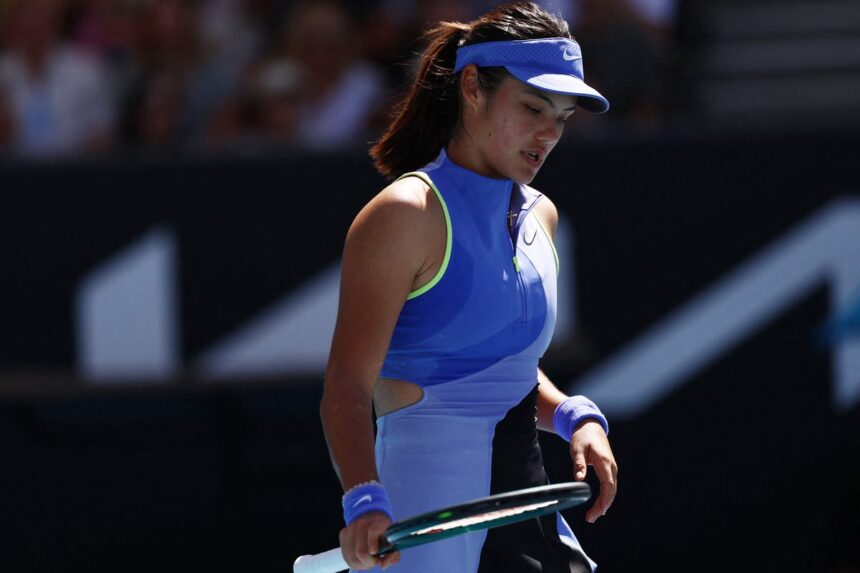
Emma Raducanu’s Australian Open Exit Exposes a Damning Identity Crisis
The narrative was supposed to be one of resurgence. After a year lost to surgeries and a grueling rehabilitation, Emma Raducanu’s return to the Australian Open carried the hope of a fresh start. Instead, her second-round exit to Anastasia Potapova has left behind a far more troubling conclusion. Beyond the foot injury, beyond the tricky Melbourne winds, Raducanu’s defeat laid bare a fundamental and damning truth: four-and-a-half years after her seismic US Open triumph, the most unexpected Grand Slam champion in history is still, startlingly, searching for who she is as a tennis player.
The Unfair Shadow of a Flushing Miracle
Raducanu herself is acutely aware of the distorted lens through which her career is viewed. Winning a major as an 18-year-old qualifier, without dropping a set, was a feat of such staggering improbability that it instantly recalibrated all expectations. It created a paradox: a player with the ultimate trophy but without the foundational career scaffolding upon which champions are usually built. The learning curve, the gradual building of a game identity, the process of weathering tour-level storms—all of it was circumvented by a lightning strike of perfection in New York.
That victory set an unfair benchmark for an inexperienced athlete, one that has made every subsequent stumble feel like a crisis rather than a step in a normal development path. As Raducanu noted, the attempt to evolve and add layers to her game in the years since has, by her own admission, not worked. The Australian Open was not just a tournament loss; it was the moment she publicly acknowledged the project has gone awry. “I need to just work on playing in a way more similar to how I was playing when I was younger,” she conceded. It is a stunning admission for a former champion: to move forward, she must first go back.
The Missing “Identity”: A Champion Without a Core
In her analysis of the Potapova defeat, Raducanu pinpointed the core issue with chilling clarity: the absence of a tennis “identity.” This is the most damning revelation of all. Elite athletes, especially in an individual sport like tennis, are built upon a non-negotiable core—a foundational style they revert to under pressure. For Rafael Nadal, it is ferocious topspin and relentless fight. For Serena Williams, it was overpowering serve and return dominance.
Raducanu’s identity in 2021 was clear: fearless, first-strike tennis, taking the ball early and redirecting it with audacious precision, particularly off the forehand wing. In Melbourne, that player was nowhere to be seen. What replaced her was an erratic and tentative competitor, playing not to lose, scrapping to survive. The weapon that defined her miracle run—the big, early forehand—deserted her as errors piled up.
Key symptoms of the identity loss included:
- Tentative Shot Selection: Hesitation on crucial points, opting for safe, central balls instead of aggressive corner-seeking strikes.
- Fragile Confidence: A visible drop in body language after losing the first-set tiebreak, with minimal engagement from her coaching box.
- Over-Complication: Raducanu’s mention of “doing all this variety” suggests a game cluttered with ideas but lacking a central, trusted philosophy.
The Coaching Carousel and the Quest for Stability
The root of this identity crisis can be traced, in part, to the chaotic aftermath of her US Open win. The revolving door of coaches that followed—five in less than two years—meant Raducanu’s game was subjected to a constant stream of new voices, tactics, and technical tweaks. Each change promised progress but likely contributed to a sense of fragmentation. “I think there are just many iterations that are going on and have gone on,” she said, a telling description of a career lacking a coherent narrative.
Her current partnership with Francisco Roig, a seasoned coach from the Nadal dynasty, represents a clear push for stability and clay-court grit. Yet, the subdued, almost disconnected performance against Potapova raises questions about how effectively those lessons are translating, especially on hard courts where her natural game should flourish. Stability is only valuable if it helps crystallize, not further obscure, a player’s authentic weapons.
Path Forward: Simplification or More Struggle?
Raducanu’s prescription for her ailment is tellingly simple: “I just want to hit the ball to the corners and hard.” This is a call to return to instinct, to strip away the accumulated noise and play to her innate strengths. The challenge now is whether she can build a consistent, tour-level game around that primal instinct while adding the necessary physical resilience.
The immediate future involves a foot injury assessment and a period of “re-evaluation.” The predictions for her 2024 season are now heavily qualified:
- Short-Term: Expect a period of experimentation and likely inconsistency as she seeks to rediscover her aggressive base. Results may remain volatile.
- Medium-Term: Success hinges on her and Roig defining a non-negotiable game style. Will they commit to the first-strike aggression of 2021, or a more constructed, physical approach?
- Long-Term: Raducanu’s ceiling remains high, but only if this identity is solidified. The player who can integrate her learned skills with her core attacking identity becomes a perennial threat.
A Stark Conclusion from Melbourne Park
Emma Raducanu’s Australian Open exit concludes one chapter and forcefully demands the start of another. The damning conclusion is not that she lost to a competent opponent while injured. It is that she lost looking like a stranger to herself. The champion’s aura is not just built on winning points, but on the unwavering belief in a way of playing. Raducanu currently possesses neither.
The road back is no longer about managing external expectations or navigating injury comebacks, as difficult as those are. It is an internal quest to rediscover and recommit to the fearless tennis identity that made her a legend. The raw materials of a top player—the hand speed, the timing, the mental fortitude she showed in New York—are still there. But they are buried under layers of doubt, change, and complexity. For Raducanu, the most important work now happens not on the practice court, but in the mirror. She must decide, once and for all, who Emma Raducanu the tennis player truly is.
Source: Based on news from Yahoo Sports.