Naomi Osaka’s Australian Open Victory Overshadowed by Tense Exchange with Sorana Cirstea
In the high-stakes pressure cooker of a Grand Slam, victories are often measured not just in sets won, but in grace under fire. For Naomi Osaka, her hard-fought 6-3, 4-6, 6-2 second-round win over Romania’s Sorana Cirstea at the Australian Open was a testament to her returning prowess, but the match’s conclusion sparked headlines far beyond the scoreline. A frosty, minimal handshake and a clear verbal admonishment from Cirstea to Osaka at the net created an immediate viral moment, leaving fans and pundits to dissect what transpired in the heat of Melbourne’s battle.
The Incident: A Chilly Conclusion to a Scorching Contest
The match itself was a compelling duel of power and precision. Osaka, the former champion and one of the sport’s most formidable ball-strikers, seemed poised for a straight-sets victory before Cirstea mounted a fierce counter-attack, leveraging her own flat groundstrokes to force a decider. However, Osaka’s champion mentality resurfaced in the third set, as she elevated her intensity and shot-making to secure the win. The tension, however, had been simmering.
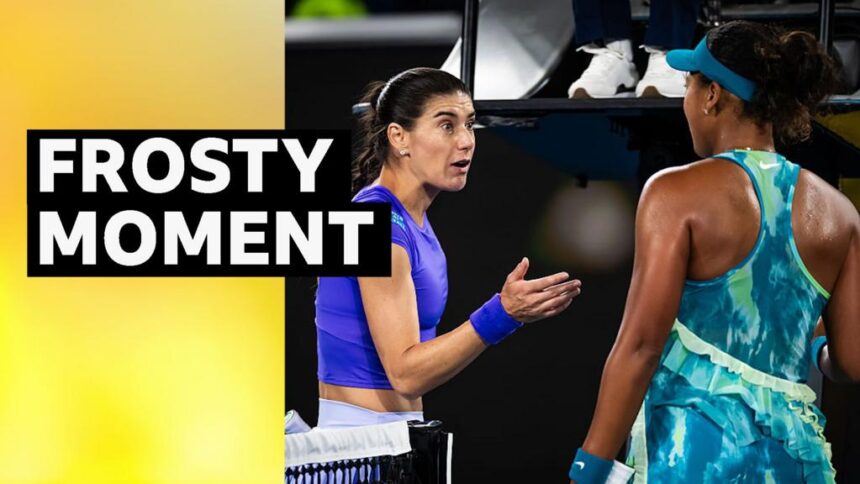
As the final point ended, the players approached the net. What followed was not the customary, if brief, moment of shared respect. Cirstea offered a rapid, perfunctory handshake, barely making contact, while clearly stating words to Osaka. While not picked up by broadcast microphones, lip readers and subsequent reports confirmed Cirstea’s message was a pointed critique of Osaka’s conduct during a pivotal moment. The Romanian’s demeanor was one of clear displeasure, turning swiftly to collect her belongings as Osaka, looking initially surprised, offered a conciliatory pat on the arm before walking to her chair wearing a contemplative, somber expression.
Decoding the Discontent: Gamesmanship or a Breach of Etiquette?
In the immediate aftermath, the tennis world scrambled for context. The crux of Cirstea’s issue, as later clarified, centered on a specific incident early in the third set. With Cirstea serving at a critical juncture, Osaka was seen forcefully bouncing the ball with her racket—a common action between points—just as Cirstea was beginning her service motion. From Cirstea’s perspective, this constituted an intentional distraction, a breach of the unwritten code of tennis etiquette that demands quiet and focus during a player’s service preparation.
This incident highlights the fine line between gamesmanship and disruption in modern tennis. Experts point to several factors at play:
- The Unwritten Rules: Tennis maintains a strict, self-policed code of conduct. Audible or visual distractions during a player’s service motion are considered a serious faux pas.
- The Pressure Moment: The start of a deciding set is a psychological battleground. Any perceived external gamesmanship can feel magnified and intentionally personal.
- Osaka’s Intensity: Known for her deep, almost meditative focus between points, Osaka’s action may have been an unconscious manifestation of her own adrenaline and concentration, rather than a calculated tactic.
“These moments are where match tension boils over into personal friction,” notes veteran tennis analyst Robert Lansdowne. “Cirstea, a seasoned pro, felt a line was crossed. Osaka, locked in her own competitive bubble, may have been unaware of the precise timing. The post-match reaction is the inevitable release of that frustration.”
Osaka’s Response and the Path Forward
True to her character, Naomi Osaka did not let the incident linger in ambiguity. Taking to social media later, she addressed the situation directly and with unexpected public contrition. “I want to apologize to Sorana,” Osaka wrote. “I was in my own zone, but I realize now what I did was disrespectful and I’m sorry.” This proactive apology is significant. It defused a potential controversy and showcased a maturity that prioritizes sportsmanship over pride.
For Osaka, this tournament is a monumental step in her comeback journey. The mental resilience required to win a grueling match, navigate an uncomfortable public moment, and then publicly acknowledge a misstep speaks volumes about her current mindset. It suggests a player who is not only refining her powerful game but is also deeply thoughtful about her presence and legacy within the sport. Handling this incident with grace may, in the long run, become a more telling indicator of her growth than the win itself.
For Sorana Cirstea, the incident underscores the passionate fire that has kept her competitive at the top level for over a decade. Her on-court reaction, while cold, was a direct and old-school enforcement of the sport’s etiquette from a respected veteran. It was a reminder that beyond the corporate polish, professional tennis remains a gladiatorial arena where respect is earned and expected in equal measure.
What This Means for the Australian Open and Beyond
While the match is over, the reverberations of this tense exchange will be felt. It serves as a potent reminder of several key dynamics in modern tennis:
- The Micro-Battles Within the War: Grand Slams are won not just by physical skill but by navigating countless psychological skirmishes. This was one played out in the open.
- The Scrutiny of the Comeback: Every action of a returning superstar like Osaka is magnified. This incident became a narrative precisely because of her global stature.
- The Importance of Conflict Resolution: Osaka’s swift apology likely closes the book on any lingering animosity, allowing both players to move forward without a distracting feud.
Looking ahead, this moment could paradoxhetically strengthen Osaka’s campaign. By confronting and resolving a potentially destabilizing controversy immediately, she has cleared a mental hurdle. It demonstrates a focus on controlling the controllables—her game and her conduct—which is the bedrock of deep Grand Slam runs. For Cirstea, the statement was made, and the principle was defended. The tennis world now turns the page.
The legacy of this Australian Open match will be dual-faceted. Officially, it goes into the record books as a three-set victory for Naomi Osaka, a sign of her returning grit. But its enduring story is the complex human drama that unfolded at its conclusion—a clash of intensity and etiquette, met with a subsequent act of accountability. In a sport where character is tested as fiercely as forehands, this tense exchange and its aftermath provided a raw, compelling chapter, proving that sometimes, the most powerful moments happen not during the rally, but in the silence that follows.
Source: Based on news from BBC Sport.