Will Manchester United Seize Their ‘Second Chance’ to Prove Champions League Credentials?
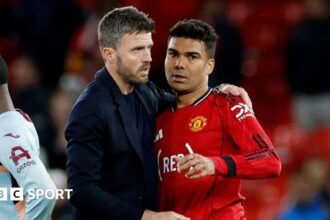
The roar at the final whistle at the Etihad was one of pure, unadulterated catharsis. Not just for the Manchester United fans who had witnessed a stunning, tactical masterclass in a 3-2 victory over their rivals, but for a club that has spent this season lurching from crisis to identity crisis. Under the interim stewardship of Michael Carrick, United didn’t just beat Manchester City; they out-thought and out-fought them. But as the euphoria settles, a profound question emerges: was this a glorious one-off, or the moment Manchester United finally grasped a ‘second chance’ to prove they belong among Europe’s elite in the Champions League?
The Etihad Blueprint: More Than Just a Derby Win
To understand the potential of this ‘second chance,’ we must first dissect what made the victory so significant. This was not a fluke. It was a deliberate, executed plan that addressed United’s most glaring weaknesses.
Carrick, often seen as a continuation of the Ole Gunnar Solskjaer era, made a decisive break. He abandoned the speculative, open approach that has seen United shredded by Liverpool, Leicester, and others this season. Instead, he installed a compact, disciplined 4-4-2 mid-block. The intent was clear: suffocate City’s creative zones, force them wide, and strike with ruthless precision on the counter.
Fred and Scott McTominay were not just midfielders; they were defensive sentinels, shielding the back four with a tenacity often missing. Bruno Fernandes was deployed in a deeper, more disciplined role, conserving energy for explosive transitions. And in Cristiano Ronaldo and Jadon Sancho, United had the cold-blooded finishers to make City pay. This was a victory of structure over spontaneity, a template for how to compete against the continent’s best.
The Credentials Question: What Has Been Missing?
United’s Champions League campaign this season has been a paradox of individual brilliance masking systemic failure. They sit top of Group F, yet their performances have been a masterclass in how to make hard work of straightforward tasks. The issues are well-documented:
- Defensive Fragility: A lack of coordinated pressing and a porous midfield has left the defense exposed time and again.
- Midfield Imbalance: The ongoing struggle to find a cohesive, controlling partnership has made United easy to play through.
- Tactical Naivety: A recurring theme in big games has been a game plan that appears reactive rather than proactive.
- Leadership Void: On the pitch, a clear, commanding voice to organize and inspire in moments of pressure has been absent.
The Etihad performance directly challenged every one of these failings. It proved that the personnel, often criticized, are capable of a vastly different level of collective discipline. The second chance is not about qualifying—they are on the brink of that. It is about proving they can consistently perform with the tactical maturity required to advance deep into the knockout stages.
Carrick’s Crucible and the Rangnick Revolution
The timing of this victory is fascinating. It arrives in the interregnum between managers, with German tactician Ralf Rangnick poised to take interim charge. Suddenly, Carrick has not just steadied the ship; he has provided a compelling case study.
Did he simply stumble upon a formula, or does this indicate a squad more adaptable to tactical instruction than previously believed? Rangnick, the godfather of *gegenpressing* and intense, proactive football, will have watched with keen interest. The principles United showed—discipline, collective sacrifice, swift transitions—are not alien to his philosophy. The victory may have shortened the perceived gap between the squad’s current habits and Rangnick’s demands.
This is the core of the ‘second chance.’ It is a chance for the players to demonstrate to an elite-level coach that they are coachable. That they can absorb complex instructions and execute them against the best. The City win is the perfect foundation upon which Rangnick can build. It removes the excuse of “we can’t do it” and replaces it with the evidence that, for one afternoon at least, they absolutely could.
The Path Ahead: Predictions for a Defining Period
The immediate future is a litmus test. The reaction to the City win will be more telling than the win itself. The danger is a return to complacency, the old habits creeping back in against ‘lesser’ opposition. The opportunity is to use it as a springboard.
In the Champions League, United will likely qualify, but their seeding and momentum are at stake. A confident, structured United is a team no one wants to draw in the Round of 16. A return to the chaotic, vulnerable version makes them a coveted opponent.
My predictions are contingent on one factor: tactical continuity.
- If Rangnick can instil his principles while retaining the defensive solidity shown at City, United will become a formidable, if not yet fluent, cup team.
- They have the individual match-winners (Ronaldo, Fernandes, Sancho, Rashford) to decide tight knockout ties.
- However, the squad’s ability to maintain the physical and mental intensity required week-in, week-out remains a serious question.
- A realistic, but optimistic, forecast is a hard-fought progression to the Champions League quarter-finals, with signs of a clear identity forming.
The Premier League title may be a bridge too far this season, but a top-four finish and a credible European run would constitute a successful re-calibration.
Conclusion: A Chance Forged in Discipline, Not Destiny
Manchester United’s ‘second chance’ was not gifted; it was forged in the disciplined heat of a Manchester derby. It is a chance born not from luck, but from a proof of concept. The victory over Pep Guardiola’s City was a resounding answer to the question of *capability*.
The question now is one of consistency and character. Can this squad, under a new and demanding manager, turn a glorious exception into their new rule? Can they approach a trip to Villarreal or a home game against Young Boys with the same focused intensity they showed against the champions?
The credentials they need to prove are no longer about the names on the back of the shirt. Those credentials—tactical intelligence, collective resilience, strategic maturity—are now on the table, waiting to be claimed. The blueprint is there, drawn up by Michael Carrick and executed by the players. The ‘second chance’ is real. But at Manchester United, chances are only remembered if they are taken. The rest of their season depends on it.
Source: Based on news from Sky Sports.
Image: CC licensed via commons.wikimedia.org