Ryba-power: Rybakina’s Thunderous Game Halts Swiatek’s Historic Grand Slam Quest in Melbourne
The air in Rod Laver Arena crackled with the weight of history. Iga Swiatek, the world number one, stood on the precipice of a monumental achievement, needing just the Australian Open title to complete the career Grand Slam. Her path was blocked by a force of nature wielding a tennis racket. In a stunning display of raw power and unflappable composure, Elena Rybakina, the reigning Wimbledon champion, delivered a performance of breathtaking clarity to dismantle Swiatek’s dream 7-5, 6-1. The Kazakh’s victory was not just a quarter-final win; it was a seismic statement that reshuffled the narrative of the women’s tour and postponed a potential coronation.
The Clash of Titans: Precision Meets Power
This match was billed as a classic stylistic confrontation: Swiatek’s relentless, spin-heavy precision and legendary footwork against Rybakina’s first-strike, serve-dominated power. From the first ball, Rybakina executed her game plan with chilling efficiency. Her serve, one of the most formidable weapons in women’s tennis, was dialed in. She fired aces and unreturnable serves that left Swiatek, one of the game’s best returners, rooted to the spot.
Rybakina’s power did more than win her free points; it systematically dismantled Swiatek’s rhythm. The Pole thrives on extended rallies, using her heavy topspin to drag opponents out of position. Rybakina refused to engage in those wars. She took the ball early, on the rise, and redirected it with flat, penetrating force, constantly pushing Swiatek back behind the baseline. The first set was a tense, high-quality affair, but the crucial break at 5-5 showcased Rybakina’s boldness. Once she secured the opener, the dynamic shifted irrevocably.
Where the Match Was Won and Lost
The second set was a masterclass in controlled aggression from Rybakina and a testament to the pressure of the moment on Swiatek. The foundation of Swiatek’s game—her impenetrable defense and ability to turn defense into offense—crumbled under the relentless barrage.
- Serve Dominance: Rybakina’s serve was the ultimate difference-maker. She finished with a commanding number of aces and won a staggering percentage of points behind both her first and second serves, neutralizing Swiatek’s greatest defensive asset.
- Neutralizing the Forehand: Swiatek’s forehand is her engine room, but Rybakina targeted it with deep, powerful shots, often forcing errors or weak replies that she could then put away.
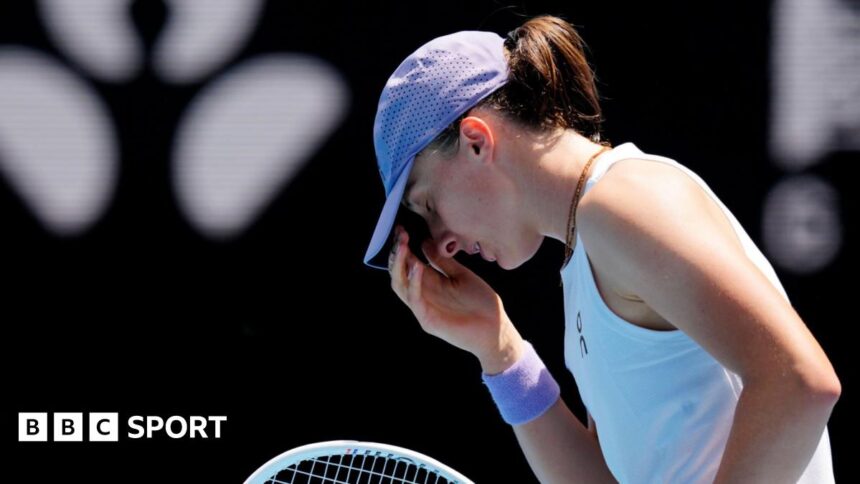
- Mental Fortitude: In the face of the historic stakes, Rybakina appeared ice-cool. She played the match, not the occasion. Swiatek, by contrast, showed rare signs of frustration, her shoulders slumping as winners flew past her.
The career Grand Slam attempt for Swiatek, which would have placed her alongside legends like Serena Williams and Maria Sharapova, was effectively ended not by a collapse, but by a superior force on the day. Rybakina did not just beat Swiatek; she presented a blueprint of how to disrupt the world number one’s dominance.
Swiatek’s Legacy: Still Among the Greats
While the loss in Melbourne stings, it is crucial to frame Swiatek’s career in its proper, still-ascendant context. At just 24 years old, her resume is already the envy of her generation:
- Six Major Titles: Four French Opens, two US Opens, and the crucial 2023 Wimbledon crown.
- Master of All Surfaces: Her victory on the grass of Wimbledon, once considered her weakest surface, proved her adaptability and champion’s mentality.
- Sustained Dominance: Her 37-match winning streak in 2022 and multiple seasons-ending as world number one speak to a consistency rarely seen.
This setback does not diminish her standing; it merely postpones her date with destiny. Swiatek’s career Grand Slam quest will now move to the clay of Roland Garros, where she is the undisputed queen. The pressure of completing the set in Melbourne, on a surface where she is brilliant but not invincible, was immense. She will now carry the experience, and the lessons from Rybakina’s power game, forward.
The Road Ahead: Predictions for the Rivalry and the Tour
This match felt like the opening chapter of a defining rivalry for the next era of women’s tennis. Rybakina announced that her Wimbledon title was no fluke and that when her game is on, she can beat anyone, anywhere. For Swiatek, the path forward involves subtle adjustments.
Expert analysis suggests Swiatek will work on adding more variety and first-strike capability to her game, particularly against power players like Rybakina. The rivalry is now beautifully poised: Rybakina’s thunderous power versus Swiatek’s relentless precision. Their future clashes, especially on clay and hard courts, will be must-see events.
Furthermore, this result throws the women’s tour wide open. It proves that while Swiatek is the consistent benchmark, a cohort of powerful, elite players—including Rybakina, Aryna Sabalenka, and Coco Gauff—are capable of beating her on any given day. This creates a thrilling, unpredictable landscape for the remaining Grand Slams in 2024.
Conclusion: A Pause, Not an End
Elena Rybakina’s commanding victory at the Australian Open was a spectacular triumph in its own right, a declaration of her permanent residence at the sport’s summit. But it also served as a dramatic pause in one of tennis’s most compelling current narratives. Iga Swiatek’s quest to join the pantheon of players with a career Grand Slam was delayed, but its inevitability remains undimmed.
History was not made in Melbourne, but a classic match was. It provided a stark reminder that in modern tennis, supreme power, when harnessed with calm precision, can overcome even the most complete game. For Swiatek, the dream is merely deferred. The chase continues, the legacy continues to build, and the tennis world will watch with bated breath as she regroups and sets her sights on Paris, where the clay awaits and history’s door remains ajar.
Source: Based on news from BBC Sport.