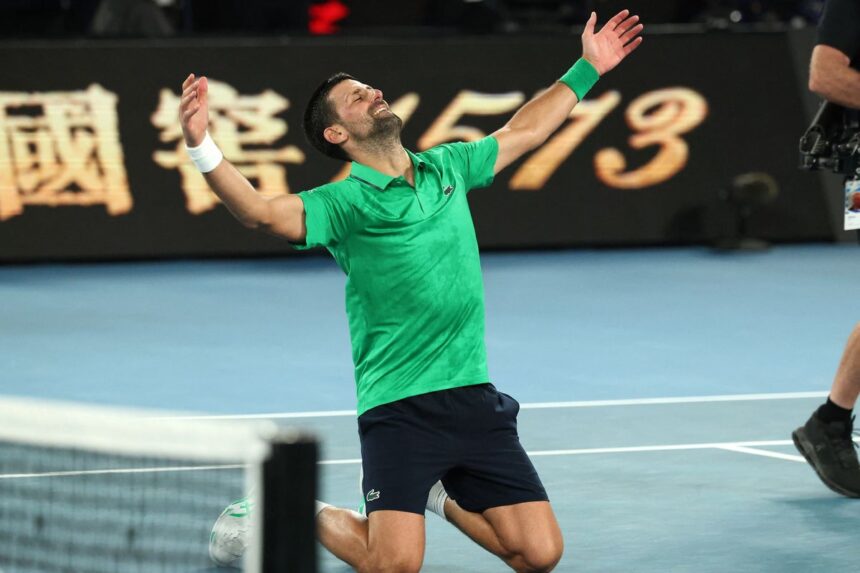
The Djokovic Fire: How a Single Word Ignited a Vintage Australian Open Comeback
In the quiet, fluorescent-lit room of a post-match press conference, a champion’s pride was pricked. Novak Djokovic, having just survived a monumental scare against Lorenzo Musetti, was asked to reflect on the past and present. The question framed him as once the hunter of Federer and Nadal, and now, in the era of Alcaraz and Sinner, the hunted. Djokovic’s response was not just an answer; it was the spark that lit the fuse for one of the most defiant, vintage performances of his immortal career. What followed was a masterclass in mental warfare and physical resilience, a four-hour epic that didn’t just win a semi-final—it rewrote a narrative and proved, once again, that writing off the greats is a perilous endeavor.
The Spark: A Question of “Disrespect” and a Reignited Fire
The foundation for Djokovic’s stunning comeback against Jannik Sinner was laid not on Rod Laver Arena, but at a microphone. After his quarter-final escape, a journalist’s query inadvertently provided the psychological kindling. The suggestion that he was now “chasing” a new generation, erasing the decade of dominance in between, struck a nerve.
Djokovic’s bristling response was a pivotal moment. He labeled the wording “disrespectful,” defending his era of supremacy. In that instant, the calculated, sometimes serene champion was replaced by the fiery competitor who built his legacy on a chip on his shoulder. “I’m going to fight until the last shot, until the last point,” he vowed, his eyes burning with a familiar intensity. This was no longer just about tennis; it was about legacy, respect, and historical correction. The stage was set for a statement.
The Crucible: Defying Odds and Father Time at 2 A.M.
Entering the semi-final, the cold, hard data was overwhelmingly against Djokovic. The context was daunting:
- He was on a five-match losing streak against the ascendant Sinner, including a sobering defeat in last year’s Davis Cup.
- He had looked vulnerable and physically strained against Musetti, two sets down and seemingly on the brink.
- At 38, facing a rival 14 years his junior, he possibly faced the longest pre-match odds of his Australian Open career.
For a set and a half, the script held. Sinner’s blistering, error-free power tennis secured the first set and a break in the second. The obituaries were being drafted. But then, the spark from that press conference ignited. Djokovic found a higher gear, a deeper well of precision. He broke back, seized the second set, and engaged in a brutal war of attrition. In the oppressive Melbourne heat that bled into a 2 a.m. finish, it was the younger man who first showed cracks in his physical and mental resolve. Djokovic, leveraging his unparalleled grand slam experience, pounced. His defensive wizardry turned into offensive pressure, his serve found untouchable corners, and his will became a tangible force on the court.
The Mind Game: Doubt as Fuel for the Ultimate Competitor
In victory, Djokovic peeled back the curtain on the mentality that sustains him. His post-match comments were a direct address to his doubters—a group he actively uses as propulsion.
“There’s a lot of people that doubt me,” he stated, a wry smile playing on his lips. “I see there is a lot of experts all of a sudden that wanted to retire me or have retired me many times… I want to thank them all, because they gave me strength. They gave me motivation to prove them wrong.”
This is the core of the Djokovic engine. Where others might be demoralized by skepticism, he metabolizes it into competitive fuel. The admission last year that Alcaraz and Sinner were “too good” and beating them in best-of-five would be “very, very difficult” was not surrender; it was the acknowledgment of a challenge worthy of his focus. By naming the obstacle, he could then dedicate every fiber of his being to dismantling it. This match was the ultimate manifestation of that process—a calculated, fiery response to a perceived shift in the tennis world order.
The Final Frontier: Alcaraz Awaits and History Beckons
By defeating Sinner, Djokovic didn’t just reach another final; he shattered records and set the stage for a legacy-defining clash. He became the oldest Australian Open finalist in history. Now, he faces Carlos Alcaraz, the world No. 1 and the man who dethroned him in a classic Wimbledon final 18 months ago. The narrative is perfect: the king versus the prince, experience versus exuberance, a record 25th major title on the line.
What can we expect in the final? The dynamics have shifted since Wimbledon. Alcaraz, while spectacular, has shown he is not invincible, as seen in his own tough semi-final. Djokovic, armed with the momentum of his greatest win in over a year and that freshly stoked fire, is a different beast. He has exorcised the Sinner demon and reclaimed his aura in Melbourne, where he is virtually unbeatable. The key will be his physical recovery, but his mental edge is now razor-sharp. He has publicly stated his motivation is now “the slams” and history above all else. Sunday is a shot at the standalone record, a chance to avenge Wimbledon, and an opportunity to, once and for all, silence the talk of a changing of the guard.
Conclusion: The Unending Lesson of a Champion’s Heart
Novak Djokovic’s 2024 Australian Open semi-final victory was more than a comeback from two sets down. It was a thesis on longevity, a lesson in the power of perceived slights, and a reminder that champions are defined by their response to existential threats. A single word—“chasing”—unleashed the vintage Djokovic: the relentless defender, the clutch server, the iron-willed competitor who treats doubt as his most potent energy source.
In an era obsessed with data, momentum, and the inevitable rise of youth, Djokovic provided a timeless counter-argument: never underestimate the heart of a legend who still sees chapters left to write. Whether he lifts the trophy on Sunday or not, his performance against Sinner stands as one of his most significant. He didn’t just prove the experts wrong; he reminded the world that in the grand narrative of tennis, as long as he is playing, the final word is his to claim.
Source: Based on news from Yahoo Sports.