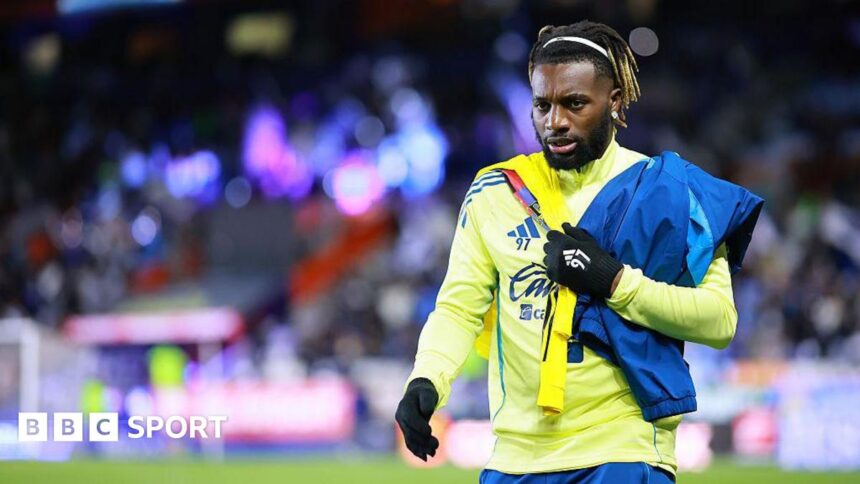
Saint-Maximin’s Stand: A Father’s Defiance and Football’s Unending Battle Against Racism
The beautiful game, for all its global unity and moments of transcendent joy, continues to be scarred by an ancient, ugly poison. This week, that reality hit with a deeply personal and sobering blow, as the electrifying talent of Allan Saint-Maximin exited a major club not for sporting reasons, but as a profound act of paternal protection. The French winger’s mutual consent departure from Liga MX giants Club America, following racist abuse directed at his children, is more than a transfer headline. It is a stark reminder that for players of color, the pitch is only one arena of conflict, and the most vicious attacks often target the most vulnerable.
- A Line in the Sand: “I Will Never Tolerate My Kids Being Picked On”
- Beyond the Pitch: The Systemic Challenge of Fan Culture and Accountability
- Expert Analysis: The Precedent and the Price
- Predictions and Pathways: What Comes Next for Saint-Maximin and the Fight?
- Conclusion: The Colour of Our Thoughts Defines the Game
A Line in the Sand: “I Will Never Tolerate My Kids Being Picked On”
Allan Saint-Maximin has never been a stranger to expressing himself. On the field, his dazzling dribbles and unpredictable flair were his vocabulary. Off it, he has often used his social media platform with similar directness. However, his recent Instagram post carried a weight far beyond the typical athlete’s update. It was a manifesto from a father, raw and principled.
“The problem is not the colour of your skin, it’s the colour of your thoughts,” he wrote, distilling the issue of racism to its core: a failure of humanity, not genetics. He acknowledged a lifetime of developing a thick skin against personal attacks, a sad rite of passage for many Black athletes. But he drew an unequivocal line: “I’m being attacked, not a problem – I grew up, I learned to fight against attacks… but there’s one thing I will never tolerate is my kids being picked on.”
This statement is the crux of the matter. Players are often expected to absorb abuse, to “rise above it” for the sake of the team or the sport. Saint-Maximin’s decision reframes that toxic expectation. It declares that family is the non-negotiable sanctuary, and that no career opportunity is worth subjecting his children to trauma. His subsequent departure from Club America, a club with a massive and passionate fanbase, proves his words were not merely rhetorical. He acted on them, at significant professional cost.
Beyond the Pitch: The Systemic Challenge of Fan Culture and Accountability
While the specific incidents prompting Saint-Maximin’s post remain detailed by the player, his exit from Mexico prompts a difficult conversation about the ecosystems surrounding football clubs. Racist abuse in football is a global pandemic, manifesting in different leagues with varying degrees of institutional response.
Club America released a statement respecting Saint-Maximin’s decision and reiterating its “commitment against violence and discrimination,” but the episode raises critical questions:
- Where does club responsibility end and fan accountability begin? Clubs often condemn abuse but struggle to police anonymous online hate or isolated stadium incidents.
- Is mutual consent a dignified solution or a systemic failure? While allowing the player to prioritize his family, it also means a talented individual is lost, and the perpetrators face no direct consequence tied to their actions.
- How do we protect families? The targeting of players’ children represents a chilling escalation, moving abuse from the professional to the intimately personal, where standard “ignore the trolls” advice is morally bankrupt.
This incident underscores that anti-racism measures must extend beyond stadium announcements and social media banners. They require proactive education, sophisticated monitoring of fan forums, and unequivocal, permanent bans for offenders, enforced with the same vigor as rules on financial fair play.
Expert Analysis: The Precedent and the Price
From a sporting perspective, Saint-Maximin’s exit is a seismic event. Club America loses a marquee signing meant to elevate their attacking threat. For the player, at 28, leaving a club of such stature is a major career interruption. This is not a transfer motivated by ambition or tactical fit; it is a withdrawal driven by well-being.
“Saint-Maximin’s decision sets a powerful, painful precedent,” says Dr. Emilia Rodriguez, a sociologist specializing in sport and race. “We have seen players walk off pitches after abuse. We’ve seen campaigns. But a player of his profile terminating a contract because his family was targeted? That is a new level of consequence. It shouts that racism is not just a ‘problem’ for the sport to manage, but a deal-breaker that destroys partnerships and squanders talent.”
The financial and competitive ramifications are significant. The mutual consent departure likely involved complex negotiations, potentially forgoing future earnings. For Saint-Maximin, the immediate future is uncertain, but his stance may empower other players facing similar horrors to prioritize their families without fear of being labeled “difficult.”
This episode also places Liga MX and its clubs under an international microscope. How they respond systemically—not just with words but with actionable, stringent policies—will affect their ability to attract top global talent in the future. No player wants to enter an environment where their family could be a target.
Predictions and Pathways: What Comes Next for Saint-Maximin and the Fight?
The immediate question is where Allan Saint-Maximin’s career goes from here. Several pathways are possible:
- A Return to Europe: His proven ability in the Premier League with Newcastle United makes a return to a top-five European league the most likely outcome. Clubs with strong, established anti-racism protocols and supportive fan cultures will be attractive.
- Advocacy Role: This experience may see Saint-Maximin become a more vocal activist against racism in football, potentially partnering with organizations like FIFA’s anti-discrimination task force or Kick It Out.
- A Catalyst for Change in Mexico: While he has left, his very public reason for leaving could pressure Liga MX into implementing stricter, league-wide measures to protect players and their families, creating a legacy beyond his brief tenure.
For the sport at large, this is a clarion call. The fight must evolve from reactive punishments to proactive protection. This includes:
Comprehensive family support systems for players moving to new countries, including security and mental health resources. Mandatory education programs for fan groups, tied to ticket access. And a unified, global database of banned individuals to prevent offenders from simply migrating their abuse to another club or league.
Conclusion: The Colour of Our Thoughts Defines the Game
Allan Saint-Maximin did not leave Club America because he couldn’t adapt to the style of play or the climate. He left because the “colour of thoughts” in a segment of the environment was intolerable. His departure is a tragic loss for football, but a necessary stand for human dignity.
It reinforces that the battle against racism is not won with moments of silence, but with loud, consequential actions. It is fought not just on the terraces, but in the minds of fans and the boardrooms of institutions. True progress will be measured not when players are strong enough to endure abuse, but when families are safe enough that they never have to. Saint-Maximin, in prioritizing his children over his career, has issued one of the most powerful protests in recent sports history. The football world must now decide if it will merely listen, or finally, meaningfully act. The future of the game’s soul depends on it.
Source: Based on news from BBC Sport.