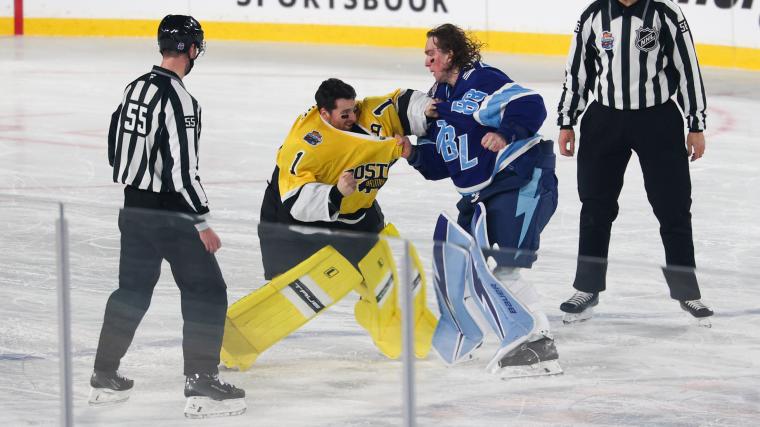
Bruins-Lightning Goalie Fight: The Frosty Fury Behind Swayman vs. Vasilevskiy
The NHL’s Stadium Series is designed to create moments that live forever in hockey lore. Under the uncharacteristically chilly Tampa skies, the Boston Bruins and Tampa Bay Lightning delivered a memory no one will forget: a rare, raw, and riveting goalie fight between two of the world’s best netminders, Jeremy Swayman and Andrei Vasilevskiy. This wasn’t a staged sideshow; it was a spontaneous eruption of pent-up frustration and protective instinct, a flashpoint that defined a lopsided game and reminded everyone that even the sport’s most disciplined position players have a breaking point.
The Spark That Lit the Frozen Fuse
To understand the fight, you must first understand the game’s context. The Boston Bruins, the NHL’s juggernaut, were systematically dismantling the Tampa Bay Lightning. By the midway point of the second period, the score was a glaring 5-1 in favor of Boston. Andrei Vasilevskiy, the Lightning’s Vezina and Conn Smythe-winning backbone, was having a night to forget. The usually unflappable “Big Cat” had been beaten five times on 18 shots, a stat line as foreign to him as the cold Florida weather.
The tension was palpable. With the game slipping away, physical play escalated. After a whistle near the Bruins’ net, a scrum formed. Tampa Bay’s Nicholas Paul and Boston’s Charlie McAvoy were tangled, and Jeremy Swayman moved in to push Paul away from his teammate. In a heartbeat, Vasilevskiy skated the length of the ice, shedding his gloves with purpose. Swayman, seeing the 6’3” Russian star approaching, did the same. What followed was a brief but symbolic clash, two elite athletes releasing the game’s built-up pressure in a flurry of punches before being separated.
Expert Analysis: Decoding the Unspoken Rules
From a tactical standpoint, a goalie fight with your team down four goals is unconventional. But hockey operates on a code that often supersedes the scoreboard. Analysts and former players point to several key factors that made this confrontation inevitable:
- Vasilevskiy’s Mounting Frustration: “Vasy is a competitor who holds himself to an impossible standard,” says former NHL goaltender and analyst Kevin Weekes. “Letting in five goals, regardless of defensive breakdowns, eats at a guy like that. The fight was a physical reset, a way to stand up for himself and his team in a game where nothing else was going right.”
- Swayman’s Protective Instinct: Jeremy Swayman is known for his fiery, team-first demeanor. His initial involvement was to defend McAvoy. “Swayman wasn’t looking for a fight, but he wasn’t going to back down when challenged,” notes NHL columnist Emily Kaplan. “In that code, once the other goalie commits, you commit. It’s about respect.”
- The Stadium Series Atmosphere: The outdoor game, with its amplified crowd and spectacle, fuels emotion. Players feel the history in the making. A fight in that setting becomes a legendary event, a fact not lost on the participants.
This was more than a fight; it was a goalie fight narrative rich with symbolism. It was the proud champion, Vasilevskiy, refusing to go down without a show of fight, and the rising star, Swayman, meeting that challenge head-on to cement his team’s dominant statement.
The Aftermath: Penalties, Precedent, and Team Morale
Both goaltenders received fighting majors and game misconducts, ending their nights early. For the Bruins, it was a minor inconvenience; backup Linus Ullmark seamlessly took over. For the Lightning, it meant turning to backup Jonas Johansson in a already-decided contest.
The immediate consequences were clear, but the long-term effects are more nuanced:
- For the Lightning: While they lost the game 5-1, the fight may have provided an emotional spark. Vasilevskiy’s act demonstrated a refusal to quit, a message to his teammates for the final stretch of the season. It was a cathartic release that could galvanize a struggling squad.
- For the Bruins: The incident underscored their complete dominance. They got under the skin of a championship-caliber opponent and emerged unscathed. For Swayman, it further endeared him to a fanbase and locker room that values toughness and camaraderie.
- For the League: The NHL benefits from such viral moments. The Stadium Series game highlight instantly became a top trending clip, showcasing the passion and unpredictability that makes hockey unique.
Predictions: Rivalry Rekindled and Playoff Implications
This single event has injected new life into the Bruins-Lightning rivalry. While both teams have moved on, the memory lingers. Here’s what to watch for:
1. The Next Meeting: When these teams next face off, all eyes will be on the crease. While a rematch fight is highly unlikely, the underlying tension will be present. Every scoring chance will feel like a personal duel.
2. Playoff Psychology: Should these Atlantic Division powers collide in the postseason, this moment will be part of the preamble. The Bruins have proven they can overwhelm Vasilevskiy. The Lightning now have a tangible example of their goalie’s fighting spirit. It adds a compelling layer to a potential series.
3. Legacy of the Fight: For Swayman, this is a rite of passage. He stood toe-to-toe with a future Hall of Famer and didn’t flinch. For Vasilevskiy, it’s a footnote that highlights his competitive fire. It becomes a permanent part of both their legacies, a quirky and fierce chapter in their careers.
Conclusion: More Than Just a Fight
The goalie fight between Jeremy Swayman and Andrei Vasilevskiy was the perfect storm of emotion, circumstance, and hockey culture. It was born from Vasilevskiy’s rare frustration and Swayman’s unwavering loyalty, set against the dramatic backdrop of an outdoor showcase. It transcended the lopsided score, giving fans a pure, unscripted moment of passion.
In the end, it reaffirmed why we watch sports: for the human element. These are not robots in pads, but fiercely proud athletes whose emotions can boil over in spectacular fashion. The Bruins-Lightning brawl will be replayed for years, not just for its rarity, but for the story it tells—a story of pride, protection, and the unbreakable code that governs the fastest game on ice.
Source: Based on news from Yahoo Sports.